
Perhaps I am wrong or exaggerating, and it would be better if I were, there are too few children and young people who do not get a cold and not at all friendly thrill at the thought of the math exam. We often hear confessions like these, perhaps unbelievably often: „I don't like math”; „it's never been my friend”; „I'm afraid of the math thesis/exam/work”; „anything but ma-te-ma-ti-ca!”. You've heard it all these days, haven't you? And we'll hear it in the days to come. But there are also many for whom neither mathematics, nor poetry, nor spiritual growth, nor the Way that promises us eternity seem to be just another chance in life to grow and excel.
About such a young man, for whom math was the most beautiful and „non-stressful” baccalaureate exam, I recently learned. At that time his name was Ioan-Daniel, he was a graduate of the Orthodox Theological High School Seminary „Mitropolitul Dosoftei” in Suceava and he was one of the young people of whom, a few years later, he himself would say that they were „like the springtime breath of the Church. They bring with them energy, enthusiasm, novelty, freshness. In their presence, even the elderly seem to be converted by their joy.” One of this young man's joys was, perhaps unexpectedly, math. He was the only seminarian in his graduating class to take the baccalaureate exam in math and pass with a 10. And not necessarily by reconfirming, but - rather - by continuing, following a passion, a joy of living mathematics, which began in childhood. He got an A in the math exam at the end of middle school and was admitted to the seminary. Then he studied theology, worked for a while as a journalist and was called from the quietness of the Putnaean monastery to the dignity of the archiepiscopate.
It surprises you a bit, doesn't it? I'm talking about the V. Damaschin the Dornean. And may he himself bear witness to this confidence that mathematics can be a beautiful and high joy to be. It is enough to mention matrices or determinants, theorems and Cartesian coordinates, equivalence and commutativity, and the joy is on his face - illumined as if by a transfigured answer. And his thoughts seem to begin to share the same conviction as Galileo Galilei's: „mathematics is the language with which God wrote the Universe”. A science that captivates and reveals the mysteries of the world, that can often seem hard and inaccessible, but can be beautiful when understood, a science of harmony, of beauty. I know that even today, as in every year and in every new series of exams, the Vladica does not remain far from the subjects that the young candidates receive, and that not a single item or exercise, among those that „have been given”, remains without being analyzed and solved.
And such knowledge also reveals the way in which the Most Reverend Father chooses words that edify and utters them and sends them out into the world. A word full of meaning, like this one, „taken” from a priestly conference: „You will not hold in your hands and you will not touch an Ark - a work of human hands, but you, like us now, will hold in the palms of clay the Body of God.” Or: „The miracle does not necessarily make us stronger in faith, but the personal encounter with Christ, that will make us more faithful” because „faith is not just a gift from God, it is an encounter”. And: „faith is not an endless series of enthusiasms coming from outside, but a faith that is soft, steady, effervescent. Enthusiastic, but rooted in something else”.
I read, not long ago, a review of the doctoral dissertation of His Eminence Archbishop Damaschin Dorneanul, recently published by the Crimca Publishing House of the Archdiocese of Suceava and Rădăuților,
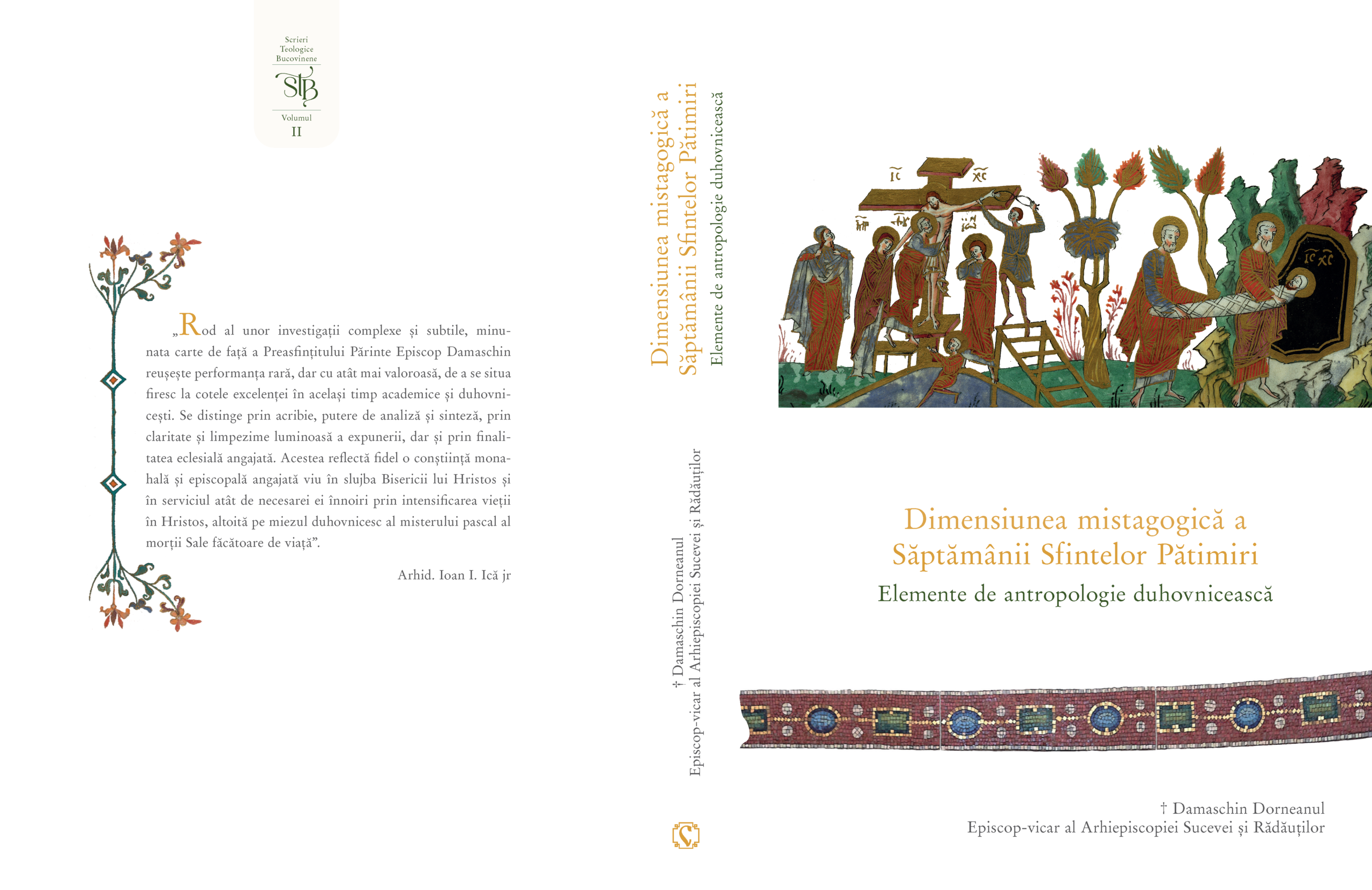
„The mystagogical dimension of Holy Passion Week. Elements of spiritual anthropology“. Said the author of the review thus: „This book reminds me, somehow, of Bartholomew Ananias who described himself as a „Bible scholar“, translating Holy Scripture for 10 years. What work! And so was PS Damaschin: he took on the difficult task of speaking at length about the Week of the Lord's Passion from the perspective of its disturbing hymnography, the link between asceticism and divinity and, above all, from the angle of the famous saying of early Christianity: Lex orandi, lex credendi, lex vivendi (i.e. the law of prayer, the law of faith, the law of life), in the sense of the interweaving and crowning of the three elements in the period mentioned above.” (Răzvan Bucuroiu)
Ioan Ică jr., supervisor of the doctoral thesis: „The fruit of complex and subtle investigations, the wonderful book (...) achieves the rare but all the more valuable performance of being at the level of excellence at the same time academic and spiritual excellence. It distinguishes itself by its acuteness, power of analysis and synthesis, by the clarity and luminous limpidity of its exposition, but also by the ecclesial finality of its commitment.”
I also quote from the work, which I keep reading and re-reading, not at random. From the sub-chapter „Quadregessima. Liturgical arithmetic and spiritual meaning”, for example: „In a spiritual „arithmetic”, the fast of the last week or of the six weeks is like a single day; time is compressed, the end is anticipated and already present in a mystagogic way at each stage of the journey of the fast: «One day is said to be the whole life of the earthly».”
An exercise with mathematical precision and with the enthusiasm of life in Christ that Father Bishop mentioned.
