
„You will find pages of sober words...”
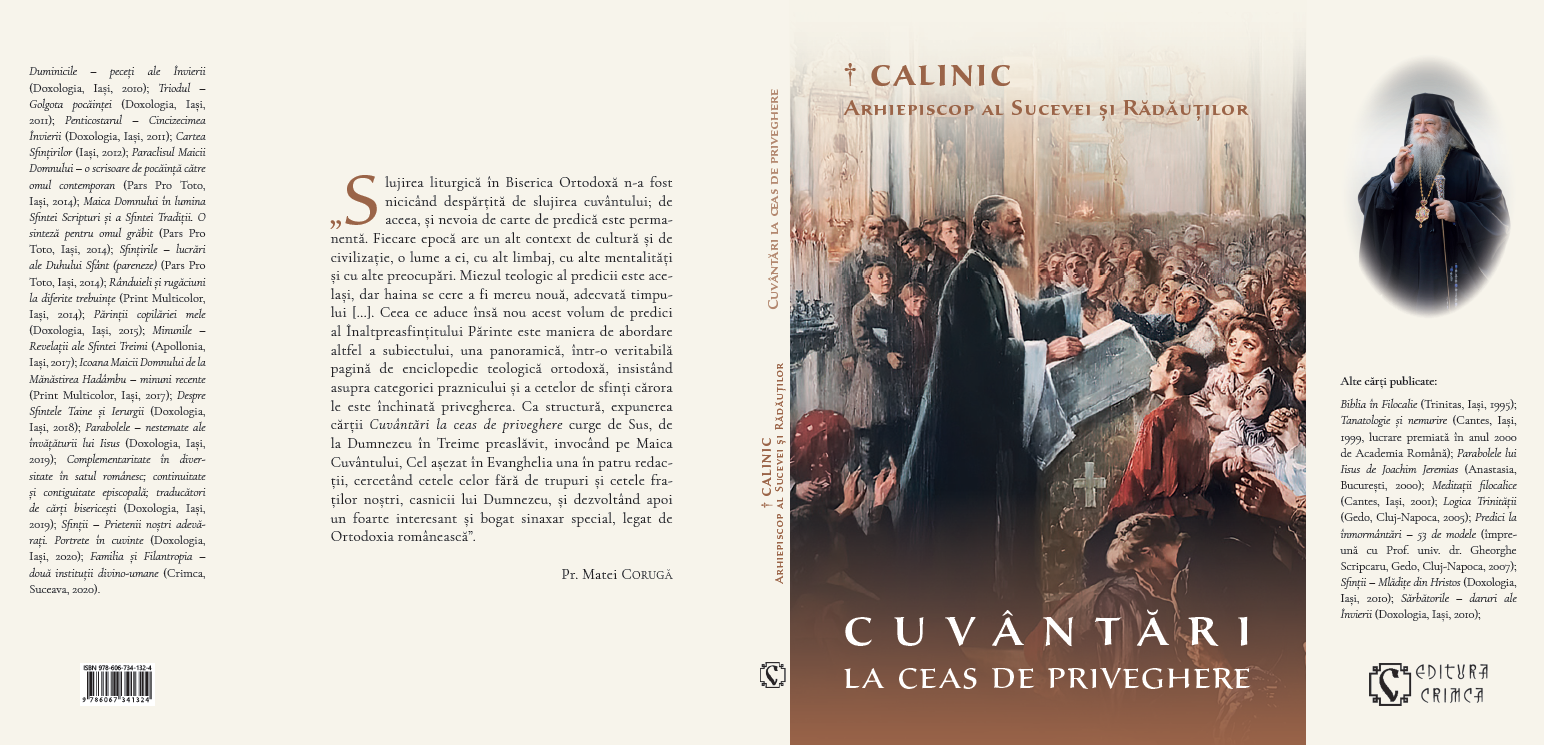
I have before me, barely breathed over a sleepless night and the joy of reading, the books of His All-Holiness the Most Reverend Father Calinic, Archbishop of Suceava and Rădăuților: Thanatology and Immortality (Ed. Crimca, Suceava, 2nd ed., 2021, 483 pg.) and Words on the Watch (Ed. Crimca, 2021, Suceava, 215 pg.). Two simple gems, bookish in the most non-bookish sense possible. If we knew the first volume and the first edition of the first volume, enthusiastic in its scope and content, the second one expresses, in a warm and full of the culture of the Spirit, the encounter with the interior of the sermon, with the heart of the text that we hear from the pulpit to us.
I wouldn't dare say too much about the first of these works. At the time of the sterile death in which we are struggling, the death of hope or the death of threat, such a work comes to teach us the depth of a presence that leads us to the Resurrection. Far be it from me to think how or what to read from this treatise on tanatology and immortality but, for fellow priests, I think it has become unthinkable to go on through the surrounding stigmata without this luminous encouragement that the Vlach of the Eternal City of Bucovina shares with us. You will immediately after Word before (signed by Professors Gheorghe Scripcaru and Petru Dumitrescu, pp. 8-14) and Preface (signed by Fr. Vasile Mihoc, pp. 15- 23) an extremely solid construction of meditation on death and Resurrection seen through the prism of science and spirituality, without which science would not be complete. Thus after Introduction (pp. 25-44) we have a first part, A. Thanatology and Epistemology: 1. Thanatology and its scientific and cultural aspects: Epistemology and immortality; apoptosis; epistemological aspects of research into the phenomenon of death; imperfect death and absolute death; death a necessary phenomenon of nature; interdependence of vital and lethal phenomena; border stages between life and death; temporal asymmetry between brain death and organism death; the psychology of those who sense the imminence of death; death as a voluntary act; the interrelations between vegetative and dignified death; death after conception; euthanasia; strategic thanatosociology; assistance in dying; the so-called right to death and the absolute right to life; the epistemological matrix of ecology and the cultural meaning of death, pp. 45-134).
A second part, B. Tanatology and Philosophy proposes an extensive second chapter 2. Thanatology and its philosophical aspects (transcendence, a way of approaching philosophy to religion; from the tragic sense of death, through metaphysical anxiety and creation, to immortality; the increase of metaphysical anxiety through indifference; thanatology in the thought of ancient philosophers from Thales of Miletus to the blessed Augustine; life and death in the great philosophers of modern and contemporary times; representations of death; through the maieutics of death to the valorization of life; Romanian philosophy in the face of the concept of immortality and death; through a stenic conception of death as an impetus for creation, towards human salvation and eventual metadigms, pp. 135- 306) and a third part, C. Thanatology and eschatology (The biblical dimension of death; mysteries and lights in the work of Father Dumitru Stăniloae, pp. 307- 429). A series of acts and works on medical deontology and two addenda (pp. 431- 456) as well as an extensive and complex Bibliography (pp. 457-483). A book that harmonizes science with the luminous spirit of faith in the ample, confessional way.
The second volume, Words at the Vigil, represents the core of words of the liturgical confession, the Masses being thus placed in the mystagogical basket of the understanding of the truth of faith through a synopsis of thought and reflection. The preface - signed by Fr. Matei Corugă - provides us with a series of reading keys and directions for understanding the reading proposal addressed to us by the Vedic preacher. You will find pages of sober words about the Holy Trinity, the Mother of God, the Gospel and the evangelists, about angels, saints, prophets, martyrs and confessors, hierarchs, holy monks and monasteries, about the holy doctors without silver, about St. Andrew, the Christianizer of Romania and about the saints emperors of Byzantium, about the saints of the Holy Kings and the saints imprisoned under communism, about icons - as seen images of the unseen, about the Beatitudes and the Our Father (in the utterances of the Holy Spirit). A Bibliography offers us the possibility of broadening our own utterances (pp. 201- 215). We are not simply seated in preaching. We are seated before a school of learning to understand the Gospel and Orthodoxy in the spirit of the Fathers of old who ennobled the Athonite side of Bucovina. Knowing his speaking voice, his rhetorical care and the punctuality of his ideas, I identify in this volume a good homiletic manual, a call for every preacher to adopt the method and the words of a lover of preaching.
Two books, like two hearts beating for the Resurrection.
Pr. Constantin Necula
Text source: tribuna.ro
