
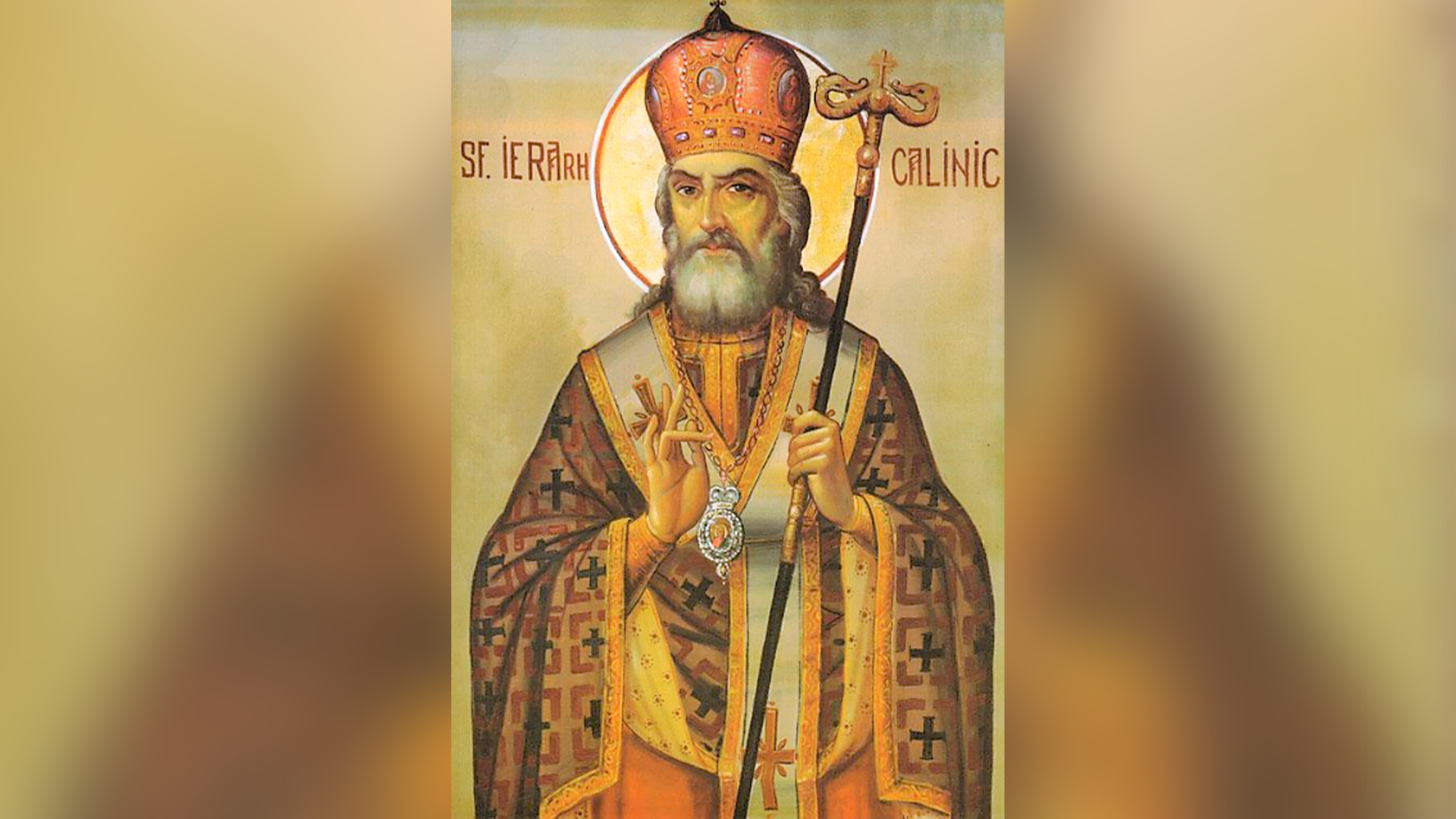
The saints and the feasts dedicated to them are celebrations of God’s love. And every feast is a new call to communion. As we reflect on the life of the saint whose feast day our Church celebrates on April 11— Saint Calinic of Cernica – The Patriarch reiterates that He is one of the most representative Romanian saints, the most balanced in the relationship between word and deed, between faith and culture, between love for God expressed in prayer and love for one’s fellow human beings expressed in good deeds; (…) a role model in terms of the balance between building up souls and building new altars of prayer.
This year, as we approach the days that recall the time when the branches and flowers that had been laid out to welcome the Gentle Jesus were turned into spikes, we also enter the liturgical season dedicated to Saint Hierarch Calinic of Cernica, recognized „teacher of unceasing prayer”, elected spiritual patron of the Most Reverend Father Archbishop of Suceava and Rădăuților.
Between the incense medallions of confession and prayer in the book Saints - our true friends (Doxologia Publishing House, 2020), which bears the signature of our Father Archbishop, we also find a „portrait in words” of the saint who was the Bishop of Ramnic, born in 1787, canonized in 1955, „inscribed - here on earth - in the diptychs of the Church of the nation, and there - Up in the choir of the Holy Hierarchs, with whom he will participate in the Archpastoral Liturgy of love, in the great cosmic cathedral of God”.
I read and re-read the portrait of this chosen of Heaven, so beautifully and wholly set in a medallion of prayer and words, and I cannot help thinking that I find so poignant notes of self-portrait of the Vlădicăi of today, from the Citadel of Suceava.
St. Calinic of Cernica „was a monk par excellence, dedicated to the spiritual life since childhood, showing himself in all things temperate, demanding with himself, but generous to others. He was the hierarch who never abdicated from the fundamental moral principles by which, moreover, he guided his life, whatever the mission entrusted to him. (...) He knew how to build both churches of the wall and of the soul. The architecture of his foundations breathes the architecture of his soul”. (pp. 73-75)
The Archpriest of Christ had a kindness springing from an authentic mystical experience and he distinguished himself both by his literary and spiritual - missionary and cultural - activity, as well as by his organizational activity.
A hieratic portrait is also the one put into words by Father Dumitru Stăniloae, in Sermon at the canonization Mass of Saint Calinic of Cernica, October 23, 1955: „It is amazing how the contemplation of the divine world and the careful observation of the details of everyday life coexisted and harmonized within him, the alertness that follows the subtlest thoughts of the mind and the attention that combines and carries out prudent and precise plans for building, organizing, and managing. Unity was achieved—perhaps—by the fact that he saw the things below in the light and under the inspiration of the things above. In the beautiful harmony of divine reason, Saint Calinic contemplated the orderly scheme of the plans he was to carry out below, and in the things below he perceived the rays of light from above. If during the day he drew up plans for churches, this creative inspiration and the forms in which he brought these things to life came to him, as from an inexhaustible spring, from his nightly readings and prayers. For Saint Calinic loved books and was a man of prayer.”.
And, as I was saying, „they seek me out” and indeed find me—confirmations that each of these iridescent hues of the hieratic portrait is found in the „architecture” of the soul of Archbishop Calinic, tireless in his ceaseless and complete service to the Highest Heaven, bathed in the light of the saints. What first comes to mind are the countless testimonies from the hundreds of pages of the commemorative issue of Theologica Pontica (No. 1/2021, „Ovidius” University of Constanța, Academy of Orthodox Theology – Chișinău), which was dedicated to him some time ago: more than three decades of self-sacrificing service, nearly 90 published works, „works that will endure in the soul, in history, and in eternity”—thousands of services performed, over 400 churches built, over 800 churches restored and painted, the construction of countless social facilities, as well as nearly 1,000 parish and social houses built from the ground up.
Then, just a few highlights from that first year in Suceava: the reopening of Solca Monastery and the appointment of its first abbot in 236 years; the reopening of Pătrăuți Monastery and the appointment of the first abbess, after 200 years; the „No Home Without the New Testament” program; the formation of the „Dimitrie Suceveanu” Psaltic Group; the reconfiguration and expansion of the church goods store, which now includes the „Saint Joseph of Arimathea” colportage warehouse, the „Arimathea – Joy for the Soul” church goods shop, and the „Arimathea – Light for the Soul” candle shop.
Or, secondly, as becomes apparent even from a cursory glance at the 456 pages of the Activity Report – 2021, published by Crimca Publishing House: the anniversary celebrations „The Putna Celebration – 150. The Continuity of an Ideal”; hundreds of pastoral visits to parishes and branches, to monasteries and hermitages; dozens of visits to social, medical, and cultural-educational institutions; many publishing projects, numerous books published, countless articles and sermons written; the reopening of three more monasteries (Ilișești, Ițcani, Bălinești) and the establishment of Arbore Monastery; the coordination and support of numerous educational, cultural, and philanthropic projects, at the regional and national levels, for children and youth; campaigns and programs aimed at people in need within the parish communities of Suceava County; The „Saint James of Putna, the Metropolitan” Parish; The „Saint John the Merciful, Metropolitan” Communion Hall; ongoing coordination of work at the „Bishop Dosoftei” Diocesan Center and the „Metropolitan Silvestru” Diocesan Office Center.
And a review of the achievements of the past three years in the Archdiocese of Suceava and Rădăuți would not be complete without mentioning those presented at the Diocesan Assembly earlier this year: approval of the restoration project for the entire complex of the „Saint John the New” Monastery and the commencement of work; completion of the „Bishop Dositei” House, intended for monastic staff, and continuation of construction work on the „Metropolitan Silvestru Andrievici” Cultural Center; construction of a candle factory near the Cămârzani Monastery; the numerous events held under the auspices of the 2022 Year of „The Musatin Legacy – Culture, Faith, History,” events marking the 500th anniversary of the consecration of the Church of „Saint George the Great Martyr” at the Monastery of „Saint John the New of Suceava,” founded by Bogdan III Voivode and Ștefăniță Voivode, the 500th anniversary of the consecration of the „All Saints” Sunday„ Church – Părhăuți, founded by boyar Gavril Trotușan, and the 400th anniversary of the consecration of the Monastery of ”Saints Peter and Paul” – Solca, founded by Stephen Tomșa II, Voivode.
Nor are the repeated processions with the relics of Saint John the New, the saint’s canopy, nor the entire series of liturgical, ecclesiastical, cultural, and heritage events organized annually for the feast day of the Archiepiscopal Cathedral in Suceava. Nor is it the persistent care in supporting those around us, so sorely tried by war: „(…) he visited the Siret border crossing several times, spoke with the volunteers, thanking them and encouraging them to persevere in the self-sacrificing work of serving their neighbors, he ensured the smooth running of relief efforts for those in need, and discussed with those directly involved in this philanthropic endeavor to promptly address the identified difficulties and needs. Last but not least, he sought to comfort and strengthen, through prayer and blessing, the sorrowful, frightened, or disoriented souls of those who found themselves overnight caught up in a conflict they barely understand.”
From all of them, the vocation of the founding is steadfast. In the fulfillment of each one of them, they are prayers. Prayers among those that strengthen and confess the faith in truth.
All the best to you, Your Eminence, Your Eminence, Archbishop!
Daniela Ceredeev
