
In this report I will explore a novel field, on the border of the social economy: investigating the social and economic role of church units and their role in the social economy.
Although religious institutions have not usually been investigated as actors of the social economy in the literature, previous research has revealed that faith-based organizations have been a relatively fast-growing sector in recent years; many of these organizations have become social service providers. Faith-based NGOs have grown in numbers despite the economic crisis. The Church as well as faith-based NGOs have started to access structural funds, including with projects in the field of the social economy, and to develop such projects themselves.
Thus, the reason why we have chosen this topic is because religious organizations are active in different sectors of the social economy, even when they are not part of it. Moreover, their actions are significant from a social economic point of view, and as such we cannot afford to ignore them. And although social services are an important dimension of the services that the Church provides in general, they cannot be attributed to one area of the social economy alone. The Church is very often involved in more than one sector of the social economy (social and/or health services, education, vocational training, social inclusion, etc.).
Since the earliest centuries of Christianity, the Church has been active in the social, charitable and educational fields and developed early models of social institutions and economic self-sufficiency. Monasteries, with their system of mutual aid, division of labor and their philanthropic (charitable) activities, but also bishoprics and even small church communities contributed to the articulation of the socio-economic structures of Europe and the Middle East for several centuries. These institutions often functioned as precursors of institutions and practices associated today with the social economy.
In today's Romania, they were also the main actors in the social and educational sectors, until the modern state decided to take more and more responsibility for social and health care, the education system, etc., and largely dismantled the „organic solidarities” of pre-modern society. However, within the limits set by the Romanian state, which deprived the great Churches of most of their patrimony (both in the 19th and 20th centuries), they continued to equip themselves with social and educational institutions until the totalitarian communist regime took over the administration or creation of new institutions in this field from the religious denominations and other private institutions. Since the fall of communism, the restitution of confiscated property has been slow and far from complete, but the Church has begun to set up new social institutions.
Non-governmental organizations with a religious profile operate according to O.G. 26/2000 on the statute of associations and foundations and, in the case of accredited social service providers, also according to Law 292/2011 on social assistance. This allows NGOs accredited as social service providers to enter the social services market; associations and foundations directly affiliated to recognized cults can more easily obtain this status (according to Law 489/2006).
The Orthodox Church builds its charitable tradition by following the traditional principle of philanthropy, articulated on the model of God's love for mankind. Within this model, the spiritual and liturgical dimension is directly articulated with health and social care, the two being seen as a continuum.
The Christian social concept has been articulated around the concept of Christian philanthropy (charity), based on the biblical teaching of love of neighbor. As a Christian virtue in the Eastern tradition, philanthropy is associated with Christian love and „implies a feeling of active goodwill towards everyone, regardless of their identity or actions”, o „deliberate, religious and meaningful expression of love and compassion for humanity”. (Demetrios J. Constantelos, 1968, p. 6).
Christianity celebrates the fundamental dignity of man as the „image of God” and the crown of divine creation. All men are considered brothers and sisters by virtue of this fact, and all the more so after the incarnation of the Son of God. In this sense, the foundation of Christian philanthropy is to be found in Christian anthropology. Compassion towards the sick, the poor, the needy is a recurring theme in the Gospels, and the concern for their care has been assumed from early on by the members of the Christian Church, and this expression of the imperative to help those in need has been institutionalized since the first centuries of Christianity. Bishops were primarily responsible for the administration of the Church's charitable work, and they were also the first initiators of institutionalized forms of assistance to various categories of the needy, assisted in their activities by deacons and deaconesses. Wealth and material possessions were seen as mere instruments to help fulfill man's fundamental vocation - to be deified or united with God. Attachment to material goods was understood as a hindrance to the fulfillment of this vocation, since it bound the human mind to things alien to God and transitory. The distribution of wealth to help the poor and needy is instead seen as a way of gathering „treasures in heaven”. Mercy is among the essential Christian virtues.
Christian philanthropy is not only understood as a responsibility of the clergy of the Church, but a necessary virtue for all Christians. The practice of philanthropy has been encouraged throughout society since time immemorial and beyond. It became an imperial virtue of the Christian basililium of Constantinople, but it permeated society as a whole, encouraging and generating various forms of solidarity and helping those in need. In the Byzantine Empire, the main institutions that arose as an expression of Christian philanthropy were hospitals (sickbeds), orphanages, old people's homes, and homes for the reception of foreigners and the needy. In addition to these were the distributions of money and necessaries of life to those in need, both practiced and encouraged by the Church and widespread in all sections of society. The tradition of Christian philanthropy was centered on caring for the whole human person, body and soul, and therefore care, education and medical practices were integrated with participation in the liturgical life of the Church, and this was to remain an essential principle of Orthodox social thought and practice to the present day. (Constantin Pătuleanu, Social-philanthropic and medical assistance organized by the Romanian Orthodox Church in the past and today, p.35)
The Romanian Orthodox Church revolves around the essential principle of uniting the liturgical and social dimensions. „The liturgical Eucharist and social philanthropy are interior to each other”(Patriarch Daniel, The importance of the social-philanthropic work of the Church, p. 251) argues Patriarch Daniel. The proposed Orthodox philanthropic model is a continuationist one: Orthodox philanthropy is an extension of Christ's work in the world; it is liturgical (inseparable from the Liturgy, both being forms of manifestation - mystical and practical, respectively - of God's love of people) and pastoral (material support being only the starting point for the journey towards salvation); the main community models are the parish and the monastery; and it is primarily missionary (cooperation with other organizations is subject to respect for the eschatological orientation of the Church).
This is, in his view, the characteristic and necessary feature of Christian philanthropy; the absence of the liturgical and ecclesiastical dimension means for him a secularization of philanthropic activity, turning it into a mere form of social assistance, inevitably incomplete, as it is deprived of its spiritual dimension. Cooperation with the state, the call for financing through European funds should be made with the same reservation of preserving the spiritual dimension of philanthropic social assistance.
Orthodox philanthropy in its broadest sense, encompassing all the Church's activities with a social purpose, is currently at the crossroads of several organizational and operational models. On the one hand, the tradition of direct, often informal, aid to meet immediate and urgent needs is preserved, which can be done by mobilizing the resources available in the parishes. Thus, for example, the organization of social canteens, the occasional distribution of parcels and direct financial aid are forms of direct aid which do not require very rigorous institutionalization or a high degree of professionalization of the employees and volunteers who administer them.
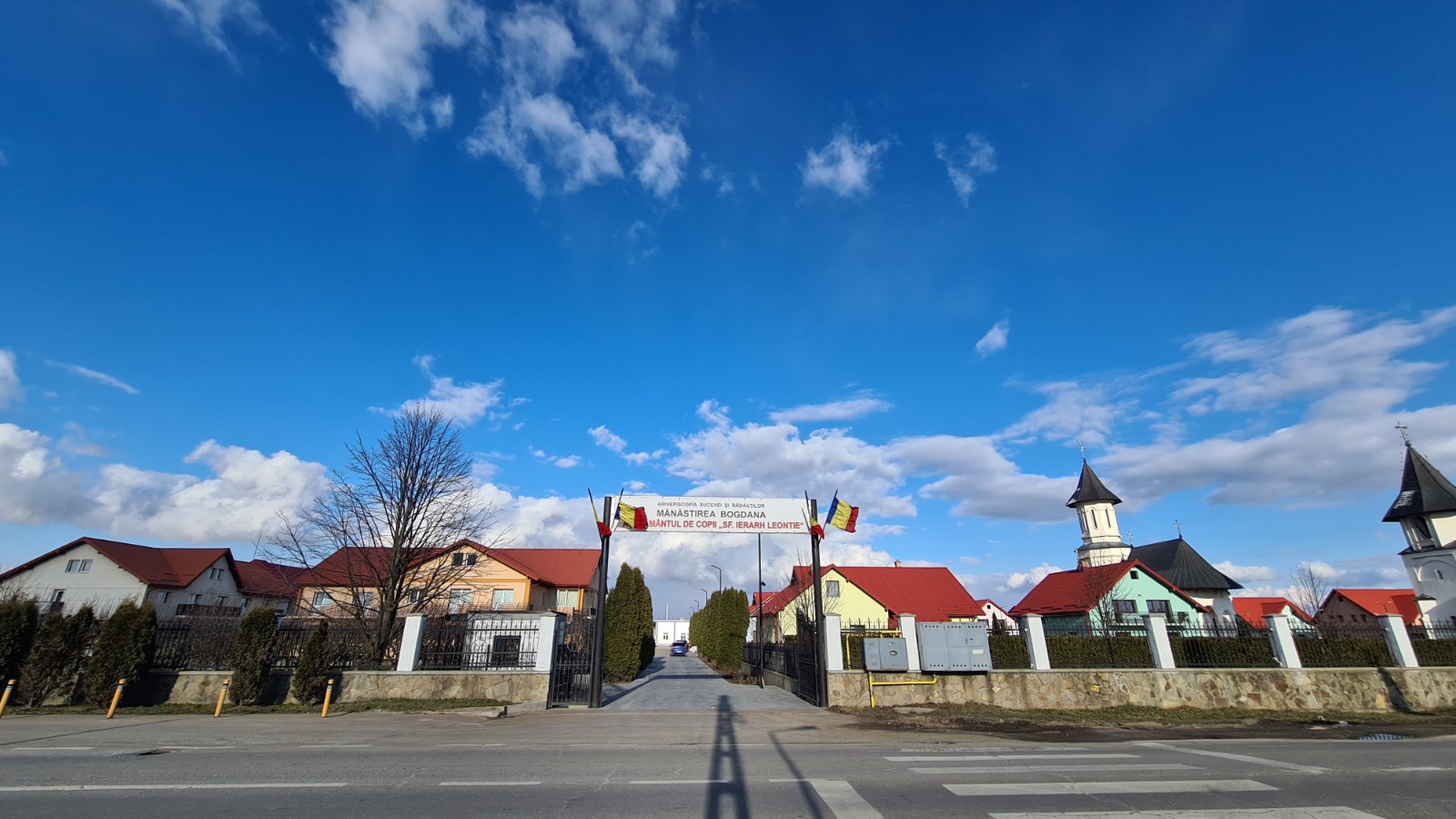
An important part of these forms of direct aid, whether through parishes, monasteries, bishops' offices or religious NGOs, remains discreet: direct material and spiritual support given to individuals or families in difficulty, occasional direct or indirect direct or indirect aid offered informally by priests, parishes, monasteries, etc., remain unquantifiable in terms of social results and in economic terms. On the other hand, the institutionalization of Orthodox philanthropy is primarily in the form of the provision of social and social-medical services within associations or foundations. They can be organized either by a monastery, as in the case of Bogdănești Monastery (Social Centre for over 100 elderly people), Bogdana Monastery (St. Hierarch Leontie's Centre for Children, approx. 120 children, an activity carried out in collaboration with the Suceava County Council), or the Eparchial Center of a diocese, such as the St. John the New Home for the Elderly in Suceava (where there are 50 elderly people), or associations or foundations directly or indirectly associated with some religious units, such as the St. John the New Association in Suceava (extended day nursery and secondary school). .
Other solutions for participation in the social economy sector - the organization of arts and crafts schools, vocational (re)qualification courses, sheltered workshops, social enterprises, etc. - came most often as a form of response and adaptation to the opportunities offered by Romanian legislation.
It is not only the declared religious affiliation of Romania's population that remains among the highest in Europe. Confidence in religious institutions has remained consistently very high throughout the entire post-communist period, and responses to questions on the role of religion in personal as well as in social and public life confirm the high importance of Orthodox values in the lives of Romanian citizens compared to other countries. Compared to other majority Orthodox countries, liturgical participation in Romania is significantly higher. At the beginning of the 2000s, indicators of religious faith, trust in the Church and the role of religion in personal life had increased since the 1990s. Recent research shows that the high religious affiliation, trust in the Church and the important role of religion in personal and social life are confirmed and manifested in the material and voluntary commitments of citizens to Churches and cults.
Thus, the cults (religious denominations and other institutions offering religious services) seem to be among the main beneficiaries of the 2% or 3.5% of tax redirections. Thus, according to a FDSC research, the share of those who directed 21TPTP3T of their tax directly to cults (this figure does not include the activities of religious organizations that carry out social, medical or educational activities) was 401TPTP3T out of the total population that had made the directing. A GFK Omnibus survey in March 2010 indicated that the share of those who would have directed 21TPTP3T of their tax to religious denominations or church associations or foundations was 291TPTP3T in 2009. At the same time, over 501TPTP3T of adults made at least one donation to the church in a given year, once or several times. 18.6% volunteered for their church or community, and 4.9%3T served on or were part of a parish or church committee.
„Christian philanthropy is an essential coordinate of the Church”, (His Eminence Calinic, , Family and philanthropy, two divine-human institutions, p.129)
In conclusion, the history of the Church's activity shows us the multitude of activities it has carried out over the years. However, despite their distinct character, their specificity in relation to lay organizations with similar social concerns, organizations within the Church and beyond, represent a field of research that is too little explored and with a particular capacity to help. Many tools are still needed to strengthen, capitalize and develop this beautiful work of the Church of Christ.
Bibliography
Demetrios J. Constantelos, 1968, Byzantine Philanthropy & Social Welfare, Rutgers University Press.
Patriarch Daniel, 2011, The importance of the social-philanthropic work of the Church, Basilica, Bucharest.
Pr. Prof. Dr. Constantin Pătuleanu (coord.) et al, 2012, Social-philanthropic and medical assistance organized by the Romanian Orthodox Church in the past and today, Basilica, Bucharest.
His Eminence Calinic , 2020, Family and philanthropy two divine-human institutions, Crimca Publishing House, Suceava
