
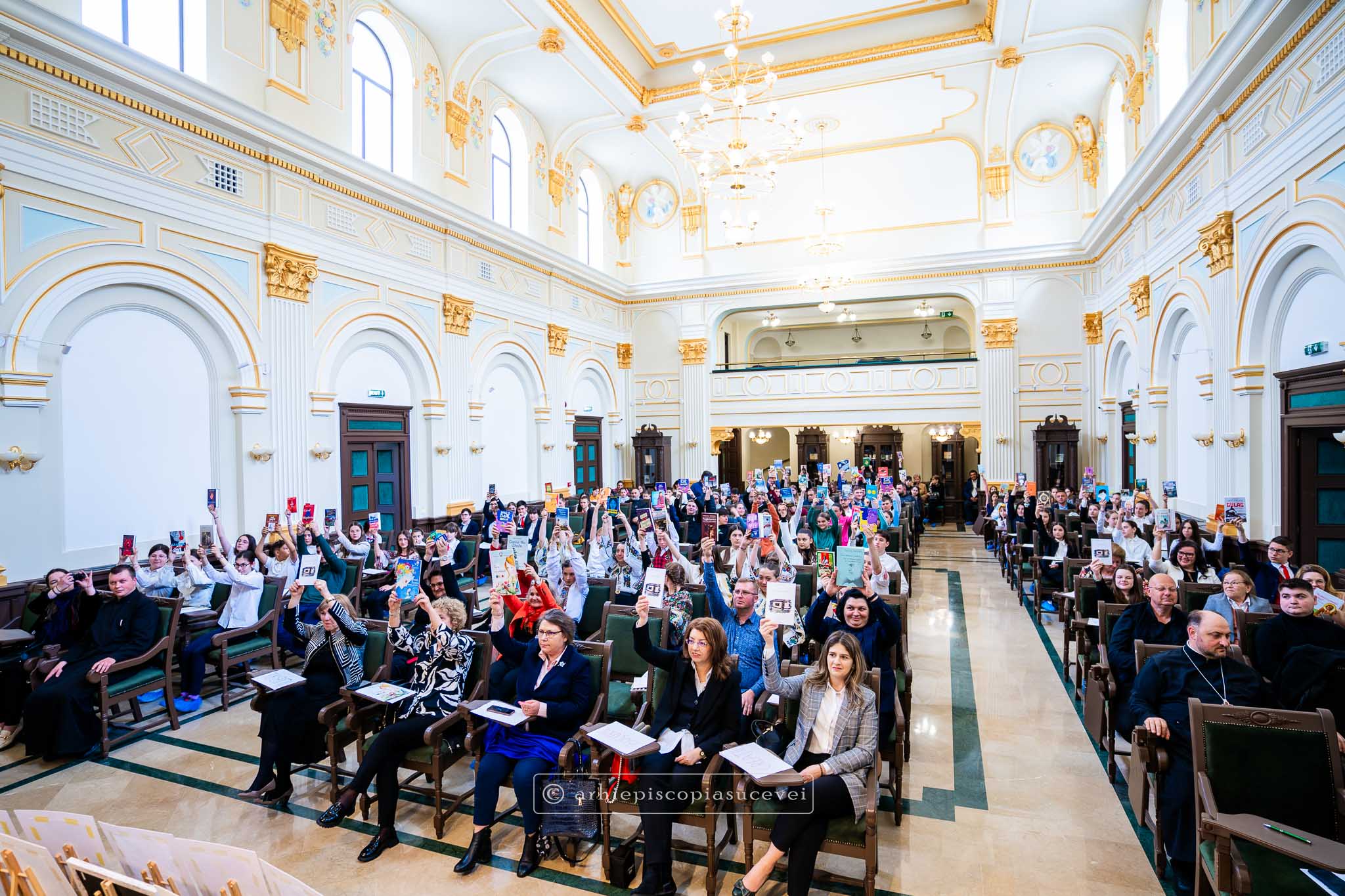
Internal Dayțs Cărții, celebrated every year on April 23, was marked in a special way in the Archdiocese of Suceava and Rădăuților, one of the outstanding cultural-artistic and educational events organized on this occasion being the event entitled Word that (is) beautiful, which took place in one of the most beautiful monuments erected at the end of the 19th century, the „Dornelor Palace”, a veritable Athenaeum of Bukovina.
Young people, children, parents, teachers, teachers, clergy, but also souls in love with art, writing, drawing and poetry, from the Dornelor region, from Câmpulung Moldovenesc, Suceava and beyond, met on Wednesday, April 24, 2024, to celebrate books and authors, the beautiful and word, through a series of unique moments - exhibitions, storytelling workshops, book launches, all of which are graced by the presence of living statues immersed in the world of emotions.
Prof. Daniela Ceredeev, the initiator, coordinator and moderator of the event held on this special day, welcomed the guests who have learned the „golden rule of the event”, according to which each participant must be accompanied to the activity by a favorite book, talked with young people of all ages, offering book prizes to those who were attentive, brave and curious.
This was followed by the opening of the national itinerant exhibition of calligrams, „Word that (is) beautiful”, organized within the homonymous project, with the blessing and contribution of His Most Reverend Archbishop Calinic, by the Suceava County School Inspectorate and the Archdiocese of Suceava and Rădăuților, through the Sector Media and Communication.
According to the initiators of this program, the exhibition includes 451 works, entered in the competition by 567 students from 82 schools in the counties of Bihor, Dâmbovița, Dolj, Mureș, Neamț, Sibiu, Timiș, Vrancea, Suceava and Bucharest. The participants were coordinated by 123 teachers who teach a variety of subjects.
It includes calligrams in Romanian, English and French, and the texts and authors proposed by the competitors are among the most diverse. There are, of course, an overwhelming number of scriptural and patristic texts, acactychism Philocalii and Lemonariu, but also contemporary writings, such as - for example - Decalogue of the Elderly, prepared by His Eminence Archbishop Calinic.
Thus, The Happiness, Prayer Domnească, Psalms, Proverbs of Solomon, Hymn of Christian love, The calligraphs, fragments from the Pauline epistles, lives of saints and pages from the history of the Church and of the country have found a beautiful place in calligraphy. Among the authors of literary texts, we may mention: Mihai Eminescu, Octavian Goga, George Coșbuc, George Coșbuc, Ioan Slavici, Tudor Arghezi, Lucian Blaga, Magda Isanos, Emil Gârleanu, Elena Farago, Andrei Mureșanu, Nichita Stănescu, Adrian Păunescu, Ana Blandiana, Virgil Carianopol, Gheorghe Tomozei, Nicolae Steinhardt, Radu Gyr, Costache Ioanid, Ioan Alexandru, Traian Dorz, but also Aesop, Carlo Collodi, Alexandre Dumas, Mark Twain, Alphonse de Lamartine, William Shakespeare.
The organizers confessed that this exhibition is the first of a whole series of exhibitions to be organized in the county and in the country, to inspire other children and young people to discover the beauty of words and the aesthetic, artistic and cultural joy of such a learning tool.
During the event, children's author Cătălina Gheorghian held a storytelling workshop and launched her latest book, Michael receives the Holy Light, published by Doxologia Publishing House. A special moment was the launch of a bunch of verses written by Oana Carmen Budeanu, priestess, chief police officer and psychologist, who launched her debut volume, On the porch of thought, published with the blessing of His Most Reverend Father Archbishop Calinic, Crimca Publishing House of the Archdiocese of Suceva and Rădăuților.
Mrs. Prof. Daniela Ceredeev, inspector for discipline religion at the Suceava County School Inspectorate, shared the feelings that her friend Oana arouses in her poems full of meaning. „She writes as she lives. With naturalness, without sterile striving, wide-eyed, but with the dream clinging to an eyelash of Heaven. Her word is not sterile. Nor is her restlessness at all foreign to her. But she seems to know that the natural is best for her. Her poetry is a confession. Of self, of faith, of becoming in love. It is a confession spoken shyly and meekly, with the sweet thought that we all live a miracle every day. It was with joy that I discovered her writing and I was fascinated by the naturalness with which she reveals her soul, holding it in her palms, a beautiful little hand, a beautiful little hand that carries Christ. Ever since then, I have not been left with the feeling that the true-and-simple-cerse's-poetry-is-right-and-simple-right-near-you. He knows Him and calls the Good One almost faithfully. And she shows Him to us in the silence of an unexpected dreamy glimmer, measuring with the compass of beauty the sky between sunrise and sunset, sweetly pondering how much more there is to hide in the dust that we are. Reading her writing, one can easily imagine her lining with the velvet of prayer the nest of the heart in which she welcomes the Word of Light: With the scent of dates and the song of the lute/ You always come, Jesus, you come to give me life,/With your warm hand, with the wound in the flowers,/You always come, Jesus, you always drive away the clouds. Or, elsewhere, adding to miracle crops, pretending in liturgy the song of the lark. Her words carry, line by line, when the pure murmur of doxology, when the long-tempered stubbornness of singing of songs, when the steadfastness towards the ectenes and psalms, when the pacified tingling of ecleziast. A confessional lyricism that would always want to remind us that we are called to be joy and flower to people, that we are called to place brightness and sunshine on the sky of their hearts, called to wipe away the tear and to be healing, called to make huts in the love that alone does not die and there to meet, shoulder to shoulder, peace and trust that come to us from Above, from a flash of the skies.”
After the signing session, those present visited the binary salon „Book by book, for children and for the Christian mother's library” of the Christian Mother's Library Crimca of the Archdiocese of Suceava and Rădăuților, as well as the entire exhibition of calligraphy, „Word that (is) beautiful” located in the Museum and Multicultural Center „Dornelor Palace”.
