
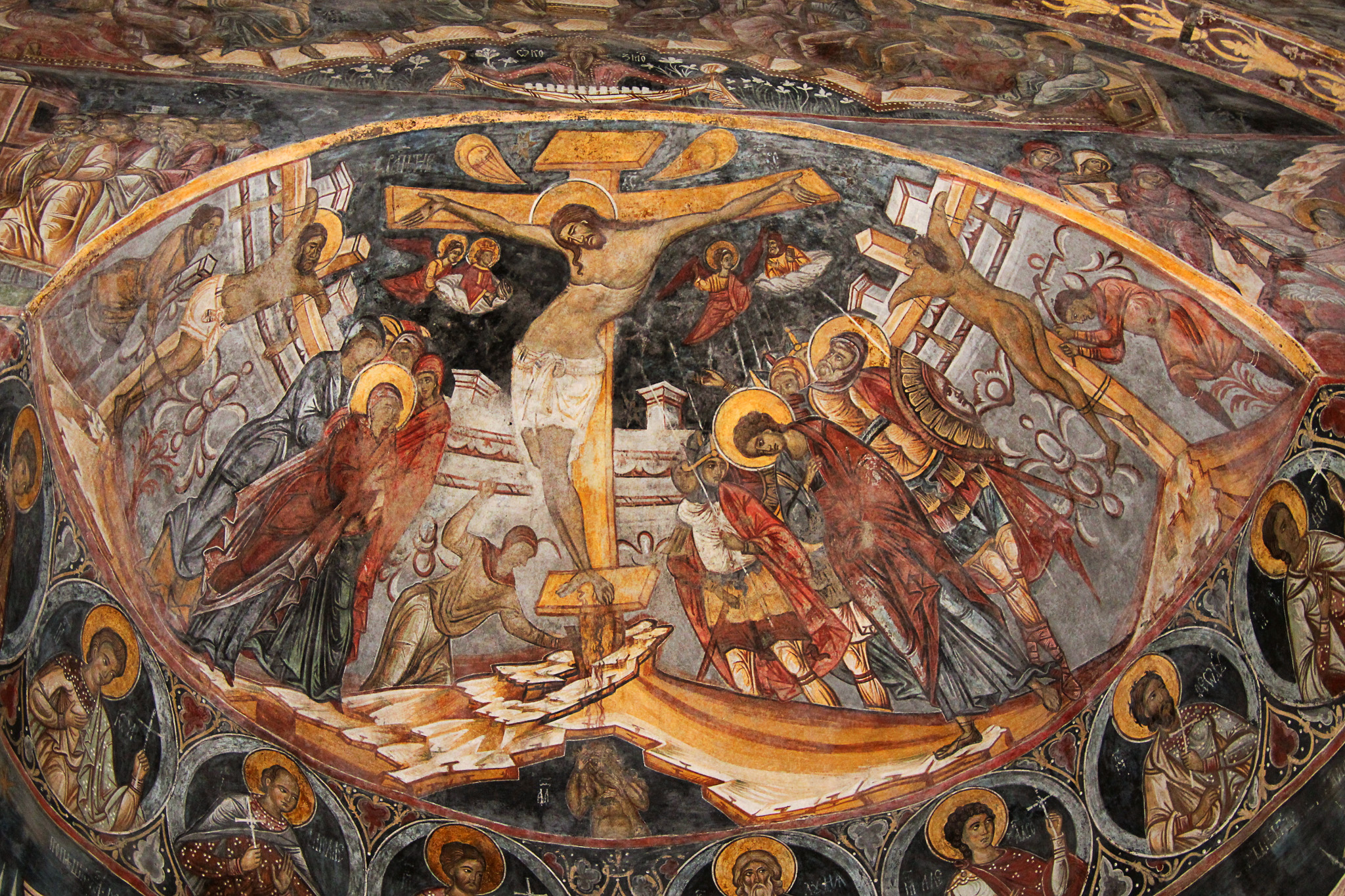
In most of the 15th- and 16th-century churches in Moldova (Dobrovăț, Popăuți, Voroneț, Humor, Moldovița, St. Dumitru in Suceava, St. George in Hârlău), the Passion of Christ is depicted in a continuous frieze[1]to which the main register is dedicated. The first painter to use this technique was the hieromonk Gavriil, the creator of the paintings in the church at Bălinești (1493). However, the frieze composition, which was consistently adopted by Moldavian painters, underwent a process of cultural and artistic evolution, as they were drawn to complex compositions featuring clusters of figures and detailed depictions of clothing, shifting the emphasis toward the decorative and the picturesque. These scenes are depicted in great detail and follow the Gospel texts of the Synoptic Gospels (Matthew, Mark, and Luke).
The depiction of biblical scenes is arranged in a continuous sequence and constitutes „the most important and compelling part of the collection of paintings decorating the nave.”[2]. It begins on the south wall near the iconostasis and continues on the west wall beneath the scene of the Dormition of the Mother of God, ending on the north wall up to the iconostasis, and then extends into the two side apses and the iron-clad windows.. It begins with the Agathos Melos in the Garden of Gethsemane (in two scenes) and continues with the encounter between Christ and the soldiers who came to arrest Him, Judas’s Kiss and the Arrest of Jesus, Peter cutting off Malchus’s ear, Peter’s Denial, on the western wall—Jesus before Annas and Caiaphas, Jesus before Pilate, The Mocking of Jesus, Judas Returns the Silver Coins of Betrayal, Judas’s Hanging; on the north wall—The Road to Golgotha, The Nailing to the Cross, The Division of the Savior’s Garments, The Descent from the Cross, The Lamentation over the Body of Christ, Jesus’ Tomb Sealed and Guarded by Soldiers, The Descent into Hell. In addition to this frieze depicting the Passion, the painter uses the vault of the north apse to depict the scene of the Crucifixion.
This entire depiction shows us the painter mastering his means of expression regardless of the scene: whether he is conveying the calm of the Prayer in Gethsemane, the drama of the Crowning with Thorns, or the splendor of a mounted procession in The Road to Golgotha. The artist makes use of the customary elements of the Byzantine tradition, such as stylized rocks, fanciful architecture, and trees with abstract silhouettes; but in addition to these, he also introduces artistic elements that capture the human figure in various poses or that reproduce the richness of the costumes of that era.
The Supernatural Prayer in the Garden of Gethsemane
The Prayer in the Garden of Gethsemane is set in the midst of a rugged landscape full of jagged rocks and dotted here and there with sharp cypress trees. It is depicted in two scenes.
In the first of these, we see the Savior apart from the apostles, having gone up the mountain and praying to the Father to take this cup away, if it is possible. The Savior’s posture of prayer—kneeling and bowing down to the ground—shows that He entrusts Himself entirely to the will of His Father, to Whom He shows perfect obedience: „And going a little farther, He fell with His face to the ground, praying and saying, ”My Father, if it is possible, let this cup pass from Me! Yet not as I will, but as You will.’”[3]. His garments are a deep purple, suggesting the suffering and sacrifice that lay ahead. At the foot of the mountain, we see the apostles depicted in various, almost caricatured poses of sleep. Although they were urged to keep watch and pray with Jesus, they had all fallen asleep out of sorrow.[4]. In the upper right corner, we see the Savior speaking with the angel sent by the Father to strengthen Him[5].
In the second scene, we see Christ approaching the apostles, who are still asleep—except for Peter, whose eyes are open and who is exchanging glances with the Savior. Christ looks reproachfully at the apostles who were unable to keep watch with Him, even though not long ago they had promised that they would not deny Christ (Peter[6]) and that they will be able to drink the cup that Christ will drink (the sons of Zebedee[7]): „Lord, as You approached Your voluntary Passion, You said to Your disciples: ”If you could not keep watch with Me for even one hour, how could you have promised to die for Me? … Get up and pray! Let no one deny Me when they see Me on the Cross.”[8]. The mountain from which Christ descended is no longer white and is depicted in red precisely to convey the intensity of the Savior’s prayer in Gethsemane—we know that the Savior prayed here with tears of blood[9]. Here, „Jesus’ heart was literally broken … Jesus had already <a început să moară prin propria alegere>”[10].
The Encounter Between Christ and the Soldiers Who Came to Arrest Him
After praying in the Garden of Gethsemane, the Savior awakens His disciples and tells them that the time has come for the Son of Man to be handed over to sinners. Christ knew that the one who had betrayed Him was approaching. The Savior is depicted at the head of the group of apostles, appearing to walk willingly toward the armed soldiers who were searching for Him. The apostles are grouped together, standing side by side as if hidden behind the Savior, and their concern is evident on their faces. The soldiers are armed with spears and torches, and their military uniforms and armor are rendered in detail. Some of the soldiers are depicted lying on the ground, faithfully conveying the dialogue between them and Jesus.[11], namely, that when Jesus reveals to them who He is, they recoil and fall to the ground. The powerful suddenly find themselves powerless, and here too we see that the Savior does not hesitate to carry out the work of redeeming humanity, for „the One whom Isaiah had previously called the Lamb, proclaiming Him, He comes willingly to the slaughter.”[12]. The New Adam gives the Father the answer He had been waiting for in paradise from the old Adam.
Judas' Kiss and the Arrest of Jesus
The Savior is depicted surrounded by soldiers clad in armor, wearing metal helmets and holding spears and swords in their hands. The disciples fled in fear of the soldiers, leaving the Savior alone. Here Judas approaches Christ, giving Him that poisonous kiss of betrayal: „O deceitful kiss! ”Rejoice, Teacher,’ Judas says to Christ, and with those words, he betrayed Him to be slain; and the kiss was the sign he had given to the lawless: ‘The One I kiss is the One I have promised to hand over to you.’”[13].
Upon closer inspection, it is clear that the Savior appears to be floating above the ground, while Judas, trying to reach the Savior’s cheek to kiss Him, seems to be climbing up the Savior. The soldiers appear ready to strike the Savior: one has his sword halfway out of its sheath, another has a staff raised to strike, and a common soldier has his hand raised above the Savior’s head.
The landscape behind the scene of the Savior’s arrest also heightens the drama: there are two sharp peaks, one bright red and one light in color, with edges like a saw that seem to tear through the sky. The Savior’s pain is evident on His face.
Peter cuts off Malchus's ear
The Savior is escorted to the high priest Anna with His hands bound and held by the high priest’s servants. Then Peter, desperate to save Him, draws his sword and cuts off the ear of Malchus, the high priest’s servant. The Savior, however, turns around, looks at him, and urges him not to thwart His divine and salvific plan: „Shall I not drink the cup that the Father has given Me?”[14]”The act of healing (Luke 22:51) is not depicted in the painting.
Peter's Denial
The painter manages to depict, within a limited space, all three of Peter’s denials, to which he adds Peter’s bitter weeping.
Thus, on the left side, in the portico of an entrance, we see the female gatekeeper who lets Peter into the high priest’s courtyard at the intercession of the Apostle John. However, she recognizes Peter as the disciple of „this man” (John 18:16–17), and Peter denies Christ for the first time. The next scene shows Peter sitting by the fire, warming himself, while the high priest’s servant—a relative of Malchus—identifies Peter as a close associate of the Savior (Mark 14:66–68, 1 John 18:26). But Peter denies Him again. Peter’s third denial—revealed by his Galilean accent—is depicted on the right side of the scene. Just above it is depicted the rooster that reminds Peter that the Savior knew in advance that he would deny Him three times (Matthew 26:75): „Peter, seeing what was happening at that moment and overcome with fear, when questioned by a servant girl, denied You, Lord, not only as You said, but as You knew—You who know all things.”[15].
„And when he went outside, he wept bitterly” (Mt 26:75). Peter’s repentance is ingeniously depicted by the painter, who places him outside the walls, above them, thus suggesting that repentance is the only thing that can lift him above this terrible fall, the only path to reconciliation with Christ. Peter’s heart, filled with grief, is rendered very expressively through the gesture of resting his head on his left hand, the apostle’s eyes closed.
Jesus at the House of Anna and Caiaphas
Also on the south wall is depicted the scene of Jesus being brought by soldiers (who are gesturing frantically) into the city to be presented to the high priest. The Savior has His hands bound (John 18:12) and is dressed in a red robe. The scene continues on the west wall, where we see Annas and Caiaphas seated to judge the Savior. The artist does not depict Christ’s appearance first before Annas and then before Caiaphas in chronological order (John 18:13–24), but rather portrays them both together. Standing, the high priest Caiaphas is depicted tearing his clothes (Mark 14:63) upon hearing the Savior’s testimony about Himself: „From now on you will see the Son of Man seated at the right hand of Power and coming on the clouds of heaven” (Matthew 26:64). Thus he passes judgment: „He is guilty of death” (Matthew 26:66). Thus begin the darkest moments in human history. Creation rises up against the Creator, determined to remove Him from its life, determined to kill Him. But as we shall see, it is not death that has the last word, but love, which reveals that Christ’s death is truly life-giving.
Jesus Before Pilate
The scene depicts the moment when Pilate washes his hands. He is shown seated on a throne, dressed in imperial robes, wearing red shoes (reserved for those of royal blood) and a crown on his head. A servant pours the water with which he washes his hands as he utters the words that reveal his cowardice—his refusal to defend the One in whom he finds no fault (Luke 23:4): „I am innocent of the blood of this righteous man” (Matthew 27:24).
The Scene of Jesus' Mockery
The scene depicting the Savior’s Crowning with Thorns occupies a central place in the depiction of the Lord’s Passion, with the painter employing „a highly skillful treatment of the overall composition.”[16]. Set right in the center of the west wall, the scene of the Crowning with Thorns—the Mocking of Christ—forms the very geometric axis of the entire depiction. The obvious purpose of this placement is to place this image of suffering at the center of the viewer’s field of vision and attention.
Clothed in a red cloak (Mt 27:28) and depicted in an upright posture, Jesus appears to be the central figure of the entire west wall. His figure is highlighted by the fact that the painter Toma leaves an empty space around him, intended to emphasize „the image of solitary suffering.”[17].
Left alone and handed over to the governor’s soldiers, Jesus must face all the hatred and wickedness of mankind: „And they wove a crown of thorns and placed it on His head, and put a reed in His right hand; and, kneeling before Him, they mocked Him, saying, ”Hail, King of the Jews!’ And spitting on Him, they took the reed and struck Him on the head.”[18]. The hymnographer also emphasizes their cruelty: „They stripped Me of My garments and clothed Me in a red cloak; they placed a crown of thorns on My head, and put a reed in My right hand, so that I might shatter them like the pots of a potter.”[19]. Because of this wickedness, all the members of the Savior’s Body suffer. Yet the Savior’s love is boundless, and nothing can stand in its way: neither suffering, nor pain, nor the cross, nor even death: „Every member of Your holy body endured humiliation for us: the head endured thorns; the face, spitting; the cheek, slaps; the mouth, the taste of vinegar mixed with gall; the ears, pagan blasphemies; the back, scourging; and the hand, the reed; the stretching of the whole body on the cross, and nails, the joints, and the side, the spear. You who suffered for us and saved us from our passions; You who humbled Yourself for us through Your love for mankind and exalted us, Almighty Savior, have mercy on us.”[20].
The gestures of the crowning with thorns, the placing of the reed in Jesus’ hand, the spitting, and the blows are depicted with precision, in an atmosphere full of dynamism and commotion, suggested not only by the positions of the figures involved but also by the presence of musicians playing trumpets and percussion instruments.
Judas Returns the Silver Coins of Betrayal / The Hanging of Judas
The return of the silver coins and Judas’s suicide are depicted together in the same scene, the last one on the west wall.
Although Vasile Drăguț speaks of receiving the silver coins of betrayal[21] However, the scene—now cleared of smoke and grime—suggests that we are witnessing the moment when Judas returns the silver coins. We see Judas in the temple, emptying the silver coins of his betrayal from a bag onto a table. Judas is holding the bottom of a bag from which those cursed coins are spilling out[22]. In the painting, we see four priests who are either pointing toward Judas with their hands or holding their hands in a defensive posture, as if expressing the words of the Gospel: „What does this have to do with us? You will see.”[23].
In the same painting, off to the side, we see Judas hanging himself from a palm tree. The fact that the rope is tied to a palm frond suggests that his repentance would have been enough to overcome and break the sin of despair. The fact that his hands appear to be bound visually expresses what the Gospel text says, namely that after he took a bite, Satan entered him[24].
The Road to Golgotha
This episode is depicted on a grand scale, opening the scene of the Passion on the north wall and is divided into three scenes. In the first scene, we see a group of soldiers dressed in armor, armed, and carrying a banner, with two trumpeters with page-style haircuts behind them. The group of soldiers is led by Pilate himself, who holds a sign in three languages: „Jesus of Nazareth, King of the Jews.”[25].
In the central scene, we see Jesus dressed in a red robe, with his hands bound, in the midst of a tight-knit group of soldiers armed with spears and clad in the armor typical of the time, closely followed by a high priest holding in a basket the four nails that will fasten Christ to the cross. The mountain behind the soldiers, a fiery red with very sharp peaks, accentuates the drama of this scene.
In the next scene, located in the side apse, we see the two thieves carrying their crosses toward Golgotha, and next to them we see Simon of Cyrene carrying the Savior’s cross[26]. The good thief, recognizable by his beard, leads the way, looking ahead toward the path that would open the gates of heaven for him, while the other thief looks back.
The Ascension to the Cross
Since the Passion was considered, along with the Resurrection and to a large extent together with the Nativity, to be a pivotal event in the life of Christ and in the Gospel, it is most often highlighted and depicted in a place of honor. Due to limited space, the painters were unable to depict the Savior’s Passion in detail, focusing instead on the key scenes of the Crucifixion or the Nativity.[27].
The scene depicts Christ climbing a ladder leaning against the cross, assisted by a soldier at the base of the ladder and a servant at the top. Next to the cross stands another servant preparing the nails, a hammer in his hand. This depiction, in which the Savior willingly ascends the cross, is inspired by a medieval legend based on the words of the prophet Isaiah in chapter 53. The legend tells us that Christ climbed the ladder alone, of his own free will, astonishing the officer who was carrying out the Savior’s execution: “What a miracle this is, that this prophet comes of his own free will to be crucified. He offers no resistance and utters not a word.”[28].
The Division of the Savior's Garments
The scene depicts two soldiers sitting and a servant holding a pair of scissors, together holding Christ’s robe. On the table, the lots that have been cast are visible. The image does not faithfully reflect the text from John (19:23–24), which tells us of four soldiers who divided Christ’s garments among themselves, while the tunic was not to be divided but torn in two because it was seamless.
The Crucifixion
The Crucifixion scene is not located within the continuous frieze, but on the vault of the north apse, „in the best light”[29], suggesting its importance through the chosen location and its much larger size. The result is a monumental composition that fills the entire north apse.
According to tradition, this fresco depicts Christ at the moment of His death or immediately afterward. His eyes are closed, His head is bowed, and His body is bent to the left. The source of inspiration for the depiction of the Savior’s bowed head is the passage from John: „And he bowed his head and gave up His spirit.”[30]. This depiction of the Crucifixion was influenced by the Good Friday services—the prayers and hymns that are recited today and that recognize in Christ, hanging on the Cross, both the true God and the true Man.
On the right is the Virgin Mary, mourning alongside a group of myrrh-bearing women. The Virgin Mary, supported by the women around her, expresses her grief by raising a hand to her cheek. The hymnographer also deepens the Mother’s grief in words: „Today, seeing You, O Word, crucified on the Cross, the spotless Virgin, weeping with compassion like a mother, her heart was pierced with bitterness, and sighing with pain from the depths of her soul, she tore at her cheek in anguish; therefore, beating her breast, she cried out in sorrow: ”Woe is me, divine Son! Woe is me, Light of the world! How have you vanished from my sight, the Lamb of God?”[31]
On the left is the Apostle John alongside a group of soldiers, among whom is the centurion Longinus, depicted not at the moment when he pierces Christ’s side, but merely as a witness to His death (Luke 23:47). The divinity of the crucified one is already acknowledged, as he is depicted with a halo: „Even if you have died, / the Centurion God knows you”[32]. The entire creation shares in the suffering of those present at the Cross; the earth quakes, the sun is darkened, the veil of the temple is torn, and the dead are raised (Mt 27:51–53); for, „When You were crucified, O Christ, all creation, seeing this, was shaken; the foundations of the earth trembled in fear of Your power. For as You were lifted up today, the Jewish people were lost. The veil of the Temple was torn in two, and the dead rose from their graves; the centurion, seeing the miracle, was filled with awe; and Your Mother, standing beside You, cried out, weeping as a mother and saying: ”How can I not weep and beat my breast, seeing You hung on the wood, naked as a criminal?” You who were crucified and buried and rose from the dead, O Lord, glory to You!”[33]
On either side of the Savior, the two thieves are crucified. They are not nailed to the cross but merely bound. The good thief has a halo, is girded at the waist with a white cloth, and is depicted with a beard. In popular belief, the absence of a beard is a bad omen. He is positioned facing the Savior, while the evil thief has his back turned toward the viewer; he has no beard and is depicted naked. Both thieves are depicted at the moment their legs are being broken. The good thief shows us the importance of repentance, as well as its power to change a person’s life in just a few moments, when it is experienced with the utmost intensity. This repentance of the thief will open for him today the gates of heaven that had once been closed: „The thief uttered a faint cry on the cross, and found great faith. In an instant he was saved, and, opening the gates of heaven first, he entered.”[34].
Beneath the Savior’s Cross, in an open grave, one can see the naked bust of the forefather Adam, over which the blood of Jesus flows, suggesting, together with passages from the services on Good Friday and Holy Saturday, the cleansing of the original sin of the old Adam through the blood of the New Adam.
One notable feature is the presence of two allegorical figures. One depicts the Church, personified as a man wearing a crown and accompanied by an angel. He holds the chalice out toward Christ to receive the life-giving Precious Blood. The other figure represents the Synagogue, personified by an Old Testament high priest, who is also accompanied by an angel that appears to be drawing him away from Christ.
The crucifixion of the Savior reveals humanity’s ingratitude, hatred, and rebellion against God. Those who were supposed to know the Law and obey it proved themselves to be lawbreakers and ungrateful. This was Christ’s greatest pain. „It was not the Cross that was so heavy. It was not the nails that caused Jesus pain. His greatest suffering was caused by the unworthiness of those before Him. … It was not the centurion’s spear that pierced His heart—which was already bleeding—but the hatred directed against Him. The bitterness of their ingratitude was more bitter to Him than that of vinegar and gall.”[35].
Crucified on the Cross, Jesus brings about the forgiveness of mankind and restores humanity to God’s love. „Your life-giving side, flowing like a spring from Eden, waters, O Christ, Your Church, as a speaking paradise; from which, dividing as in the beginning into the four Gospels, it waters the world, bringing joy to creation and teaching the nations to worship Your kingdom with faith.”[36]. His blood nourishes the Church, springing forth eternal life: „You have redeemed us from the curse of the law with Your precious blood, as You were nailed to the cross and pierced with a spear, our Savior, You have bestowed immortality upon mankind; glory to You.”[37]. And He does all this because He is God: „Let us all come and praise Him who was crucified for us, for Mary saw Him on the cross and said: ”Though You suffer crucifixion, You are my Son and my God.’”[38].
The Descent from the Cross
Recounted by all four evangelists, the scene depicts the descent from the Cross as an act of great love and tenderness. „Joseph of Arimathea, a distinguished councilor, who was also awaiting the kingdom of God”[39] After asking Pilate for Jesus„ body, she carefully, as if in an embrace, took Him down from the Cross to prepare Him for burial: ”Joseph, the man of good appearance, took Your most pure body from the wood, wrapped it in a clean shroud, and laid it in a new tomb with fragrant spices.”[40]. He is leaning against the staircase, in a tender embrace that reveals his deep concern for Jesus’s lifeless body. He is assisted on either side by the Virgin Mary and the Apostle John, who, as a sign of reverence and great love, each kiss the Savior’s hands.
Lamentation at the Body of Christ
Once again, we see the Savior’s Mother, His beloved disciple, and Joseph of Arimathea standing by His side. The naked body of Jesus lies on the anointing stone. Joseph, full of care, leans forward to lay Jesus„ feet. The Apostle John, bowed down to the ground, humbly kisses His left hand, while the Virgin Mary, overcome with grief, holds Jesus” head in her hands, touching her face to that of her beloved Son in a maternal gesture. Behind them, a group of women expresses their grief over Christ’s death by bowing their heads, resting their faces in their hands, or raising their hands toward heaven. Next comes the anointing of Jesus’ body with “about a hundred liters of a mixture of myrrh and aloe.”[41]brought by Nicodemus and His wrapping in the shroud: „When they took You down from the cross, dead, the man from Arimathea wrapped You—the life of all—in myrrh and a shroud, O Christ, and with love he was moved to kiss Your incorruptible body with his heart and lips.”[42].
The shroud in which the Savior’s body will be wrapped is placed before the anointing stone and draws attention because of the way it is depicted. This reveals the painter’s attention to detail, showcasing a „true study of drapery, a masterclass in technique.”[43].
Jesus' tomb, sealed and guarded by soldiers
The scene of the Lamentation is followed by the image of the sealed tomb that holds Jesus’ body for a short time. Joseph of Arimathea and Nicodemus, terrified by the death of the Son of Man, hastily bury His body with all due respect in the earth that He Himself had created, without a funeral rite. The tomb was a new one, hewn out of the rock and prepared by Joseph for himself (Mt 27:60). The painter does not faithfully reproduce the Gospel text but depicts it as a stony, royal tomb. The royal seal is also carefully depicted. Fearing that Jesus’ body might be stolen, the chief priests and Pharisees obtained permission from Pilate to secure the tomb with a guard (Mt 27:62–66). Yet it is precisely these guards who will be the first witnesses to Christ’s Resurrection.
The soldiers are clad in armor, wearing helmets, and armed with spears. The painter depicts them sleeping, suggesting the lie concocted by the chief priests and elders—that while they were asleep, the disciples stole Jesus’ body (Mt 28:11–14). The price of this lie is valued, just like the price of the sale, in silver coins (Matthew 28:15).
The Descent into Hell
The final scene of the Savior’s Passion, which also reveals the purpose of the Incarnation of the Son of God, is that of the Descent into Hell. „The Descent into Hell replaces the scene of the Resurrection itself.”[44], as it is referred to directly in ancient monuments The Resurrection. While the Resurrection appeared in symbolic form in early Christian art, from the 8th to the 9th centuries—when ecclesiastical themes began to be codified as dogma—the scene of the Descent into Hell entered Byzantine art.
In the center of the icon, we see Christ bearing the marks of the crucifixion, with a halo. He stands on the shattered gates of hell and stretches out his hands toward Adam and Eve, whom he is pulling out of the pit. They point toward Christ with their hands and gaze upon their Savior. To the right of the Savior is a group of the righteous, each with a halo, among whom we can see: Saint John the Baptist, two kings—David and Solomon—and two prophets. They point toward Christ with their hands, while He turns His head and gaze toward them.
On the left is a group of people without halos who, unlike the other group, are no longer pointing toward Christ with their hands. They represent the unsaved (they also appear in 16th-century Athonite frescoes).
At Jesus’ feet, in the mouth of hell, one can see the nails, the padlock, and the key that until then had secured the gates of hell. Satan himself is depicted as defeated, powerless, and bound by chains around his hands and feet.
The sources for this composition lie outside the canonical Gospels. It appears that the source is the apocryphal Gospel of Nicodemus, translated into Church Slavonic and incorporated into the sermons as well as the hymns of the services on Good Friday and Holy Saturday: „The parallels … are so evident that any further clarification is superfluous, since a side-by-side comparison of the composition and the text is sufficient to confirm the connection between word and image.”[45].
With His body in the tomb, Christ descends with His soul into hell, shatters the power of hell, and delivers those who were held captive there. Because He is the Lord of life, He is able to grant life even to those in hell. „Today Hell cries out in anguish: ”It would have been better for me had I not received the One born of Mary, for by coming upon me, He has shattered my power; He has broken down the gates of bronze. The souls I once held within me, God being what He is, He has raised from the dead. Glory, O Lord, to Your Cross and Your Resurrection.”[46].
Christ becomes the first to rise from the dead. He descends with His soul into hell, but, untrapped by it, He reveals Himself to be the conqueror of death and, at the same time, the source of life. „Today hell cries out in anguish: ”My power is shattered; I received Him as one of the dead, but I cannot hold Him at all; rather, along with Him, I lose even those over whom I reigned. I have had the dead from time immemorial, but behold, He raises them all.”[47]. Descending into the depths of hell, Christ seeks out Adam, the work of His hands, to fulfill the promise made in paradise (Gen 3:15), to „through His death destroy the one who holds the power of death, that is, the devil” (Heb 2:14) and to deliver Adam and those who came after him from death, bringing bitterness to hell. „Hell, meeting You, O Word, was embittered at the sight of You—a deified man, wounded by beatings and yet Almighty; and at the sight of Your fearsome countenance, it was left speechless.”[48].
His death gives life, and from His tomb the light of the Resurrection bursts forth, filling all things with divine glory. Christ carries His obedience to the Father to its fullest extent, and in this obedience is revealed the Father’s heart, full of love, for the one who remains to bear His image in likeness for all eternity—man. May our hearts, too, respond to this love with sincerity and warmth, finding peace only when they rest in God (St. Augustine).
Fr. Felician Buzilă
Bibliography
***, The Bible or Holy Scripture, Published by the Orthodox Bible and Mission Institute, Bucharest, 2019;
***, Liturgy Book, Published by the Orthodox Bible and Mission Institute, Bucharest, 2012;
***, The Triod, Published by the Orthodox Bible and Mission Institute, Bucharest, 2010;
Balș, Ștefan, Humor Monastery, Meridiane Publishing House, Bucharest, 1965;
Damaschin Dorneanul, Auxiliary Bishop of the Archdiocese of Suceava and Rădăuți, The Mystagogical Dimension of Holy Week. Elements of Spiritual Anthropology, Crimca Publishing House, Suceava, 2022;
Damaschin Dorneanul, Auxiliary Bishop of the Archdiocese of Suceava and Rădăuți, Adam at the Cross: 8 Meditations on the Days of the Passion, Crimca Publishing House, Suceava, 2023
Drăguț, Vasile, HUMOR, Meridiane Publishing House, Bucharest, 1973;
Podlacha, Wladyslaw and Nandriș, Grigore, The Humanism of Post-Byzantine Mural Painting, Meridiane Publishing House, Bucharest, 1985;
Sinigalia, Tereza, and Boldura, Ovidiu, Medieval Monuments in Bukovina, ACS Publishing House, Bucharest, 2010;
Ștefănescu, I. D., The Iconography of Byzantine Art and Romanian Feudal Painting, Meridiane Publishing House, Bucharest, 1973.
[1] Ștefan Balș, Humor Monastery, p. 19.
[2] Vasile Drăguț, Humor, p. 11.
[3] Matthew 26:39.
[4] Luke 22:45.
[5] Luke 22:43.
[6] Matthew 26:35.
[7] Mark 10:38–39.
[8] The Triod, The Service of the Holy and Saving Passions, Thursday Evening Matins, Antiphon 6, Troparion 3, p. 609.
[9] Luke 22:44.
[10] Damaschin Dorneanul, Auxiliary Bishop of the Archdiocese of Suceava and Rădăuți, The Mystagogical Dimension of Holy Week. p. 485.
[11] In 18, 4–8.
[12] The Triod, Vespers of Holy and Great Thursday, Stichera 5, p. 595.
[13] The Triod, Small Vespers on Holy and Great Thursday, Ode 8, Troparion 5, p. 604..
[14] In, 18, 11.
[15] The Triod, Small Vespers on Holy and Great Thursday, Ode 5, Troparion 5, p. 603..
[16] Vasile Drăguț, HUMOR, p. 16.
[17] Ibid., p. 16.
[18] Matthew 27:29–30.
[19] The Triod, The Service of the Holy and Saving Passions, the Thursday Evening Matins, Lauds, the Doxology…, p. 619.
[20] The Triod, The Service of the Holy and Saving Passions, Thursday Evening Matins, Lauds, Troparion 2, p. 619.
[21] Vasile Drăguț, HUMOR, p. 55.
[22] Matthew 27:3–4.
[23] Matthew 27:4.
[24] On the 13th and 27th.
[25] In 19, 19
[26] Matthew 27:32
[27] I.D. Ștefănescu, The Iconography of Byzantine Art and Romanian Feudal Painting, p. 116.
[28] Ibid, p. 117.
[29] Ibid., p. 118.
[30] On the 19th, 30.
[31] The Triod, The Service of the Holy and Saving Passions, Thursday Evening Matins, Stihoavna, Stichera 3, p. 620.
[32] The Triod, Friday Evening Denia, The Lord’s Burial, Tone 2, Troparion 36, p. 659.
[33] The Triod, The Service of the Holy and Saving Passions, Thursday Evening Matins, Lauds, Troparion 3, p. 619.
[34] The Triod, The Service of the Holy and Saving Passions, Thursday Evening Matins, Antiphon 14, Stichera 2, p. 612.
[35] Damaschin Dorneanul, Auxiliary Bishop of the Archdiocese of Suceava and Rădăuți, Adam at the Cross, pp. 115–116.
[36] The Triod, The Service of the Holy and Saving Passions, Thursday Evening Matins, Beatitudes, Stichera 4, p. 613.
[37] The Triod, The Service of the Holy and Saving Passions, the Thursday Evening Matins, the Troparion, vol. 4, p. 620, and in Liturgy Book, The Order of the Proskomedia.
[38] The Triod, First Hour, Holy and Great Friday, Kontakion, p. 624.
[39] Mark 15:43.
[40] The Triod, Holy and Great Friday, Vespers, Troparion, p. 645.
[41] In 19, 39.
[42] The Triod, Holy and Great Friday, Vespers, Stihoavna, p. 644.
[43] Vasile Drăguț, HUMOR, p. 17.
[44] Wladyslaw Podlacha and Grigore Nandriș, The Humanism of Post-Byzantine Mural Painting, p. 205.
[45] Ibid., pp. 209–210.
[46] The Triod, Holy and Great Saturday, Vespers, Stichera 5, p. 673.
[47] The Triod, Holy and Great Saturday, Vespers, Stichera 6, p. 673.
[48] The Triod, Holy and Great Saturday, Matins, Ode 4, Troparion 3, p. 666.
