
The Humor Monastery was built and „dedicated to the Dormition of the Holy Virgin Mary, Mother of God, at the expense and through the efforts of the servant of God Jupân Toader, the Grand Logothete, and his wife Anastasia, in the year 7038 (1530) on August 15, with the Reverend Paisie serving as priest.”[1]. The church is an example of the Moldavian architectural style that took shape during the reign of Stephen the Great. It has no steeple, and although it was not founded by a prince, it features a crypt between the nave and the narthex. It is the first building in Moldova to feature an open portico, which creates a subtle transition from the exterior to the interior, from the secular to the sacred.
The Venerable Paisie adorned the new church with frescoes „both inside and out”[2] by commissioning the painter Toma from Suceava, who, together with a team of painters, adorned the church with a painting of great spiritual and iconographic value; the final days of Holy Week resonated deeply in the painter’s heart, a fact that is reflected in the iconographic program.
Passion Week, which marks the culmination of the 40-day fast, is a time to intensify our spiritual efforts, our prayer, asceticism, and meditation on the sufferings of our Savior Jesus Christ, as well as on the events taking place now and on the teachings He leaves us during this final period of His life.
Holy Week is structured as a diptych consisting of two triduum: the Triduum of the Bridegroom, which encompasses the first three days (Holy Monday, Holy Tuesday, and Holy Wednesday), and the Paschal Triduum of the Lamb, who offers Himself as a sacrifice, which encompasses the following three days (Holy Thursday, Good Friday, and Holy Saturday)[3].
The culmination of the work of human salvation is represented by the Savior’s final days on earth, namely His Holy and Salvific Passion, which is liturgically commemorated during Holy Week.
Christ’s sufferings as an expression of boundless love, of the love stronger than death that God bears toward humanity—which, even in Paradise, wounded this love—occupy a prominent place of utmost intensity and spiritual experience in the liturgical calendar, in hymnography, and in iconographic representation.
The iconographic program of Humor Monastery devotes ample space to this holy and great week of the Passion of our Savior Jesus Christ, beginning at the altar and continuing into the nave through the iconographic depiction, in the frieze, of the Savior’s final days on earth. The importance that the painter Toma attaches to the Savior’s Passion actually reveals „the ascetic disposition that governed the souls of the monks of the Orthodox Church.”[4], because, as St. John Climacus teaches us during this period of Great Lent—and all the more so during Holy Week— the believer is called to lead a monastic life, while the monk is called to lead an angelic life.
Four scenes are reserved for the altar, arranged in the central register, between the magnificent depiction of the Virgin Mary holding the Infant Jesus, flanked by four angels on the vault of the large apse and a row of 12 hierarchs led by the Three Great Hierarchs: Basil the Great, Gregory the Theologian, and John Chrysostom. Thus, four scenes are depicted here, namely: The Washing of the Feet, the Apostles’ Communion with the Holy Body, and then the Apostles’ Communion with the Holy Blood[5] and in the fourth scene, the Last Supper is depicted.
As for the nave, the continuous frieze depicting the Passion of the Savior begins on the south wall near the iconostasis, continues along the west wall, and ends again near the iconostasis, on the north wall. It begins with the Agonic Prayer in the Garden of Gethsemane (in two episodes) and continues with the Encounter between Christ and the soldiers who came to arrest Him, the Kiss of Judas, and the arrest of Jesus, Peter cutting off Malchus’s ear, Peter’s Denial, on the western wall—Jesus before Annas and Caiaphas, Jesus before Pilate, The Mocking of Jesus, Judas Receives the Silver Coins for His Betrayal, Judas’s Hanging; on the north wall—The Road to Golgotha, The Carrying of the Cross, The Division of the Savior’s Garments, The Descent from the Cross, The Lamentation over the Body of Christ, Jesus’ Tomb Sealed and Guarded by Soldiers, The Descent into Hell. In addition to this frieze depicting the Passion, the painter uses the vault of the north apse to depict the scene of the Crucifixion.
In what follows, we will first discuss the iconographic depictions in the altar, and then, in the second part, we will present the Passion of the Savior as depicted in the nave of the church.
I. The Altar
In the altar apse, beneath the vault where the Mother of God—„Panaghia Orans”—is depicted, four scenes from Holy and Great Thursday are portrayed. Depicted here, from left to right, are: the washing of the apostles’ feet, the Holy Apostles receiving the Holy Body, the Holy Apostles receiving the Holy Blood, and the Last Supper.
- The Washing of the Apostles' Feet
This depiction of the scene is based on the words of the Gospel of John 13:4–9, which has also found its place in the Church’s liturgical service, with the rite of the Washing of the Feet included in the Triodion.[6]. This ritual has been known in the Church since the 4th–5th centuries, as it is mentioned in the Georgian Lectionary as well as in other typika in Jerusalem and Constantinople[7]. This is performed according to the liturgical order before Vespers on Great Thursday, namely, the senior deacon, wearing a stole, imitates the Savior’s gesture, which shows that whoever wishes to be first must be the servant of all (John 13:15, Matthew 20:26).
The act of washing the apostles„ feet reveals the profound humility of the One who is not only true Man but also true God. We see Christ stripped of His divinity, becoming a servant to all and taking the form of a servant, humbling Himself (Philippians 2:7–8) so that He might exalt us: ”He who made the lakes, the springs, and the seas, teaching us true humility, girded Himself with a towel and washed the disciples’ feet, humbling Himself out of the abundance of His mercy and lifting us up from the depths of wickedness—He, the Lover of mankind.”[8].
The scene of the Washing of the Feet, with its fundamental iconographic elements, first appeared in the 10th–11th centuries and developed further in the 16th and 17th centuries. As a rule, this scene is placed in the altar apse. Against an architectural backdrop, we see the Savior on the right, dressed in a red robe and girded at the waist with a towel. He is seated on a pedestal and looks toward the apostles, his left hand outstretched toward them and his right hand blessing them. On the left, we see the 12 apostles depicted without halos, also looking toward the Savior and with their hands outstretched toward him, thus showing the attention they give him. Only one of the apostles—Saint Andrew—is turned toward another participant in the ritual, appearing to say something. The apostles are wearing sandals; one of them, John, is depicted taking off his sandals in preparation for the Savior to wash his feet. Saint Peter the Apostle, seated on a chair, has his left foot in the basin of water, ready for washing, but with his left hand he points to his head, as an expression of his words in which he asks the Savior to wash „not only my feet, but also my hands and my head” (John 13:9).
So it seems clear from this, but in a much more explicit way in the hymns that adorn the services of this day: not only must the body be cleansed of defilement through washing, but also the mind, the thoughts, and the soul of man, so that they may be sanctified and become a dwelling place for the divine: „You who girded Yourself with a towel and washed the feet of Your disciples, Christ our God, wash the thoughts of our souls, and gird us with a spiritual bond, that we may keep Your commandments and sing of Your goodness.”[9]. And whoever attains this inner purity through his own ascetic and spiritual efforts, coupled with divine grace and great gifts, will be deemed worthy by the Source Himself of „every good gift and every gift from above.”[10]: „Peter was reluctant to have his feet washed by those most pure hands, from which Adam was formed; but he heard: ”If I do not wash you, you have no part in Me …’ O, how great are the gifts of the Lord!, for He promises to make His disciples partakers of His grace, and to share with them in the unspeakable glory; just as He said concerning the cup of the mystery: that He would drink that new cup with them in the Kingdom of Heaven. May He make us worthy of this as well, for He is merciful and loves mankind.”[11].
- The Apostles' Communion with the Holy Body and Blood
The Communion of the Apostles is a central decorative motif in the main apse of Moldavian churches from the 16th and 17th centuries. One of the oldest depictions of this scene can be found on an embroidery from 1481, housed at Putna Monastery[12]. This scene is based on the Gospel passage describing the institution of the Holy Eucharist and the Apostles’ partaking of the Precious Body and Blood of our Savior Jesus Christ at the Last Supper(Mt 22:13–20, Mk 14:22–24, Lk 26:26–28). The depiction appears to be an expression of the liturgical practices of the Eastern Church, where during the communion of the clergy[13] and throughout the history of the entire Church[14], they first receive the Body of Christ from the Bishop into the palm of their hand, and then they receive the Blood of Christ by drinking from the Holy Chalice.
In the first scene depicting the apostles’ communion with the Holy Body, we see the Savior Jesus Christ on the right, wearing the omophorion, thus showing that He is the Eternal High Priest, the One who offers and the One who is offered, the One who receives and the One who is distributed[15]. Behind Him stands an angel who serves Him using a sword[16]. On the Holy Table, placed under a canopy (only during the scene of the Communion of the Holy Body), there is the Holy Disk containing the Body of Christ, a Chalice containing a spoon, and the Holy Gospel. The red, pleated tablecloth is adorned with the sign of the Holy Cross. With His left hand, the Savior takes the Holy Body from the Disk, while with His right hand He offers the Divine Body to the Apostles. Unlike traditional depictions where the Apostles follow one after another as in a procession (Voroneț, Curtea de Argeș), here they form a compact group, with dynamic and varied gestures suggested by the position of their hands as well as by the sweeping movement of their robes. The twelve Apostles gaze toward the Savior Jesus Christ, with the exception of one who is turned toward the other participants, and all are leaning toward the Savior, expressing the thrill of partaking in the Divine Mysteries. An interesting detail in the Humor icon is that it is Saint Andrew the Apostle who receives the Body of Christ from His hand, indicating—probably —on the one hand—that he was the one who brought the Savior’s loaves at the miracle of the multiplication of the loaves and fishes (John 6:8–9) as a foreshadowing of the Eucharist, and on the other hand, foreshadowing by nearly five centuries the important role of Saint Andrew the Apostle in shaping the national consciousness of our people as a great champion of our nation, a fact highlighted especially at the end of the last century when the Church named him the patron saint of Romania.
In the next scene depicting the Holy Apostles partaking of the Precious Blood of our Savior Jesus Christ, we see Him wearing the same omophorion and holding the Chalice with both hands. He is assisted by an angel who is holding back a curtain, from behind which a seraphim gazes in awe. On the Holy Table, covered with a richly ornamented tablecloth, lies only the Holy Gospel. The Twelve Holy Apostles, without halos, approach „with the fear of God, with faith, and with love.”[17], emphasizing the significance of the moment by bowing his head and turning his body forward, toward the Savior. The one receiving the Precious Blood from the Savior’s hand is the Holy Apostle Paul, who also appears in other Byzantine iconographic depictions such as the Last Judgment, the Ascension of the Savior into Heaven, and the Descent of the Holy Spirit, although the Apostle Paul was converted after these last two events, representing a deviation from the historical account of the event[18]. Only one apostle—left behind—is looking the other way, and the fact that he is holding a bag of money in his raised hand reveals that he is Judas.
- The Last Supper
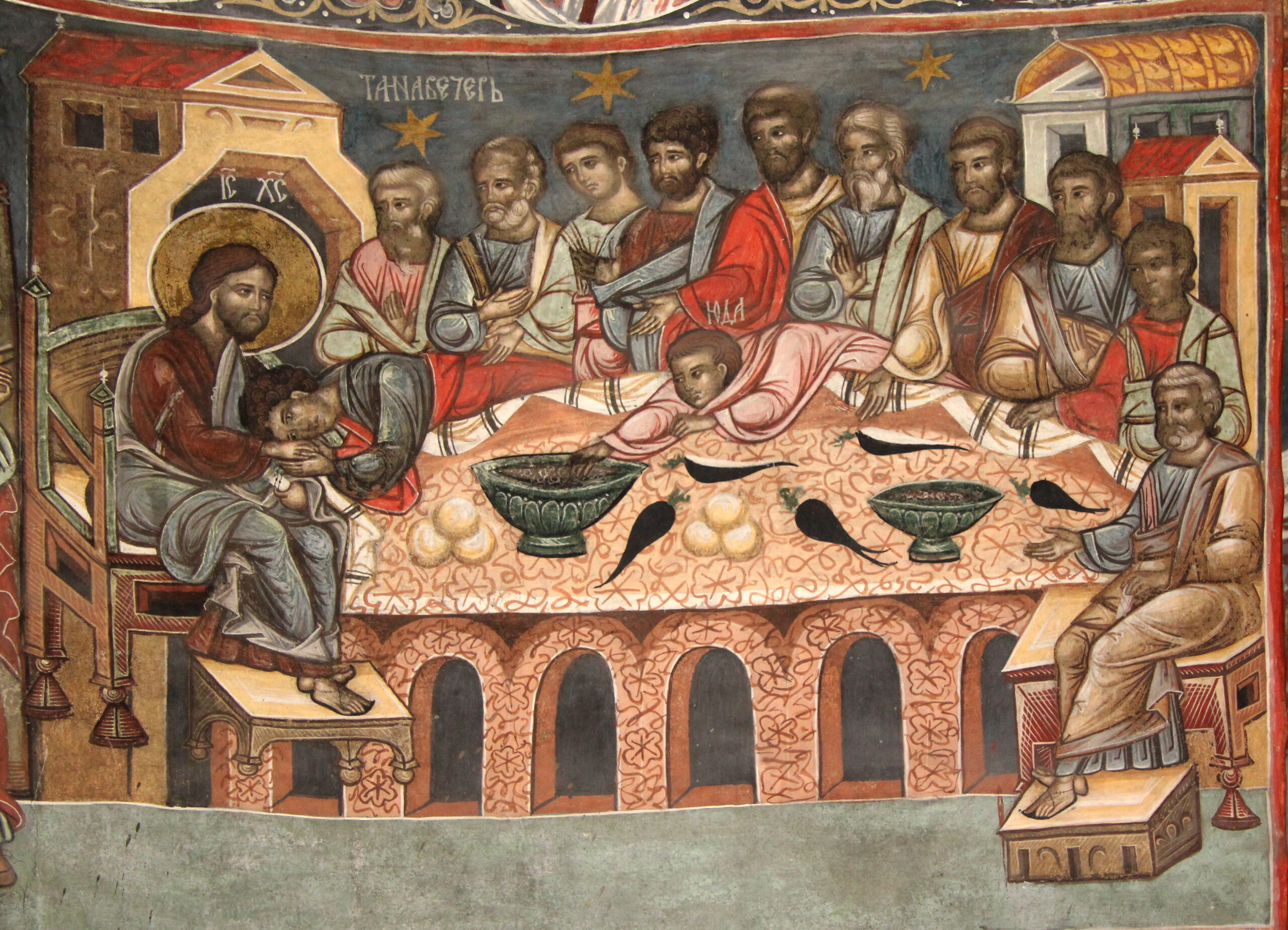
The depiction of the Last Supper is usually placed in the altar apse alongside the scene of the Apostles receiving Communion. The way it is depicted seems to emphasize in particular the moment of the revelation of Judas’s betrayal rather than the institution of the Holy Eucharist, as one might think at first glance. This is evident even from the liturgical texts of the Maundy Thursday service, which emphasize Judas’s betrayal[19]. Added to this is the Gospel of Saint John, which does not speak of the moment of the institution of the Holy Eucharist, but during the washing of the apostles’ feet, announces through the words of Christ the betrayal of Judas, which will take place during this Last Supper. This will be revealed when Christ hands the piece of bread to the betrayer (John 13:26). These words are elaborated upon in the hymns of this day[20] so that they also found an echo in the painter's attention.
In the painting from Humor, Jesus Christ the Savior is seated on the right side of the horseshoe-shaped table (on the left side of the table from the viewer’s perspective) – in dextro-cornu which represents the place of honor. He is the only one depicted with a halo; he sits on a throne, and his feet rest on a pedestal. Both the throne and the pedestal are raised above the ground, thus showing that He is in no way bound to the earth, and that what He offers us—His Body and Blood—detach man from the earth, facilitating their ascent to the Kingdom of the love of the Most Holy Trinity.
The twelve apostles are seated at the table in a semicircle; at the other end of the table sits the Apostle Peter, the chief among them, also seated on a chair with a footstool beneath his feet. Their expressions are solemn; some of them hold their palms in a defensive posture (Mt 26:22: „And they were greatly distressed, and began to say to Him, one by one, ”Surely not I, Lord?’”), thus confirming that the iconographic representation refers specifically to Judas’s betrayal.
Among the apostles, Saint John the Evangelist stands out—the one who rested his head on Jesus’ chest, depicted here in a gesture of deep tenderness: he holds the Savior’s hands in his own, touching the Savior’s face with his own, thus expressing the love he feels for Him—a love he will demonstrate on Golgotha, as he is the only one of the apostles present at the foot of Jesus’ Cross.
In contrast to John, Judas is depicted stretching out in an unnatural position across the table so that he can reach into the dish (Mt 26:23). The depiction shows the deceit with which Judas approaches his master’s table, revealing himself to be ungrateful for the gifts received from Christ: „Let no one be ungrateful for the Lord’s Supper, O believers! Let no one now come to the table with deceit, like Judas. For he, having received the bread, deprived himself of the bread of life, being only in the guise of a disciple, yet a murderer at heart; rejoicing in the presence of the Jews, yet feasting together with the Apostles. With a kiss of hatred, and by kissing, he betrayed the One who redeemed us from the curse, God and the Savior of our souls.”[21]. The love of money, argyrophilia, rules his soul and is portrayed in hymnography as the cause of Christ’s betrayal, and the fact that he approaches the Body and Blood of Christ with deceit places him under the devil’s dominion[22] which will plant in his heart the thought of betraying Christ (John 13:2) and then the despair that will drive him to suicide.
That is why we are called to draw near „with a pure heart, a reverent mind, and a humble spirit”[23] of the „Lord’s feast” and the „immortal meal”[24], where we receive the true Food and Drink with which Christ nourishes the world. Thus we receive the Divine Mysteries „for the enlightenment of the spiritual senses,” „for sanctification, for enlightenment, for strength, for healing, and for the health of soul and body, and for the complete erasure and removal of my evil thoughts, memories, and habits,” „for the purification and sanctification of souls and bodies, and as a pledge of the life and kingdom to come,” „as sustenance for eternal life and for a favorable response at Your dreadful judgment seat.”[25].
From here we move into the nave, where we will journey together with Christ, accompanying Him through these terrible yet at the same time astonishing days that reveal, on the one hand, man’s wickedness and ingratitude, and on the other, love carried to the very end, stronger than death, on the other.
Fr. Felician Vasile Buzilă
Bibliography
***, The Bible or Holy Scripture, Published by the Orthodox Bible and Mission Institute, Bucharest, 2019;
***, Liturgy Book, Published by the Orthodox Bible and Mission Institute, Bucharest, 2012;
***, The Triod, Published by the Orthodox Bible and Mission Institute, Bucharest, 2010;
Bălan, Archimandrite Ioanichie, The Romanian Paterikon, Roman Diocese Publishing House, Roman, 2001;
Balș, Ștefan, Humor Monastery, Meridiane Publishing House, Bucharest, 1965;
Cyril of Jerusalem (St.), The Catecheses, Published by the Orthodox Bible and Mission Institute of the Romanian Orthodox Church, Bucharest, 2003;
Damaschin Dorneanul, Auxiliary Bishop of the Archdiocese of Suceava and Rădăuți, The Mystagogical Dimension of Holy Week. Elements of Spiritual Anthropology, Crimca Publishing House, Suceava, 2022;
Drăguț, Vasile, HUMOR, Meridiane Publishing House, Bucharest, 1973;
Podlacha, Wladyslaw and Nandriș, Grigore, The Humanism of Post-Byzantine Mural Painting, Meridiane Publishing House, Bucharest, 1985;
Sinigalia, Tereza, and Boldura, Ovidiu, Medieval Monuments in Bukovina, ACS Publishing House, Bucharest, 2010;
Ștefănescu, I. D., The Iconography of Byzantine Art and Romanian Feudal Painting, Meridiane Publishing House, Bucharest, 1973.
[1] The text of the inscription, carved in stone and set on the south wall, Ștefan Balș, Humor Monastery, p. 8.
[2] Archimandrite Ioanichie Bălan, The Romanian Paterikon, p. 169.
[3] According to Archdeacon Ioan I. Ică Jr., this is the traditional division of Holy Week, as described by Damaschin Dorneanul, Vicar Bishop of the Archdiocese of Suceava and Rădăuți, The Mystagogical Dimension of Holy Week. p. 13, However, according to Bishop Damanschin Dorneanul, more recent divisions treat Maundy Thursday as a day in its own right, marking the transition to the Easter Triduum, as stated by Damanschin Dorneanul, Vicar Bishop of the Archdiocese of Suceava and Rădăuți, The Mystagogical Dimension of Holy Week. p. 489, note 1934.
[4] Wladyslaw Podlacha and Grigore Nandriș, The Humanism of Post-Byzantine Mural Painting, p. 136.
[5] The typical portrayal in Moldova at that time, according to Vasile Draguț, Humor, p. 11.
[6] The Triod, p. 598.
[7] Damaschin Dorneanul, Auxiliary Bishop of the Archdiocese of Suceava and Rădăuți, The Mystagogical Dimension of Holy Week. p. 448.
[8] The Triod, Sedealnă, vol. 1, Matins of Holy and Great Thursday (Wednesday Evening Denia), p. 585.
[9] The Triod, Stichera, Gl. 1, The Order of the Holy and Divine Washing of the Feet on Holy Thursday, p. 599.
[10] Liturgy Book, The Pulpit Prayer, p. 198.
[11] The Triod, Stichera, vol. 2, p. 599
[12] I. D. Ștefănescu, The Iconography of Byzantine Art and Romanian Feudal Painting, p. 71.
[13] Liturgy Book, The Order of Communion for Clergy, pp. 187–190.
[14] St. Cyril of Jerusalem, The Fifth Mystagogical Catechesis: On Spiritual Building, v. 21–22, p. 366.
[15] Liturgy Book, The Cherubic Hymn, p. 159.
[16] The presence of the angel with wings has been known since the 11th century and also stems from church practice.
[17] Liturgy Book, p. 194.
[18] Wladyslaw Podlacha and Grigore Nandriș, The Humanism of Post-Byzantine Mural Painting, p. 217.
[19] According to Wladyslaw Podlacha and Grigore Nandriș, The Humanism of Post-Byzantine Mural Painting, p. 188: Among the Copts, the distinctive custom of cursing Judas has been preserved during the reading of the account of the Savior’s final moments.
[20] „The hands with which you took the bread of immortality, you stretched out to take silver; you brought your mouth deceitfully to kiss, with which you received the Body and Blood of Christ; but, woe to you, as Christ says.” Triodion, Small Vespers of Holy Thursday, Ode 9, Troparion 8.
[21] The Triod, Matins for Holy and Great Thursday, Stihoavna, pp. 591–592.
[22] “And after he took a bite, Satan entered him””, At 13:27
[23] Liturgy Book, Prayers Before Holy Communion, Seventh Prayer, p. 360.
[24] The Triod, Matins on Holy and Great Thursday, Ode 9, Irmos, p. 590.
[25] Liturgy Book, Prayers Before Holy Communion, pp. 348–366.
