
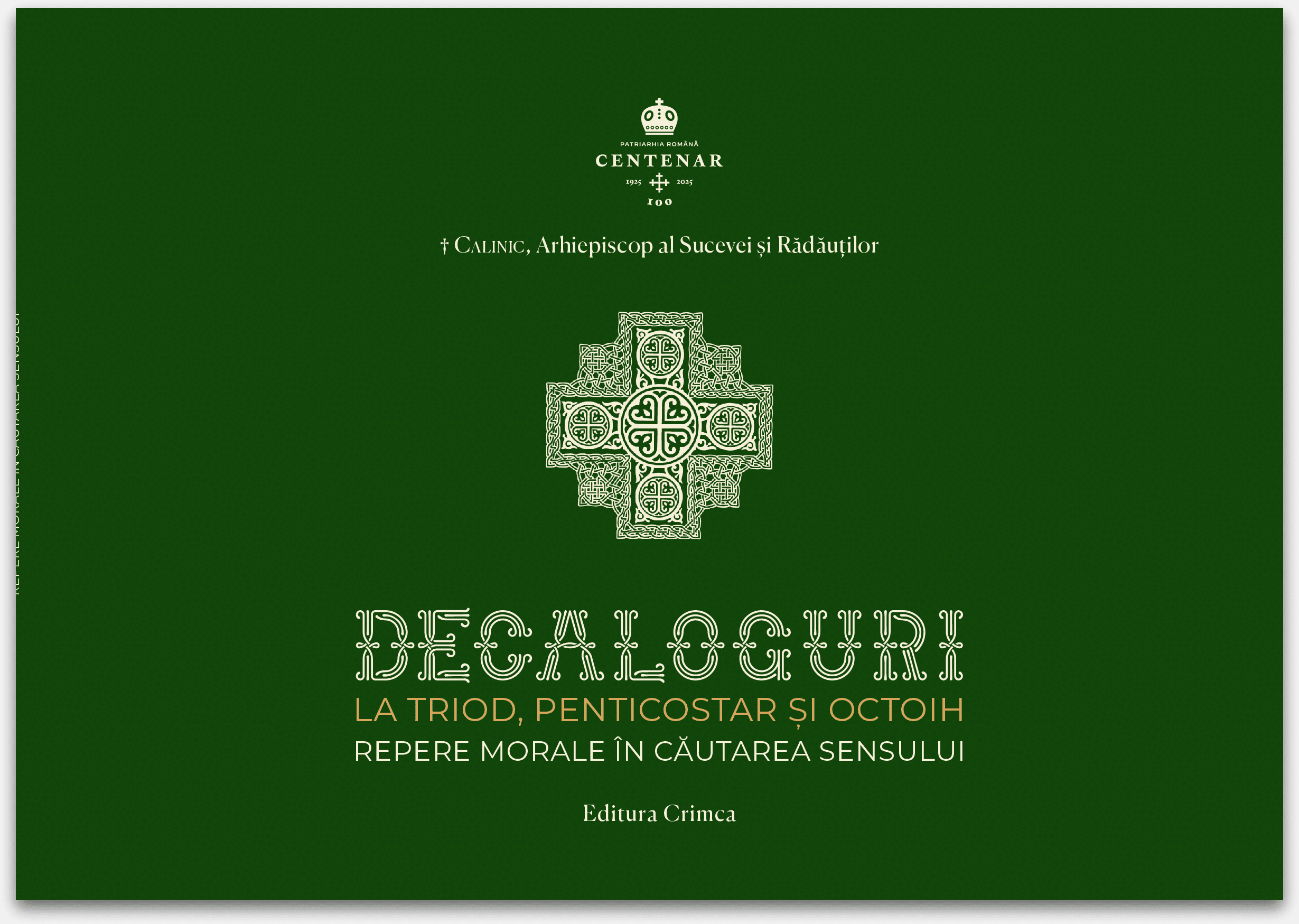
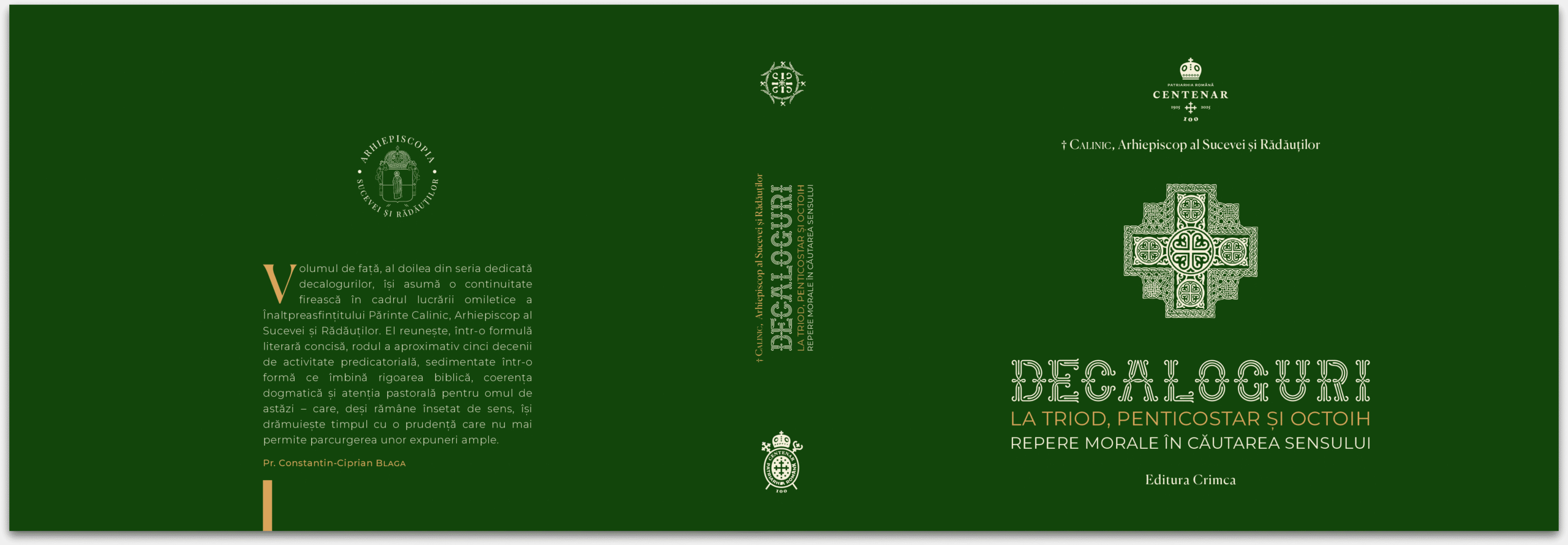
Author: Archbishop Calinic of Suceava and Rădăuți
Format: 210×150
Number of pages: 312
Year of publication: 2025
Cover type: Paperback
ISBN: 978-606-734-284-0
51,00 lei
Decalogues at the Triod, Pentecost and Octoih: Moral landmarks in search of meaning His All-Holiness Calinic, Archbishop of Suceva and Rădăuților
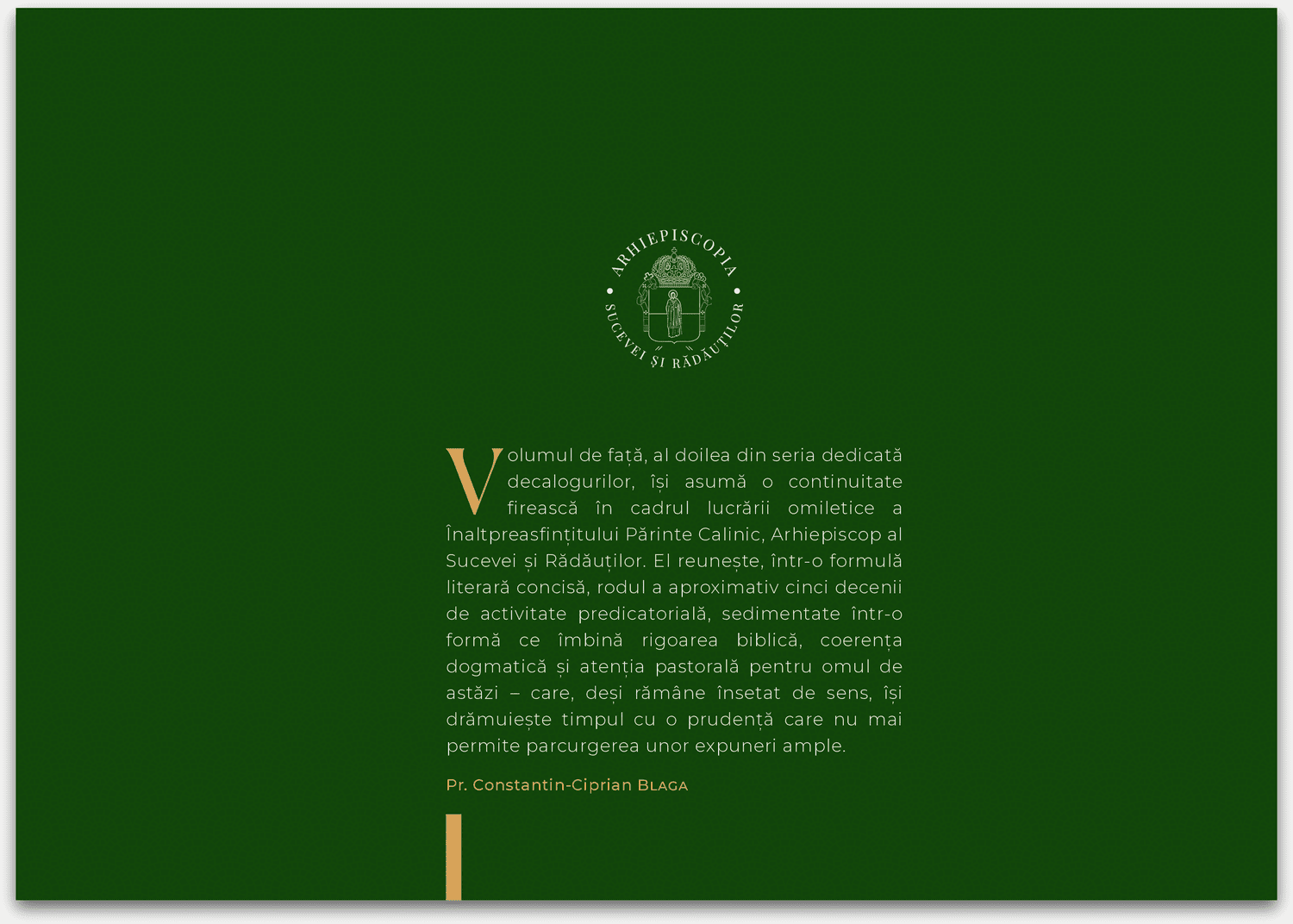
This work, the second in the series dedicated to the Decalogues, reveals itself to us as a mature project, with a well-thought-out architecture, in which the pastoral experience of over five decades is distilled into a concise, memorable and, at the same time, theologically profound formula.
The structure of the book faithfully follows the rhythm of the Church year, dividing the material in direct proportion to the three great liturgical cycles: the Triod, Pentecost and Eight Days. This structural choice is not purely organizational in nature, but expresses the fundamental theological conviction that Christian life is shaped by a pedagogy of sacred time.
The choice of the form of the decalogue refers, in an assumed way, to the fundamental structure of the Old Testament revelation, but it is reinterpreted in a homiletical and pastoral key. In the pages of this volume, the decalogue becomes a form of discursive asceticism: each sentence is weighed, concentrated, free of unnecessary ornament. We do not find prolix explanations or excessive theoretical developments, but formulations that invite personal meditation. This brevity does not simplify the message, but makes it more demanding, urging the reader to revisit the text. It is significant that the decalogues are almost invariably formulated in the imperative. This stylistic choice gives the text a constant inner tension and reminds us that the sermon, even when it is set down on the page, remains an act of calling and awakening the conscience.
An element of methodological originality is the insertion of the Gospel text after the first five imperatives of each decalogue. This reversal of the usual order produces a subtle but profound mystagogical effect. The reader does not come into direct contact with the Gospel pericope, but is prepared, oriented, „taught to listen”. The Decalogue thus functions as a hermeneutic porch, a transitional space between daily life and the sacred text. In this way, the scriptural text no longer appears as an external text, but as a word addressed to a familiar heart. This method takes up, in an adapted form, the logic of catechumenate practice, where access to the mystery was preceded by preparation and purification.
Another element of methodological originality is the use of metaphor as a condensed form of theology. The metaphors used are functional, constructed to carry dogmatic meaning and liturgical experience. Images such as „the key of humble prayer”, „the heaven of the heart”, „the tree of life”, „the garment woven of grace and light” or „the Tabor of the soul” are poetic translations of precise theological realities: repentance as openness, the cross as the central axis of salvation, light as uncreated energy, the restoration of man as ecclesial reintegration. Metaphor becomes, in this context, a form of accessible mystagogy: it leads the mind from image to reality, from the sensible to the spiritual, without vulgarizing the content of faith.
Also among the novel aspects of the volume is the association of each section with miniature iconographic representations from the Slavonic Tetraevangelium Sucevița 24, illustrated with 346 miniatures, realized at the Sucevița Monastery after 1595, at the request of the voivode Jeremiah Movilă, an option that gives the text an additional depth and places it in dialog with the visual tradition of the Church. The miniature precedes the decalogue and the Gospel pericope, anticipating their message in a symbolic language that capitalizes on the liturgical and theological memory of the ecclesial community. Through this careful integration, the reading takes on a synoptic character, in which the spoken word, the written word and the iconographic image support each other, inviting the reader to a progressive interiorization of meaning. In addition, the presence of the miniatures activates a pedagogy of the gaze, which complements the pedagogy of the word, offering a reading experience that brings together the intellectual and contemplative dimensions and fixes the Gospel message in a memorable and coherent form.

Author: Priest Alexandru Lungu
Format: 119 X 112
Number of pages: 505
Year of publication: 2025
Cover type: Paperback
ISBN: 978-606-724-267-6
45,00 lei
Author: Archbishop Calinic of Suceava and Rădăuți
Format: 190 X 110
Number of pages: 84
Year of publication: 2021
Cover type: Paperback
ISBN: 978-606-734-137-9
12,00 lei
Format: 165 X 240
Number of pages: 782
Year of publication: 2025
Cover type: hardback
Cant: printed
115,00 lei
We use cookies to ensure you have the best experience on our website. By continuing to browse the site, you consent to their use in accordance with our policy.