
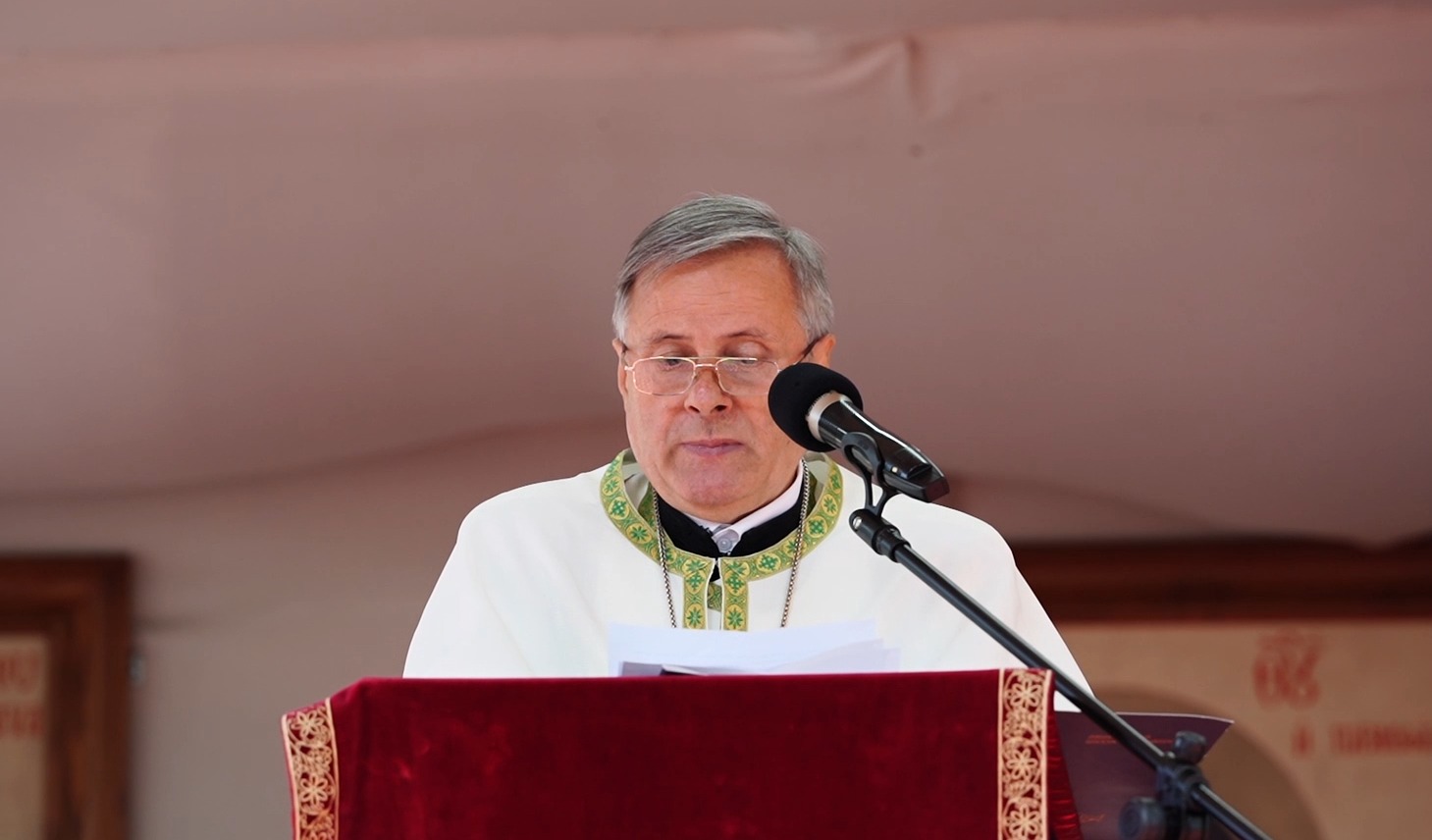
„Whoever confesses Me before others, I will also confess him before My Father, who is in heaven. But whoever denies Me before men, I will also deny him before My Father, who is in heaven. Whoever loves father or mother more than Me is not worthy of Me; whoever loves son or daughter more than Me is not worthy of Me. And whoever does not take up his cross and follow Me is not worthy of Me. Then Peter answered and said to Him, “Behold, we have left everything and followed You. What then will there be for us?” And Jesus said to them, “Truly I say to you, you who have followed Me, at the renewal of the world, when the Son of Man sits on the throne of His glory, you also will sit on twelve thrones, judging the twelve tribes of Israel. And everyone who has left houses or brothers or sisters or father or mother or wife or children or fields for My name’s sake will receive a hundredfold in return and will inherit eternal life. And many who are first will be last, and the last will be first.”.
(Matthew 10, 32-33; 37-38; 19, 27-30).
In the name of the Father, and of the Son, and of the Holy Spirit, Amen.
Your Eminence, Most Reverend and Most Reverend, Most Reverend Fathers and
Beloved brothers and sisters in the faith,
Today, our Holy Church celebrates, with great spiritual joy, all the saints from every place and every age, known and unknown, learned and uneducated, rich and poor, living in the world or in hermitages, of all walks of life and ages, the virtuous and former sinners. That is why this Sunday is called „All Saints” Sunday.”.
They attained holiness because they cooperated with the grace of the Holy Spirit and responded to God’s election and calling to be holy (Matthew 5, 48; Ephesians 2, 5-10; 1 Peter 1:16; ), following the historical event of Pentecost, when the Church was founded.
The saints are living testimonies and fruits of the descent of the Holy Spirit into the Church of Christ, and the result of the fulfillment of Jesus Christ’s prayer to the Father before His Passion: „Sanctify them in Your truth! Your Word is the Truth” (John 17, 17). Holiness is achieved only in Truth, therefore, The Truth It is an essential condition for salvation and holiness, because The Truth It is not something, but Someone, and that Someone is Christ.
Holiness is the priority in Truth, which can also bring about the unity of faith, this being a charism of the Holy Spirit and not an exclusively human work.
The Church of Christ cannot be kept alive without Truth. Some contemporary ecumenists, „for the sake of Christian unity” at any cost, desire a union that is merely social and diplomatic in nature—that is, a syncretistic, “melting pot” type of Church.
Where is it? The Truth, there is also the One, Holy, Catholic, and Apostolic Church of Jesus Christ, that is, the Universal Church, also known as the Ecumenical Church.
Beloved brothers and sisters in the faith,
In the biblical context of today’s Gospel reading, Saint Matthew the Apostle tells us that Jesus Christ sent the Twelve Apostles out to preach, after He had gives power over unclean spirits and the power to heal every disease and every infirmity, and then offers them pastoral and missionary advice „of undeniable beauty”[1], assures them that God cares for them when he tells them that even the hairs on one's head—every single one is counted, which is why not to be afraid to confess Christ, with all their courage (Matthew 10, 1-31).
In this regard, despite God’s direct and special care for them, He draws their attention to the persecutions and imminent dangers to which they will be exposed because of the Name of Jesus Christ. In other words, He tells them to rely also on their own discernment, wisdom, and pastoral tact when He says to them, „Be wise as serpents and innocent as doves” (Matthew 10, 16); „When they pursue you in one city, flee to another” (Matthew 10, 23), etc. Thus, the Savior respects their freedom of action and prepares them through insight to act appropriately.
Then He assures them that it is worth facing dangers and persecution, since their courage will be rewarded with eternal life, for „whoever confesses Me before men, I will also confess him before My Father, Who is in heaven. But whoever denies Me before men, I also will deny him before My Father, who is in heaven. Whoever loves a father or a mother more than Me is not worthy of Me; whoever loves a son or a daughter more than Me is not worthy of Me. And whoever does not take up his cross and follow Me is not worthy of Me.” (Matthew 10, 32-33; 37-38).
With these words, Christ the Savior highlights important aspects of the benefits of mutual confession: to the extent that You confess me before others, in the same way, I too will testify about you before My Father, who is in heaven. The same applies whether you deny Me or do not deny Me. From this we can deduce the conditions of holiness, namely:
- Confessing Jesus Christ before others and not denying Him, as a reciprocal condition for our being confessed and for Christ not denying us, in the face of the Father in heaven, both during our earthly life and at the time of our judgment, whether particular or universal;
- Total devotion to the Person of Jesus and the primacy of His love over our family members, which bestows a special worthiness before Christ and a complete service rendered to the Savior. The love of Christ, with our whole being, cannot be replaced by any other love;
- Taking up one's personal cross, every day (Luke 9, 23), with the joys and sorrows of life and the faithful following of Jesus Christ, who is The Light of the World and the Light of Our Lives (John 8, 12)[2].
In this context, let us ask ourselves a question: how many of us here today can meet these conditions set by the Savior?!
All three of these conditions must be met with „full knowledge of the Truth of the One who is to be duly honored” (Title 1, 1), that is, the true faith lived out in a practical, empirical, Christological, pneumatological, Trinitarian, and doxological manner. In other words, Orthodoxy lived out in its entirety the fullness of the Holy Spirit, in the Church of His Glory, since in Outside the Church, there is neither holiness nor salvation.
Upon hearing these words from Jesus, „Peter replied, ”We have left everything and followed You. What then will there be for us?’ And Jesus said to them: ‘Truly I tell you, you who have followed Me, at the renewal of the world, when the Son of Man sits on the throne of His glory, you also will sit on twelve thrones, judging the twelve tribes of Israel. And everyone who has left houses or brothers or sisters or father or mother or wife or children or fields for My name’s sake will receive a hundredfold in return and will inherit eternal life” (Matthew 19, 27-29).
Therefore, whatever little we give up, we will receive a hundredfold in return, and we will attain eternal life, which we will enjoy forever, in the dignity of being „fellow citizens with the saints and members of God’s household” (Ephesians 2, 19).
However, our Savior Jesus Christ makes an extremely important point when He sends the Apostles on their trial mission: that they will receive these honors and be rewarded „royally” if, they strive consistently and courageously and „endure to the end” (Matthew 10, 22); and that „through your patience you will save your souls” (Luke 21, 19).
Otherwise, „many who are first will be last, and those who are last will be first” (Matthew 19, 30).
So, in the most pragmatic sense, everything depends exclusively on man’s relationship to earthly things, in relation to heavenly things!
Beloved brothers and sisters in the faith,
The courageous confession of the Truth—which involves great risks—integrity, dignity, a clear conscience, giving priority to spiritual matters over material ones, and sincerity are paths to holiness. This is where we must see, seek out, and recognize the true saints, and follow the example of their self-sacrificing lives!
To support this work of witness and holiness, the Comforter is sent by the Son from the Father, from whom He proceeds and bears witness to the Son (John 15, 26), to guide the Saints into all truth; He takes what belongs to the Son and teaches them all things, and He will remind them of everything that Jesus Christ spoke to the Apostles (John 14, 26; 16, 13-15)[3].
Thus, from the moment of the descent of the Holy Spirit, Christians celebrate and benefit from the gifts received at Pentecost; they continually receive „grace upon grace” (John 1, 16) with every feast in which they participate and are sanctified „in the Truth” through the Holy Mysteries of the Church.
There are no saints without the work of the Holy Spirit in Truth and in The True Faith, just as there is no true Holy Eucharist—also called „the Lord’s Supper”— without the work of the Holy Spirit, upon whom the Divine Liturgy itself depends—that is, the Eucharistic Christ, through whom we receive the forgiveness of sins, holiness, and the pledge of our resurrection (John 6, 54).
Thus, non-Orthodox Christians who have abandoned the Epiclesis—that is, the invocation of the Holy Spirit—when the priest pronounces the words over the Eucharistic elements, namely the bread and wine: „transforming them by Your Holy Spirit,” are in fact renouncing holiness, since they say only the words of institution of the Holy Eucharist, spoken by the Savior: „Take, eat […] and drink from this, all of you […].”.
In this case, heretics consume only plain bread and perhaps a sip of wine; they commit blasphemy rather than celebrating the Holy Liturgy or the Lord’s Supper, and they are in grave error regarding the Truth. They do not become holy, but are possessed by demons! May God protect us forever from this kind of people and from those who consider themselves „the holiest of the holy,” without possessing any holiness!
Beloved brothers and sisters in the faith,
When we use the phrase „the Holy Fathers,” we must regard them as if they were one, because they are inspired by the same Holy Spirit, whom we also call „the Spirit of Truth.”.
The Holy Spirit shapes them in such a way that they understand one another with a single glance, in unanimous agreement regarding the interpretation of Holy Scripture and The True Faith. Why? Because The Holy Spirit unites them in the bond of peace (Ephesians 4, 3), inspires them, enlightens them, and gives them the quality of spiritual people, who judge (analyze—evaluate—ἀνακρίνει) everything, because I receive the mind (νου(c) of Christ (1 Corinthians 1, 17 – 2, 15-16)[4], which prevents them from remaining indifferent or silent when they see injustice and lies around them.
The Holy Fathers, as intercessors before the Heavenly Throne, were people of character at all levels of their respective societies, and through them we receive and The True Faith, through which we are sanctified in the Truth of the Word of God. That is why, originally, this Sunday, known as „All Saints” Sunday,” was dedicated solely to the Holy Fathers of the Ecumenical Councils, as we find in some ancient liturgical books and in the Lives of the Saints[5], „because the Christian faith, as they have defined and articulated it, is the foundation of our entire life in Christ”[6].
Later, their veneration spread to All Saints' Day, from all times and all places, as I mentioned at the beginning, which also includes Romanian Saints, whom we honor as a community today, and especially next Sunday, without separating ourselves from All Saints' Day other nations, but only to „bring honor and glory to our nation” (Revelation 21, 26), before God, as an offering pleasing to Him and as evidence of the Holy Spirit’s work in our geographical and historical context.
So, The qualities of the soul—the characteristics of the human person—are not dissolved in the work of divine grace, but quite the opposite; the work of sanctifying grace is shaped according to each person’s aptitudes and faculties, without the dogmas being changed; they remain uniform and unchanging.
Thus, ”the entire fabric of spiritual life—which varies from person to person and from nation to nation, depending on historical and geographical circumstances, yet is imbued with and shaped by the same divine grace and the same Christian teachings—becomes Christian; and so, obviously, each nation represents Christianity realized in a different way.”[7], says the Holy Father, Confessor, and great theologian Dumitru Stăniloae. „That is why Orthodoxy is compatible with the nationality of every people that has embraced it, and in our case, with the Romanian nation.”[8], which has produced so many saints for the kingdom of God.
So, on this Sunday dedicated to All Saints' Day We honor the saints of all nations in a communion of love, since the nations are created and willed by God, which brings together different peoples, but under one sky.
The opposite of this divine model is the ideology of globalization, which annihilates nations within a Babylonian concept; it represents the antichrist model described in chapters 18–20 of Revelation, and it will be destroyed at the Last Judgment.
The saints of the Orthodox peoples amply represent „the image of God’s incomparable holiness, showing us that God’s holiness does not remain outside us, but penetrates us, ‘bearing forth saints’” […], that is (n.m.), ”In every saint dwells the Lord Christ, through His divinity and humanity, which are holy and sanctifying and a source of grace."[9].
In other words, God—glorified in the Father, the Son, and the Holy Spirit—does not look upon us merely „from above,” but also from within us (Luke 17:21), where He established His „trinity,” since Jesus Christ, our Savior, comes together with the Father, and through the power of the Holy Spirit, they make their home within us (John 14:23), and thus we become „temples of the Holy Spirit, since the Spirit of God dwells in us” (1 Corinthians 3:17).
St. Paul the Apostle tells us, in this regard, that each of us, who have set our minds on things above […] and have died, our life is hidden with Christ in God (Colossians 3, 2–3) and thus we are sanctified and deified through our fellowship with Christ, if „we have put to death our earthly members” (that is, our passions— Colossians 3, 5), since „in Christ dwells all the fullness of the Godhead bodily” (Colossians 2, 9).
From the experience of grace and the history of human salvation, we know that every saint has a sinful past and every sinner can have a holy future through: the overcoming of passions, enlightenment, and deification.
The Holy Apostle Paul urges us: „Let us lay aside every weight and the sin that so easily entangles us, and let us run with perseverance the race that lies before us” (Hebrews 12, 1), enduring both the hatred of people and the persecution of our persecutors on our path to holiness, encouraged by the words of the Savior: „If the world hates you, know that it hated Me before it hated you. If you were of the world, the world would love what is its own; but because you are not of the world, but I have chosen you out of the world, therefore the world hates you” (John 15, 18–19); „No servant is greater than his master. ”If they persecuted Me, they will also persecute you; if they kept My word, they will also keep yours. And all these things they will do to you for My name’s sake, because they do not know the One who sent Me” (John 15, 20-21).
Beloved brothers and sisters in the faith,
In closing, a few spiritual reflections: Holy Scripture teaches us that the prayers of the saints, as well as our own, are symbolized by „golden bowls filled with incense” Revelation (5, 8). And to the angel of the Lord, „who had a golden censer, was given much incense to offer, together with the prayers of all the saints, on the golden altar before the throne of God” (Revelation 8, 3-4).
The Holy Apostle Paul exhorts us with a father’s love when he says: „Remember your leaders, who spoke the word of God to you; consider carefully how they finished their lives, and follow their faith” (Hebrews 13, 7), actually tells us to examine the life and work of All Saints' Day for our benefit, as role models we can look up to regarding their patience (Revelation 13, 10; 14, 12) and for their spilled blood for their faith in Jesus (Revelation 16, 6; 17, 6; 18, 24).
Sunday All Saints' Day It is liturgically represented, in a practical sense, every time the Holy Proskomedia is performed. The priest takes a small, triangular piece in honor of the Mother of God—the Holy All Saints' Day, and placed her to the right of Saint Agneț—the Eucharistic Lamb, that is, next to Jesus Christ, The Saint Above All Saints, then mentions the nine choirs of saints and all the heavenly powers.
Thus, the Proscomidia liturgically recapitulates and summarizes „the prayers of the Most Holy Mother of God and of all the saints who have been pleasing to God from time immemorial.”[10], as it is pronounced in The Prayer of the Most Holy Hymn.
After the consecration of the gifts, the priest raises the Holy Body and makes the sign of the Holy Cross over the Holy Disk, as a sign that the saints commemorated have taken up their Cross and followed Christ, and says: „Let us remember, the Holy of Holies!” Then he places them all in the Holy Chalice. Now, the Holy Blood of Christ encompasses all the saints and is offered to those present in the form of Bread and Wine.
Here is the most evocative liturgical image of today’s feast, which spiritually reflects how God rests in all His saints, and how they are honored by our Savior Jesus Christ!
Therefore, „let us work at our sanctification with fear and trembling” (Philippians 2, 12) and let us pray fervently to the Most Holy Mother of God and Ever-Virgin Mary, as well as All Saints' Day, so that they may intercede with the Good Lord for the salvation of our souls, to the glory of the Holy Trinity: the Father, the Son, and the Holy Spirit! Amen.
June 15, 2025
Rev. Prof. Dr. Associate Professor Mihai VALICĂ
[1] † CALINIC BOTOȘĂNEANUL, The Word Trilogy. Sermons for Sundays Throughout the Year, Ed. Crimca, Suceava, 2022, p. 62.
[2] Rev. Prof. Stelian TOFANĂ, Ph.D., The Gospel of Jesus. The Mission of the Word, 2nd revised edition, Mega Publishing, Cluj-Napoca, 2018, p. 92.
[3] Rev. Dr. Constantin COMAN, The Hermeneutics of the Spirit, Bizantină Publishing, Bucharest, 2002, pp. 42–43.
[4] Rev. Dr. Constantin COMAN, „The Spirit of God and the Spiritual Man,” in: The Hermeneutics of the Spirit, Bizantină Publishing, Bucharest, 2002, pp. 80–81.
[5] The Lives of the Saints, vol. 4, Published by the Diocese of Roman and Huși, Roman, 1993, p. 170.
[6] Father PLACIDE DESEILLE, The Blessed Crown of the Christian Year: Sermons for the Sundays and Feasts of the Liturgical Year, Doxologia Publishing, Iași, 2015, p. 503.
[7] Dumitru STĂNILOAE, Orthodoxy and Romanian Identity, Vol. VIII, Published by the Basilica of the Romanian Patriarchate, Bucharest, 2014, p. 33.
[8] Rev. Dr. Marius MAGHERCA, in: https://www.arhiepiscopiasucevei.ro/nationalism-si-natiune-la-sfantul-preot-marturisitor-dumitru-staniloae/, accessed on March 3, 2025.
[9] David Hugh FARMER, Prof. Remus RUS, Ph.D., Oxford. Dictionary of Saints, trans. by Mihai C. Udma and Elena Burlacu, Univers Enciclopedic, Bucharest, 1999, p. 6.
[10] Liturgy Book, Published by IBMBOR, Bucharest, 2000, pp. 134–135.
