
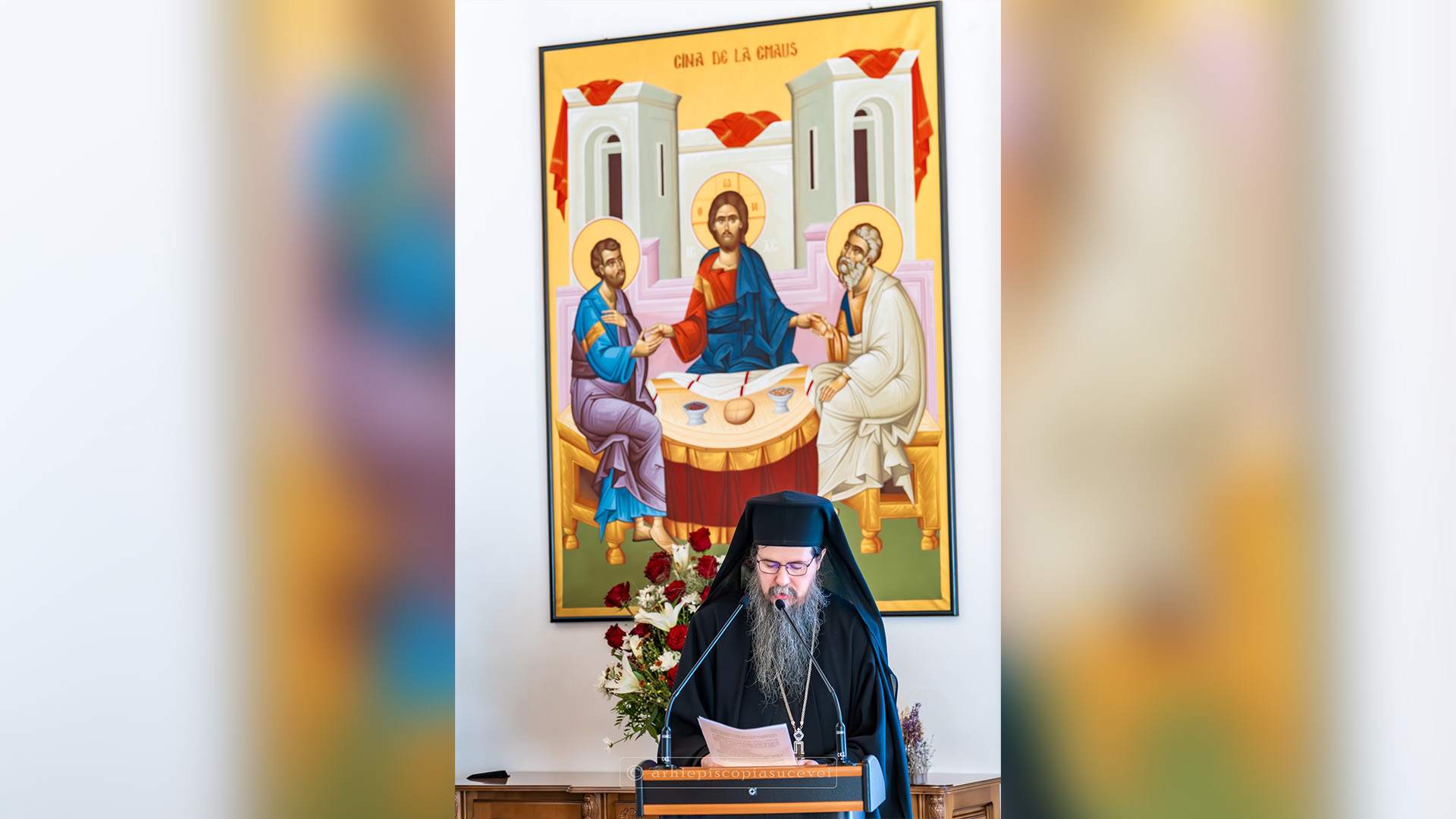
Born on October 26, 1624, to Leontari and Misira, with roots in Transylvania, he became a monk at Probota Monastery, was appointed Bishop of Huși in 1658, then Bishop of Roman in 1660, and from 1671 Metropolitan of Moldavia until 1686, with one interruption—he was detained in Poland from 1686 to 1693—Saint Metropolitan Dosoftei was a man of God, sometimes ahead of his time from a human perspective, who worked with humility, skill, and dedication in the service of God in Moldavia, among the Romanian people, and also, in terms of dogmatic teaching, within the Universal Church.
The International Situation
Given his high ecclesiastical position and his constant contact with the political elite of Moldova, as well as that of neighboring countries, in order to understand his thinking and actions, we must first briefly outline what was happening in this part of Europe during the second half of the 17th century.
The Ottoman Empire, which ruled Wallachia and Moldavia with an iron fist, rapidly replacing their rulers, was at the height of its expansion in Europe. In 1683, the Turks reached Vienna and, after a two-month siege, were defeated thanks to the direct efforts of the Polish King Jan III Sobieski, as well as the lack of fighting spirit among the Romanian army units at their disposal. The consequence of this defeat was that, after 300 years of decline, the Holy Roman Empire, led by the Habsburgs, took the initiative in the struggle for territory against the Ottoman Empire.
At the beginning of the following century, the Turks would place rulers from the Phanar on the thrones of Moldavia and Wallachia, as a sign of their lack of trust and their desire to dominate the two principalities, and they would become the direct rulers of the fortress of Hotin between 1711 and 1812.
In Western Europe, the Reformation had given rise to Protestant denominations, and the Counter-Reformation was attempting to regain ground, including by expanding Catholicism eastward through the Union.
Contribution to the Development of the Romanian Language
Saint Metropolitan Dosoftei is known in Romanian culture and civilization for his contribution to the development of the Romanian language. In particular, regarding his place in Romanian poetry—and, by extension, in the historical process of the formation of the literary Romanian language—the most apt characterization comes from Professor Eugen Munteanu, who considers him „the first and greatest Romanian poet before Eminescu.”[1].
The immediate impact on popular culture and language was brought about by the publication of his first printed work, The Psalter in Verse[2], in 1673. Like his other books, this one circulated throughout the Romanian-speaking world and, moreover, had a profound influence on folk art—star songs and carols, with pagan roots, incorporated many fragments of psalms. In his *Psalter in Verse*, he drew upon the vernacular, but, like any writer, he refined and enriched it[3].
The Introduction of the Romanian Language into Religious Practice
The use of the Romanian language in religious services, as natural as it seems to us today, was just as difficult to achieve in the past, for two reasons.
The first is that the transition from the so-called sacred languages—Greek, Latin, and Slavonic—to the national languages was a process that, even today, remains unfinished in some Orthodox Churches.
It is true that Saint Dosoftei was not the first to print religious books in Romanian, neither in Moldova —that honor belongs to St. Metropolitan Varlaam—nor, more generally, in the Romanian-speaking world—that distinction belongs to Deacon Coresi, who did so 100 years earlier. However, the works of Deacon Coresi and St. Metropolitan Varlaam had not become the standard, and they could have remained mere beginnings—uncontinued or with a continuation postponed for centuries.
Updating the language was also a difficult task in other Churches. When Patriarch Nikon (1652–1658) in Russia oversaw and carried out the revision of the Slavonic liturgical texts based on the Greek texts, the schism of the Rascolniks ensued. In the Greek Church, the hieromonk Maxim Kalliopolites was the first to translate the New Testament into Modern Greek in 1638; his work was condemned by three Greek Synods, and a version printed in 1703 was burned.[4].
Furthermore, the transition to the Romanian language was carried out and promoted by the Protestant denominations, and it was easy for those who supported the transition to associate themselves with them. In 1544, a book had been printed in Sibiu The Romanian Catechism Lutheran – the first book printed in Romanian[5]. Deacon Coresi had printed religious texts and liturgical services in Romanian, some strictly Orthodox, others (The Catechism, The Liturgy Book, The Gospel with Teachings, Prayer Book) at the initiative of some Protestant clergy or those with strong Protestant influences.
From The Liturgy Book printed by Deacon Coresi in 1570; it took 109 years before Saint Dosoftei printed The Divine Liturgy[6], in 1679 (a second, expanded edition followed in 1683). Coresi’s Liturgy Book contained only the Liturgy of St. John Chrysostom; now St. Dosoftei prints all three and adds several prayers[7]. In the book's full title, he states his goal: The Divine Liturgy, now printed for the first time in Romanian, with great dedication, so that all may understand God’s salvation in its entirety.
It was circulated throughout the Romanian-speaking world and was the first Liturgy Book printed in Romanian and endorsed by an Orthodox hierarch.
In the first edition, in the preface, he quotes the response of Theodore Balsamon, Patriarch of Antioch, to the question posed by Mark, Patriarch of Alexandria, regarding the mandatory use of the Greek language: „Therefore, those who are truly Orthodox, even if they are completely unfamiliar with the Greek language, should celebrate the Holy Liturgy in their own language.”.
The significance of these two editions was heightened by the fact that St. Antim Ivireanul, Metropolitan of Wallachia, made corrections and printed two editions, in 1708 and 1713, which have remained the basis for the Liturgy books to this day.
It was just as difficult with the other classic books. After the first printed translation of Psalms The first translation into Romanian was done by Deacon Coresi in 1570; the second edition was printed in 1651 under the supervision of St. Metropolitan Simion Ștefan, with the translation carried out by a group of scholars in his circle; In 1680, St. Dosoftei published his own translation, The Psalter Explained[8]. In the preface, he writes: „”What good are the locked garden and the sealed fountain, both of them?„ he then quotes Saint Paul the Apostle: ”I would rather speak five words with my mind, so that I may teach others, than ten thousand words in another language,„ and further adds: ”For this reason […] to the best of our ability to understand, we have endeavored to translate this holy book, the Psalter, into Romanian.”.
It was used by the compilers of the 1688 Bucharest Bible.
From The Prayer Book First printed by Deacon Coresi, who, although he bore that title, was not strictly speaking an Orthodox prayer book; nevertheless, more than a hundred years later, a second edition in Romanian was published by St. Dosoftei – A Prayer Book for the Understood[9], 1681. His text was also used by St. Antim of Ivire and contributed to the standard text of the Molitfelnic that is still in use today[10].
Throughout his entire body of work that he managed to publish—in addition to the works mentioned above The Lives and Feasts of the Saints[11], 1682-1686, Annual premiums[12], 1683 (which also contain elements from the Triodion, the Pentecostarion, and the Minei), and part of the Octoechos (about which we do not know whether it was published or not); in effect, St. Dosoftei made it possible to conduct the entire divine service in Romanian.
The weight I mentioned led him to justify his approach in every publication. For example, at the end of To the Prime Minister From the 2505 manuscript at Putna Monastery, he includes a text in Greek stating that „that it is not permissible to stop celebrating the Liturgy in Romanian”.
It should be noted that St. Varlaam, who enjoyed the support of Vasile Lupu, had printed in 1643 Romanian Textbook, which contained sermons but no sacred text. Of course, it had been an important and necessary step, but it needed to be taken further.
Perhaps the most eloquent argument for the difficulty he took on is a remark by Metropolitan Theodosius of Wallachia, who published a Liturgy Book Slavonic; he translated the typikon into Romanian and wrote, „I neither wanted nor dared to translate the entire Liturgy into our language or to alter it.”[13].
St. Dosoftei’s motivation and plan were clear: the entire church service should be understood by the faithful, because this would be of spiritual benefit to them. Such was the emphasis on people’s understanding of the services that two of his books include the phrase „for understanding” in their titles—the Psalter in Prose and the Prayer Book: The Psalter Explained, A Prayer Book for the Understood.
Since the translation was intended to benefit people, it was absolutely essential that the content be preserved without alteration. The quote from Patriarch Theodore Balsamon also mentions fidelity to the original: „having identical copies of the customary holy prayers, such as those translated from well-compiled anthologies using Greek texts.”.
Some of the words introduced into the language through translation have remained. From him we have the following terms in Romanian: being, non-being, nature, existence, procession, hypostasis, hypostases, creature, figure, form, presidency. Others have not survived; in an attempt to illustrate the hypostatic properties of the Persons of the Holy Trinity, he coined the phrase „al săului său.”[14]: „Just as the Father has his own way of begetting the Son and sending forth the Holy Spirit, and just as the Son is born of the Father, so too does the Holy Spirit proceed from the Father and rest upon the Son. Such is their distinction, only insofar as the persons are distinguished: the Father is distinguished by fatherhood, the Son by sonship, and the Holy Spirit by proceeding. For the Father begets, the Son is begotten, and the Holy Spirit proceeds” (Year-End Bonuses).
Thus, through a tremendous effort—we know, for example, that he worked on the Psalter in Verse for five years—St. Dosoftei became a most merciful father, a beacon of light for the Romanian people in Christ.
Orthodox apologist
St. Dosoftei’s stature as a great apologist was particularly evident in his work in Poland[15]. Here he drew upon all his patristic scholarship, all his skills as a translator, and all the theological authority recognized by theologians in both Kiev and Moscow in their dispute over transubstantiation—the Kiev theologians being influenced by their proximity to the Catholic world.
He translated excerpts from Greek into Church Slavonic from Dogmatics St. John of Damascus, 12 letters by St. Ignatius Theophorus (7 authentic, 5 inauthentic), Church History and a Mystical Perspective by St. Germanus of Constantinople, an exposition of the Divine Liturgy, Dialogue Against Heresies and on Our Faith St. Simeon of Thessalonica, Pearls, 40 sermons—34 by St. John Chrysostom, 2 by St. Ephrem the Syrian, and 4 by other saints, Apostolic Constitutions and compiled an anthology of patristic and liturgical texts On the Transubstantiation of the Holy Gifts. This latest collection, in particular, had a major impact on the debate.
A spiritual life devoted to God and others
We might ask ourselves: How did St. Dosoftei have such determination and courage to make the transition to the Romanian language? How did he manage to unite the substance of the Orthodox tradition—the truth of its content—with the form—translating it into a language understood by the community, following the developments in the West, particularly among the Western Protestant denominations? How did he possess the spiritual strength to implement this enormous change without provoking opposition among the clergy, monks, and laity? Even though the change was not finalized in his lifetime—and it would take more than half a century to be fully implemented—his contribution was decisive.
The answer lies in his own spiritual life, through which he came to know and fulfill God’s will.
What he translated, he lived in his soul. Here is how he describes his motivation for adapting the Psalter into verse: „For this reason, it seemed to us that our humble efforts would be of value and useful for salvation (n.n. salvation) the interpretation of this holy book of the Holy Prophet David, which is full of prayer and full of the great mysteries of God. Therefore, with great effort and over a long period of time, as best as we could, we interpreted and wrote it as God willed, so that it might draw people’s hearts toward its reading.”.
In his portrait of Ion Neculce, he captures his erudition and spiritual life, including his unparalleled crown of virtues—humility—and the fact that he was regarded as a saint by his contemporaries:
„This Metropolitan Dosofteiu was no ordinary man. He was of noble birth; highly educated, he knew many languages: Greek, Latin, Slovenian, and possessed profound knowledge and learning; a devout monk, and as gentle as a lamb. In our country at this time, there is no one like him.”.
After they took him to Jolfa, King Sobețchie had him dressed in the expensive garments and adornments of our country’s metropolitan see, so that he might celebrate the Liturgy on major feast days and the Jordan on Epiphany, according to the custom of our country, so that the king and all the Polish nobles would be amazed and praise the beautiful liturgy of our country’s church.
Prince Cantimir was angry with the metropolitan and had him excommunicated by the patriarchs. But they did not lay a finger on him, for people say he is a saint, whereas they did lay a finger on Prince Cantimir, for they found him bound. What is not known is that they did so for other reasons.” (The Chronicle of the Land of Moldavia, Chapter XI)
The Crown of Martyrdom in Poland
Speaking of her spiritual life, its crowning achievement was the sacrifice she made by living in Poland during the final years of her life.
Historians have studied the documents and offered various interpretations of the events that led to his settlement in Poland and his status there.
Moving forward, without conducting a historical study, I will present the elements that I believe highlight his actions and thinking, and I will quote several texts from his time that I consider to illustrate the various aspects of the truth regarding the situation in which he found himself.
In 1686, seeing that he was unable to prevent the removal of the relics of St. John the New of Suceava, as well as the treasures and archives of the Metropolis, by the Polish King Jan III Sobieski, he escalated his protests and resistance until the relics were taken and he left with them, his goal being either to return with them or to maximize the chances of recovering the relics and the properties of the Metropolis and the monasteries. In Poland, he maintained a position considered by others to be ambiguous, in which he did not accuse the King of Poland of having taken the relics as spoils of war (which would have meant they were legitimately considered to belong to Poland), nor did he demand their return on their own (which would have implied his acceptance of the relics, treasures, and archives remaining there), but he consistently asked to be allowed to return to Moldavia with the relics—never without them.
Dimitrie Cantemir’s account clearly shows that the Polish king took the relics and treasures without St. Dosoftei’s consent. In his biography of his father, The Life of Constantine of Cantemiri, who had been opposed by St. Dosoftei, writes: „The Poles plundered the holy vessels and even the relics of St. Ion the New—along with a multitude of jewels and other silver and gold treasures—and took them with them, and as for the metropolitan himself, who was loudly rebuking the soldiers” lawlessness and pleading for mercy, they ordered him to be taken with them into captivity.”.
His intention and concrete efforts to begin the process of returning the abducted people were evident from his very first actions upon arriving in Poland. Upon arriving in Stryj, where the Polish king established his residence, St. Dosoftei made a detailed inventory of everything that had been taken from Moldavia by the king. In the end, he wrote in his will: ”And I, Dosoftei, Metropolitan of Moldavia, if I am able to return these items to Moldavia, then so be it; but if I were to die, then the rulers of Moldavia will have to come and receive everything according to this written document. As a guarantee, I have signed this with my own hand and affixed my seal.”.
Regarding his repeated requests to the King of Poland to allow him to return to Moldavia with the relics, here is an account from 1692, from Zolkiew, in which St. Dosoftei writes about one of his attempts to convince the king: „That is to say, since we found ourselves stranded abroad—it has now been seven years since we arrived in Jelkova to pray to the Most Enlightened King that he might graciously grant me permission to return with the Saint to the land—my homeland—so that I, too, might die there in my final resting place.”[16].
Regarding his life in Poland, his feelings were as follows: „in the town of Stryj, enduring a long period of patience and living in a distant foreign land, where I live humbly because of my sins”; „I, a sinner, reflect on the persecution I am now facing.” A nephew of his, a clergyman, wrote: „The land of Moldavia […] which has been laid waste by King Sobieski, who took from us the relics of St. John the New of Suceava and the metropolitan, my uncle Dosoftei, whom hetook prisoner, whom he threw into a dungeon and who died in that suffering.”.
It should be noted that he also took a risk from a spiritual standpoint, ultimately being defrocked because he refused to return to Moldova.
Thus, caught between his responsibility for the relics, the sacred vessels, and the archives, the Polish king’s act of plunder, and the Moldavian rulers’ inability to recover what had been taken, he chose to sacrifice himself, remaining by the stolen items until his death.
He passed away on December 13, 1693, and his grave is currently lost beneath the streets of the city of Nestorov (the present-day name for Zolkiew), in Ukraine.
Some Aspects of the Importance of One’s Hometowns—Today, the Archdiocese of Suceava and Rădăuți
St. Dosoftei had a deep connection with St. John the New of Suceava. We could say that he could not imagine his life unfolding without him and without his protection over Moldavia.
At the end of A Chronological Poem of the Rulers of Moldavia, as noted in its final version in a copy of the Bucharest Bible from 1689, he writes:
,"Let the saint return to his estate,
”To rest in old age, at the metropolitan see."
In the following verses, he addresses the King of Poland and Voivode Constantin Cantemir with respect, urging them to resolve the issue of the return of the relics, and concludes as follows:
„May God bless them, may the Holy One come to them”
Back home, in Moldova, and with joy,
Just like in the old days, and without delay,
”I don't want the metropolitan see in Suceava."
He failed in his attempt to return to Moldova with the relics of St. John, but through his sacrifice in remaining by their side and through his tenacity, by constantly appealing to the king and writing repeatedly to state and church officials, he succeeded in deeply instilling in the consciousness of his contemporaries the duty to return the relics and to pass this duty on to future generations.
Most likely, the key to the successful return of the relics of St. John to Romanian soil in 1783, in Suceava, is attributed to St. Dosoftei. To better understand what his presence alongside the relics meant, let us consider the fate of the relics of St. Theodora, which were taken to Pecerska.
In addition to his role as the new founder of Probota Monastery, another connection to a monastery in our Archdiocese is the fact that the first monk at Sihăstria Putnei who built a church there, Lazar, was a disciple of St. Dosoftei; he had accompanied him to Poland and, after the latter’s death, had returned to Moldavia—his return to Putna may be a sign that he was from here, but this is, for now, merely a supposition.
Among the areas in which Saint Dosoftei was ahead of his time—and where church life has not yet caught up—is the proper veneration of certain saints. And I am referring to that passage in the synaxarion about the reformed monks of Moldavia in his time, which he compiled in The Lives and Feasts of the Saints: „But even among the Romanians, there are many whose lives and ways I have seen, yet they did not seek me out—except for Daniil of Voroneț and Rafail of Agapia, whose holy relics I kissed.”.
We have in our day found fathers who excel in goodness and feats of virtue, and who are deeply humble: Father Chiriac of Beserecani, who lived in poverty and hardship in the mountains for 60 years, and Chiriac of Tazlău, Epiphany of Voroneț, Partenie of Agapia. And John of Râșca, that holy and wonderful archbishop, Inochentie of Pobrata, and Istatie! For God, in His Holiness, leaves no human race on earth without the gift of His Holiness, for He has extended His mercy to all and opened the door of salvation to everyone (n.n. salvation).”.
Based on this excerpt from the synaxarion, Saint Daniil the Hermit was canonized, followed by the saints from the Neamț region, at the recommendation of the Archdiocese of Iași: Chiriac of Bisericani, Chiriac of Tazlău, Rafail and Partenie of Agapia, and Saint John of Râșca and Secu. Epiphany of Voroneț and Innocent and Eustathius of Probota remain to be included in the calendar—a moral obligation to them and to the one who made them known to us.
Aspects of the Romanian Identity of Romanians from Various Principalities
In today’s context, in which the Romanian identity of Romanians in the Republic of Moldova is denied—and sometimes even self-denied— the words of St. Dosoftei help us understand that his efforts were directed not only at the believers in Moldova—who were Romanians—but also at all other Orthodox Romanians in Wallachia and Transylvania, because their shared ethnic identity was a given.
Here are a few quotes:
The translation of the Akathist to the Mother of God „from the Slavonic language into the Romanian language” is „a gift to the Romanian language” and is printed „for the entire Romanian people”; I „translated and published the Psalter in Romanian”;
In the *Psalter in Verse*, he includes Miron Costin’s verses on the origin of the Romanians and their presence in the three principalities—Moldavia, Wallachia, and Transylvania:
„Where does the people of Moldova come from?”
From the land of Italy—let everyone create.
All the borders of the lands have been replanted,
I'm just standing here to see if maybe...
First Fliah, then Trajan, brought them here
To the ancestors of these blessed nations.
He, a scion of this lineage, Wallachia
”They conquered all of Transylvania and (the region of) Moldavia."
The The Divine Liturgy, in A Joint Message to the Entire Romanian People, writes: „Just as God has had mercy on us by bestowing His grace upon us, so too do we now bestow this gift upon the Romanian language: the Holy Liturgy, translated into Romanian from the Greek, so that all who do not understand Serbian or Greek may understand the praise of God.”.
In 1683, he wrote to Patriarch Joachim of Moscow asking for printing paper and telling him that, for this, „you will receive a holy crown from our Lord Jesus Christ for the Orthodox Christian Romanian people, saving them from spiritual hunger and satisfying them with the word that flows from the mouth of God.”.
Thus, even when he sought financial support from abroad, St. Dosoftei could not have entertained any thought of renouncing the Romanian language and the consciousness of Romanian ethnic identity within the Church—elements that he had so greatly helped to make a bridge to God for the Romanian people.
I will conclude this brief presentation with one of the 10 points about St. Dosoftei, with which His Eminence Archbishop Calinic prefaced the book and symposium dedicated to the 400th anniversary of the saint’s birth:
„He clothed his life in the precious mantle of humility, under which kindness, wisdom, mercy, justice, and love for God and neighbor bore a hundredfold fruit.”
Archimandrite Dosoftei Dijmărescu,
a monk at Putna Monastery and cultural exarch
[1] Prof. Eugen Munteanu, Ph.D., „Dosoftei, the First and Greatest Romanian Poet Before Eminescu,” in Rev. Prof. Vasile Nechita, Ph.D., and Archdeacon Vasile Demiuc, Ph.D. (eds.), In the service of the faith of our ancestors and our national consciousness, vol. 2, Crimca Publishing House, Suceava, 2024, pp. 25–41.
[2] Dosoftei. The Psalter in Verse, 1673, critical edition by N. A. Ursu, with a foreword by His Eminence Iustin Moisescu, Archbishop of Iași and Metropolitan of Moldavia and Suceava, Metropolis of Moldavia and Suceava, Iași, 1974, and The Psalter in Verse, in Dosoftei. Works, critical edition by N. A. Ursu, with an introductory study by Al. Andriescu, Minerva Publishing House, Bucharest, 1978, pp. 11–335.
[3] Prof. Eugen Munteanu, Ph.D., op. cit., passim.
[4] Prof. Dr. Zamfira Mihail, „The Reception of Hesychast Writings in Romanian in the 17th Century,” in „Theology and Life,” vol. XI, nos. 1–7, January–July 2001, p. 152.
[5] P.P. Panaitescu, The Beginnings and Triumph of Writing in the Romanian Language, RPR Academy Press, Bucharest, 1965, pp. 121–125.
[6] Dosoftei. The Divine Liturgy, critical edition by N. A. Ursu, with an introductory study by His Eminence † Teoctist, Archbishop of Iași and Metropolitan of Moldavia and Suceava, Metropolis of Moldavia and Suceava, Iași, 1980.
[7] Prof. Nicolae Fuștei, Ph.D., „The Liturgical Works of Metropolitan Dosoftei of Moldova,” in Archdeacon Vasile Demiuc, Ph.D. (eds.), In the service of the faith of our ancestors and our national consciousness, vol. 1, Crimca Publishing House, Suceava, 2024, p. 136.
[8] The Psalter Explained, text edited and linguistic study by Mihaela Cobzaru, Demiurg Publishing House, Iași, 2007.
[9] Metropolitan Dosoftei. Prayer Book, Iași, 1681; ed., studies, and glossary by Mădălina Ungureanu (coord.), Iosif Camară, Ana Catană-Spenchiu, with a foreword by Eugen Munteanu, „Al. I. Cuza” University Press, Iași, Metropolitan Iacov Putneanul Press, Putna, 2024.
[10] Professor Nicolae Fuștei, Ph.D., op. cit., p. 148.
[11] Dosoftei, The Lives and Feasts of the Saints, Iaşi, 1682–1686, edited text, editor's note, and glossary by Rodica Frențiu, Echinocțiu Publishing House, Cluj, 2002.
[12] Madălina Ungureanu (editor), Dosoftei, The Annual Prayers, Iași, 1683, Critical edition, with an introductory study, editorial note, notes, and glossary by Mădălina Ungureanu, Iași, „Alexandru Ioan Cuza” University Press, 2012.
[13] † Teoctist Arăpașu, Archbishop of Iași and Metropolitan of Moldavia and Suceava, „Metropolitan Dosoftei, Founder of the Romanian Liturgical Language,” in Archdeacon Prof. Vasile Demiuc, Ph.D. (eds.), In the service of the faith of our ancestors and our national consciousness, vol. 1, p. 47.
[14] Prof. Eugen Munteanu, Ph.D., op. cit., p. 34.
[15] Rev. Prof. Vetcislav Cazacu, Ph.D., „Metropolitan Dosoftei’s Work as a Translator in Exile,” in Archdeacon Vasile Demiuc, Ph.D. (eds.), In the service of the faith of our ancestors and our national consciousness, vol. 1, pp. 103–115.
[16] Rev. Prof. Dr. Eugen Drăgoi, „Saint Dosoftei—as Reflected in Documents from the Princely Chancelleries of Moldavia, in Letters, and in Other Documentary Evidence,” in In the service of the faith of our ancestors and our national consciousness, vol. 1, p. 236.
