
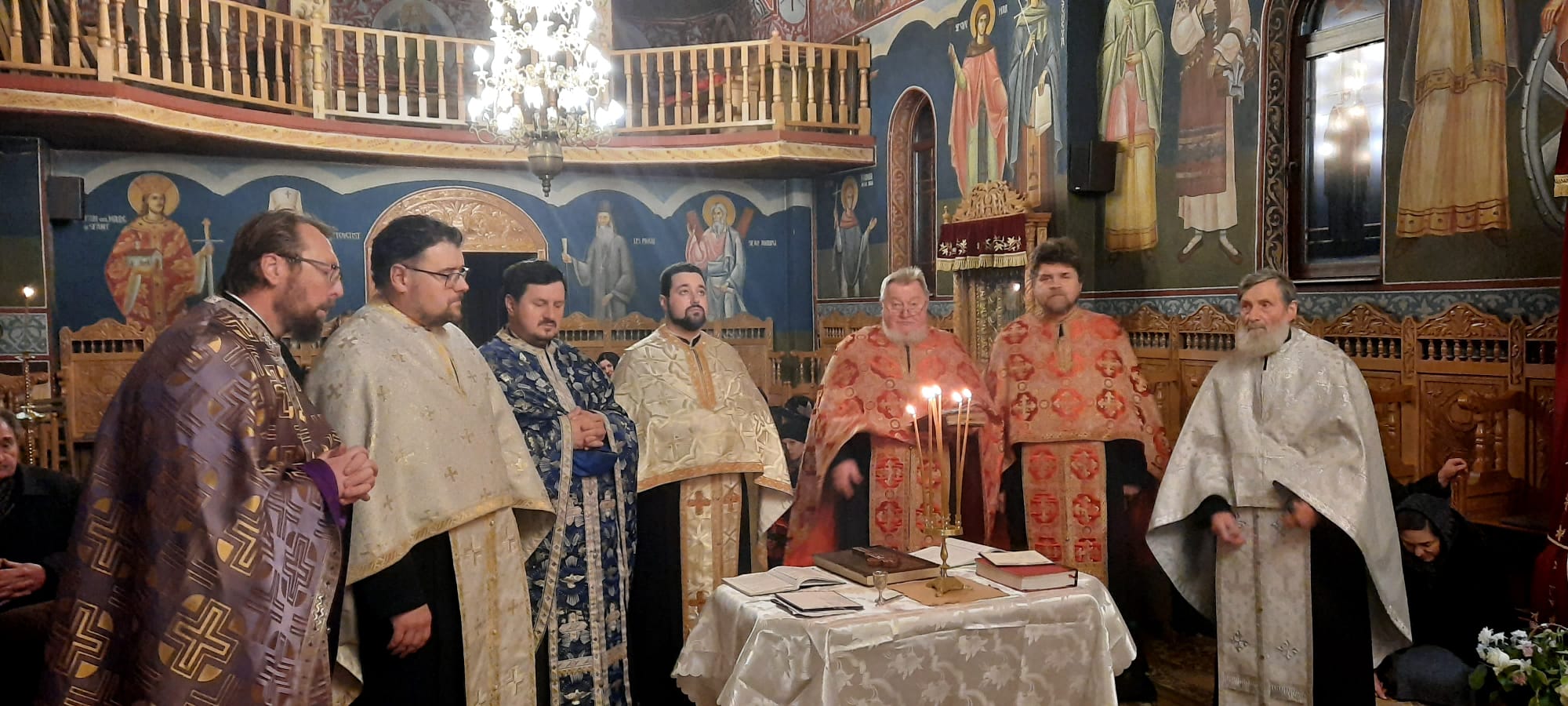
With the blessing of His Eminence Calinic, Archbishop of Suceava and Rădăuți, and under the guidance of the Pastoral Mission and Christian Affairs Department of the Diocesan Center – Suceava, meetings of the pastoral circles were held in January in all the deaneries of the diocese.
PASTORAL CIRCLE NO. 1
„St. Metropolitan Dosoftei”
On the evening of January 23, 2023, at the church dedicated to „St. John the Baptist,” located on the grounds of the Fire Department in the city of Câmpulung Moldovenesc, beginning at 5:00 p.m., a new meeting of the priests from Pastoral Circle No. 1 took place, „St. Metropolitan Dosoftei,” Câmpulung Moldovenesc—a circle coordinated by Father Dr. Macar Ilie of the „St. Hierarch Nicholas” Church in the city. The program began with the celebration of the Akathist to St. Gregory the Theologian.
Following the prayer service, Father Silviu Emilian Oblezniuc, honorary priest at the aforementioned church and religion teacher at schools in the town of Frasin, delivered a presentation titled „Rediscovering the Theological and Spiritual Depth of Byzantine Hymnography”.
From the text of the paper, we quote the following:
„The liturgical hymns of the Orthodox Church have a profound theological character, for they are addressed to God, speak of God under the inspiration of the Holy Spirit, and their words are icons of the Word of God, Who became incarnate for the salvation of all. Their authors are melodists and hymnographers, most of whom lived during the first Christian millennium, and the majority of them are Holy Fathers of the Church.”.
„The texts of the hymns sung during the services of the Orthodox Church have a clear theological significance, expressing the teachings of the Christian faith. For example, „at the beginning of the 4th century, when the heresy of those who did not believe in the divinity of the Son was just emerging—even before Arius—the Holy and Glorified Martyr Antinogen composed the hymn Soft light; during the struggles against the Nestorian heresy, Saint Cyril of Alexandria composed the hymn Mother of God, Virgin, rejoice…; and in the midst of the struggle against the Monophysites and Origenists in the 5th century, the orthodox Emperor Justinian I composed the hymn Only-Begotten… Over time, Christian apologetic poetry (which defends the faith) has flourished in various forms: troparia, stichera, canons ”etc.".
Following the presentation, the coordinating priest congratulated Father Silviu on his exploration of the history and richness of the Orthodox Church’s hymnography. We all benefited from the material presented, which highlighted the doctrinal richness contained in the liturgical books.
Father Aurel Goraș, archpriest of the Câmpulung Moldovenesc Archpriesthood, then took the floor and praised the content of the presentation. To an outsider, the terms used in liturgical books to designate the hymns may seem like an unknown language, but for the Church, they express the richness of the liturgical tradition, developed over the centuries.
The texts contained in the liturgical books are of exceptional richness and beauty, and they must be known and passed on to the faithful. In this regard, the archpriest drew the attention of the priests present to the fact that hymnography should serve as a source of inspiration for preaching. To illustrate this point, he recalled the teaching method used by his former professor of Homiletics at the Theological Seminary of Neamț Monastery, the late Reverend Professor Vasile Ignătescu, who asked seminarians to compose thematic sermons using only the texts of the hymns contained in the liturgical books, where an inexhaustible wealth of ideas can be found. Furthermore, hymnography offers a unique interpretation of biblical narratives and a dogmatic exposition faithful to the teachings of the Orthodox Church; which is why it is very important to use hymnal texts in our sermons, especially on the occasion of the Great Feasts, but also at other liturgical events throughout the year.
Another point raised by the archpriest was that priests and church cantors must read the texts from the liturgical books as accurately as possible, because they all play an extraordinary catechetical role.
In the final part of the meeting, the coordinator of the pastoral circle, Father Dr. Macar Ilie, noted that, during the current year, the priests in the pastoral circle are invited to address 12 commemorative and celebratory topics, as determined by the Diocesan Center, in accordance with the recommendations of the Holy Synod, and presented the monthly schedule of upcoming meetings and the priests who will deliver the presentations. He also emphasized the importance of pastoral circle members attending the monthly meetings.
At the end, the priests sang the hymn dedicated to the Mother of God, „It is truly fitting.”.
PASTORAL CIRCLE NO. 2
„The Romanian Saints”
On the afternoon of Sunday, January 29, 2023, at the „Dormition of the Mother of God” Church in the Holda Parish, a new meeting of Pastoral Circle No. 2, „The Romanian Saints” – Bistrița Valley, a circle coordinated by Father Radu Ungurean, parish priest of the Crucea Parish.
The event began with the celebration of the Great Vespers combined with the Litia, in honor of the Three Holy Hierarchs—Basil, Gregory, and John—officiated by the parish priest, Adrian Simiraș, and the retired priest, Ioan Simiraș.
Next, joined by the assembly of priests from the regional pastoral circle, under the leadership of the archpriest and missionary, Father Alexandru-Iulian Șuiu, the Service of Holy Water and the Sacrament of Holy Unction were celebrated.
After the prayer service, the host of the gathering, parish priest Adrian Simiraș, read the report prepared for this occasion, titled „Opportunities and Challenges in Pastoral Care for the Elderly”, from which we quote:
„Pastoral care for the elderly is the concern that the priest, the parish, and the family must show toward older people. Old age is characterized by a weakening of physical strength and a general decline in one’s condition. The Christian faith defines old age as an encounter with God and with oneself; it is a time for reflection. It is the period of life given by God to reap the fruits.”.
„From a pastoral perspective, old age—like the other stages of life—has its own particular characteristics, advantages—opportunities—and disadvantages—difficulties. The shepherd of souls, the priest, has a duty to attend closely and persistently to the religious life of the elderly. Their souls are just as precious in the sight of God as the souls of the young. Therefore, concern for the salvation of these souls must not be regarded as any less important than concern for the salvation of the other souls in the parish. On the contrary, from certain points of view, concern for the salvation of these souls should take precedence over the fulfillment of other pastoral duties. This is because every elderly person could close their eyes at any moment and, therefore, no longer has the time necessary to set their life aright.”.
The priest is called to pay special attention to the elderly, as they have greater needs—especially for spiritual guidance, support, and encouragement. Unfortunately, „the elderly are no longer given the attention they once received; they are often regarded as superfluous, as something obsolete, and are therefore overlooked, neglected, and even disregarded. This causes them deep spiritual dissatisfaction, bitter pain, and anxiety, which leave them no rest or comfort except through a more vital connection with God, the church, and the parish priest. The shepherd of souls is often the only person who knows how to appreciate, value, and give due attention to the elderly. All of these factors foster in the elderly person’s soul a certain favorable disposition toward the faith, toward the church, and toward the priest, and lead them to a more intense religious life.” The elderly must be treated with gentleness and love, with understanding, in accordance with the guidance given to us by the Holy Apostle Paul: Do not confront the elderly, but encourage them as you would a parent; encourage elderly women as you would a mother (1 Timothy 5:1–2).
The conclusions of the meeting were summarized by the archpriest and missionary, Alexandru Iulian Șuiu, who addressed the faithful with a message about the importance of honoring the elderly, who, through their experience and wisdom, can serve as guides toward what is good; it is important for the younger generation to heed and follow this sound advice. He also brought to everyone’s attention a saying by Saint Basil the Great, often quoted by Father Cleopa of Sihăstria Monastery: „The greatest wisdom for a person is to reflect on death.” Preparing for the passage into eternity is most often a concern of the elderly, but it is very important for everyone, regardless of age, to remain constantly mindful and prepared.
At the end, the parish priest, Adrian Simiraș, thanked everyone present—priests and parishioners alike—for accepting the invitation to gather in the church and pray to God for all their needs.
PASTORAL CIRCLE NO. 3
„St. Daniel the Hermit”
The priests of the „St. Daniil the Hermit” pastoral circle met on January 26, 2023, beginning at 5:00 p.m., at the „St. Peter and Paul” Church Peter and Paul” in the Gemenea Parish, Stulpicani commune. The event began with the celebration of the Akathist Hymn to Our Savior Jesus Christ.
Following the prayer service, Father Gheorghe Ianovici, coordinator of the regional pastoral circle, welcomed Archpriest Aurel Goraș to the regional pastoral circle and delivered an introductory address, drawing the attention of those present to the decision of the Holy Synod of the Romanian Orthodox Church, dated December 16, 2021, which designated 2023 as the Year of Homage to Pastoral Care for the Elderly and the Year of Commemoration of Hymnographers and Church Singers (psalts). Accordingly, the topics to be addressed and discussed during the pastoral meetings will fall within the framework of these commemorative themes. He then invited the parish priest, Father Ordinschi Iulian—the host of the first meeting—to read the prepared paper, which addresses the first topic on the list of 12 proposed by the Diocesan Center.
Next, the parish priest, Father Iulian Ordinschi, delivered a presentation titled „Rediscovering the Theological and Spiritual Depth of Hymnography”, from which we quote:
„If the year 2022 was dedicated to prayer and Hesychasm, as a spiritual endeavor to promote the unceasing prayer of the mind and heart, this year, 2023, we focus on prayer accompanied or supported by church chant, with the chanting itself becoming communal prayer. This has its origins in the Psalms of the Old Testament, as Saint Andrew of Crete, one of the Church’s great hymnographers, affirms, saying: David, at one time, set the song to music, writing it down as if it were an iconă”.
„The hymns contained in the liturgical books of our Church are the creations of hymnographers inspired by the Holy Spirit, and they help us understand the scriptural text as part of Holy Tradition. The texts of the hymns sung during the services of the Orthodox Church deepen and explain the theological richness of the Word of God. Church music is the Gospel set to song. In this regard, Father Dumitru Stăniloae said of hymnographic language that: God is so great that only poetry can attempt to express Him. The theological and spiritual depth of the liturgical texts stems from their constant drawing upon the Holy Scriptures and the writings of the Holy Fathers of the Church, who meditated at length and deeply on the Word of God.
”The theology expressed in church hymns is one of the richest in meaning and, at the same time, one of the most enlightening for the faithful of our Church; therefore, it should be drawn upon more in sermons and catechesis.„ ”The development of Byzantine hymnography was shaped by at least four factors: the freedom granted to the Church, the emergence of heresies, the inspired nature of hymnography, and the proliferation of Christian feasts.”.
For example, a dogmatic summary (or doctrinal synthesis) of the essential events of the entire Economy of Salvation, from the Nativity and Baptism (Theophany) to the Ascension and Pentecost (the Descent of the Holy Spirit), can be found in the Stichera to „Glory… and now…” from the Matins of the Ascension: You were born as You Yourself willed; You revealed Yourself as You Yourself deemed fit; You suffered in the flesh, our God; You rose from the dead, trampling down death; You were exalted in glory, You who fulfill all things; and You sent us the divine Spirit, so that we might praise and glorify Your Divinity.
After the presentation, Archpriest Aurel Goraș congratulated Father Iulian on his presentation and invited the priests to share their views on the topic of the meeting. From the priests’ remarks, we summarize the following ideas, which focused primarily on practical aspects: the importance of the church cantor at the choir loft of every church — unfortunately, most parishes face a shortage of trained cantors; there is a lack of schools for cantors as well as clear compensation structures, so in most cases, improvise; as for hymnography, it represents a treasure of the Church, faithfully reflecting the content of the decisions of the Ecumenical Councils and Christian Orthodox teaching in general; In the Church, everything is interconnected: the Liturgy, iconography, and chant—all are part of the beauty of Orthodoxy, and therefore must be known and cultivated just as they have been handed down.
One topic that was discussed—though outside the main theme—but nonetheless important concerned a recent pastoral issue: proselytizing activities by neo-Protestant denominations in the villages of the area, and advice on identifying measures to counteract them.
At the end, the conclusions of the meeting were summarized by the archpriest, who praised the presentation given during the meeting. Building on the theme of the presentation, he spoke to the priests in attendance about the homiletic value of hymnography and advised them to use, in composing their sermons, the texts of the church hymns contained in the liturgical books, which are characterized by a clear exposition of dogmatic teachings and by fidelity to Holy Scripture and the writings of the Holy Fathers. On the other hand, there is currently a danger of introducing hymns with newer texts into the liturgy, which are popular with the public, but which do not so faithfully express the richness and beauty of the Church’s liturgical and theological tradition. For this reason, some pricesneshould be avoided or incorporated into church life.
The meeting concluded with the singing of the hymn „It Is Truly Fitting”
PASTORAL CIRCLE NO. 4
„The Confessors of the True Faith”
Meeting of the members of Pastoral Missionary Circle No. 4, known as „The Witnesses of the True Faith” and coordinated by Father Mihai Valică, Ph.D., Associate Professor, of the „Holy Trinity” Cathedral in Vatra Dornei, took place on Tuesday, January 24, 2023, at The Parish „The Descent of the Holy Spirit” – Argestru. The meeting was preceded by a religious service The Akathist of the Annunciation, a liturgical text composed by Saint Roman the Melodist. Father Aurel Goraș, archpriest of the Câmpulung Moldovenesc Archpriesthood, also took part in the pastoral event.
After the service, a presentation was given on the topic: „Rediscovering the Theological and Spiritual Depth of Byzantine Hymnography”, which was presented by the parish priest, Laurențiu Paicu. As a continuation of last year, which was dedicated to prayer, this year „we must accompany prayer with church singing, for the chanting itself becomes communal prayer.” The liturgical books of the Orthodox Church contain remarkable hymns, creations of hymnographers inspired by the Holy Spirit, which help us understand the scriptural text as part of Holy Tradition.„ ”Liturgical chant supports prayer, and hymnographers are the composers of church hymns of great theological depth. The beautiful hymns we hear as we step into the church were composed by holy hymnographers. They poetically synthesized the theology and spiritual experience of Orthodoxy.”.
Among the Church’s hymnographic saints, the paper included information about Saint Roman the Melodist, Saint John of Damascus, Saint Andrew of Crete, Saint Cosmas of Maiuma, Joseph the Hymnographer, and Saint Casia (or Casiana).
After the presentation of the paper, the regional study group coordinator, Father Valică Mihai, Ph.D., Associate Professor,congratulated the parish priest on his presentation and gave a brief overview of the doctoral dissertation by His Grace Damaschin Dorneanul, published by Crimca Publishing House of the Archdiocese of Suceava and Rădăuți. The volume serves as a reference work for the study of hymnography and for understanding the theological richness of liturgical texts.
He then invited the priests present to speak on the topic covered in the presentation. Thus, from the discussions among the participating priests, we note the following ideas: – The theme of this year’s commemorative year is a very fitting continuation of last year’s theme, because the hymnographers were also Hesychasts—people of prayer. They translated into verse and hymns not only the richness of the Church’s theology but also their own spiritual experience and understanding. That is why their work was accepted by the Church and became established in the liturgical books; – In the Orthodox Church, chant harmonizes with all aspects of the church (painting, architecture). For this reason, new hymns or songs that deviate from the hymnographic tradition inherited from the Holy Fathers should not be overly encouraged.
During the discussions, Archpriest Aurel Goraș also took the floor and expressed his joy at being present at this pastoral gathering, where a beautiful topic with practical applications for pastoral ministry was discussed, and the presentation also included a historical overview. He also spoke to the priests about the homiletic value of the hymnal texts found in liturgical books, because all the hymns possess extraordinary depth and dogmatic value, being inspired by Holy Scripture, the writings of the Holy Fathers, and the decisions of the Ecumenical Councils. Another point he raised concerned the importance of chanting from the choir loft, which contributes greatly to creating an atmosphere of prayer and an understanding of the liturgical service. Unfortunately, there are no longer any schools for cantors that provide training in this area, and there is also a lack of compensation that would serve as an incentive.
At the end, the parish priest thanked everyone for attending and participating in the discussions. The meeting concluded with the singing of the hymn „It Is Truly Fitting.”.
PASTORAL CIRCLE NO. 5
„Saint Stephen the Great, Voivode”
On Monday afternoon, January 30, 2023, the „Nativity of the Mother of God” Parish, in the village of Botoș, Ciocănești commune, hosted the monthly meeting of the priests belonging to Pastoral Circle No. 5, under the patronage of Saint Stephen the Great and coordinated by Father Ilie Rusu, Ph.D., of the Ciocănești Parish.
On this occasion, beginning at 5:00 p.m. in the parish church, members of the pastoral circle celebrated a Te Deum of thanksgiving for all the blessings received from God over the past year. During the litany of the service, the priests of the pastoral circle, along with their families and parishes, were commemorated.
After the prayer service, the parish priest, Mihai Tehanciuc, delivered the presentation he had prepared for this pastoral meeting, titled „Rediscovering the Theological and Spiritual Depth of Hymnography”, from which we quote:
„The liturgical hymns of the Orthodox Church have a profound theological and spiritual character, for they are addressed to God, speak of God, and inspire us to turn to God. The Word clothed in song can heal the wounds of the soul, can bring forth tears of joy or repentance, can transform people’s evil inclinations, can bring joy to families troubled by the power of evil, and can foster love among fellow human beings. Moreover, song gives wings to the Word, lifting it up to heaven and carrying the prayers of the children to their Father: May my prayer rise before You like incense”.
„The Church’s liturgical hymnography emerged alongside the development of the liturgical rite that took place up until the 11th century, which leads us to conclude that hymnography emerged gradually over the course of several centuries, in response to the Church’s challenges and needs. Due to doctrinal issues, we are dealing with hymnography that presents the Orthodox Church’s teaching of the faith; thus, we can say that hymnology From the outset, it had a largely dogmatic character, having been driven largely by the struggle against heretics”.
„The hymns are organized according to the three periods of the Church’s liturgical year, in the books specific to each period: the Pentecostarion, the Triodion, and the Octoechos, as well as in the hymns of the Menaion—the 12 liturgical books, one volume for each month of the year—which contain the fixed feasts and the feasts in honor of the saints. The hymns expound at length on the doctrine of the Incarnation, Life, Cross, Death, and Resurrection of the Savior. They recount the entire redemptive work of our Lord Jesus Christ, which signifies deliverance from the bondage of sin and the restoration of humanity through repentance.”.
„Hymnography has caused the Church, in its very essence, to shine, drawing it closer to the beauty of Heaven. Until the creation of man, the voices of the angels resounded everywhere like a cymbal. They vied with one another in composing melodious hymns with which to glorify the Creator unceasingly.”.
After the presentation, the coordinator of the regional pastoral circle, Father Ilie Rusu, Ph.D., praised the presentation and invited the priests in attendance to share their own thoughts on the topic. The discussions focused primarily on practical aspects related to church music, the shortage of choir singers, and the lack of training programs to prepare them, as had existed in the past (mention was made of the School for Church Singers in Chernivtsi and its graduates, who formed church choirs in the parishes of Bukovina but which, unfortunately, have since disappeared over time). Father Doroftiese Gabriel, parish priest at the Dorna Candreni Parish, choir director, and organizer of musical events in the area, recalls that Patriarch Justinian Marina, through his vision of standardizing church music across the Romanian Orthodox Church, wanted everyone in the church to sing, and for communal singing to be a means of strengthening faith and fostering involvement in liturgical life. Unfortunately, nowadays, in many cases, not even the choir sings from the „Hymns of the Divine Liturgy” anymore. That is why it is very important to pay more attention to the choir.
At the end, the parish priest, Mihai Tehanciuc, thanked the priests for joining them in this moment of shared prayer and counsel.
PASTORAL CIRCLE NO. 6
„St. Andrew the Apostle”
Meeting of the members of Pastoral Missionary Circle No. 6, placed under the heavenly protection of Saint Andrew the Apostle, Coordinated by Father Ovidiu Petrovici, the event took place on January 19, 2023, at the „St. Parascheva” Church of the Păltiniș Parish in the village of Panaci.
The program began with the celebration of the Sacrament of Holy Unction for the congregation, with local priests officiating under the leadership of the archpriest and missionary, Father Șuiu Alexandru Iulian.
The Sacrament of Holy Unction was followed by a sermon, in which the missionary priest brought to the attention of the faithful present the fact that priests from a certain area meet monthly for pastoral meetings, where they address a topic followed by discussions and counsel. Since the Romanian Patriarchate has dedicated this year to the pastoral care of the elderly, the priests’ meetings and discussions will address various topics related to this issue. In the Church, every person is important, and we ought to cherish and pray for all people. In particular, we should cherish the elderly, because they are the most regular attendees at the divine services, and we have much to learn from their example of faith—we just need to make time and listen to their advice. We, the younger generation, cannot know everything, nor should we presume to know it all; that is why it is important to seek advice and learn from the example of our elders. The elderly are closer to the Church and more regularly attend services, showing greater care for the soul, because growing older makes a person wiser, but also causes them to think more about the things to come and, above all, about their meeting with the Righteous Judge.
Next, the parish priest, Father Roman Ionel, read the report titled „The Current Attitudes of Older Adults Toward the Priest and the Church”, from which we quote:
„In the Scriptures, respect for the elderly becomes a law: In the presence of the one with white hair, stand up and fear your God (Lev. 19:23). And also: Honor your father and your mother (Deut. 5:16). A very subtle exhortation in favor of parents, especially in their old age, is found in the third chapter of Jesus Sirach (vv. 1–16), which concludes with a statement of particular gravity: He who forsakes his father is a scoundrel, and he who angers his mother is cursed by the Lord. We must strive to break the trend—so widespread today—of ignoring the elderly or marginalizing them, a trend that „teaches” new generations to abandon them: young people, adults, and the elderly all need one another.
The lives of the elderly help shed light on the scale of human values; they help us see the continuity of generations and beautifully demonstrate the interdependence of God’s people. In fact, the Church is the place where different generations are called to share in God’s plan of love through a mutual exchange of gifts, by which each is enriched through the grace of the Holy Spirit. It is an exchange in which older people bring religious and moral values that constitute a rich spiritual heritage for the life of Christian communities, families, and the world.
Religious practice plays an important role in the lives of older adults. Old age seems to foster a special openness to it. This is confirmed, among other things, by their assiduous and heartfelt participation in liturgical life (church services); the unexpected return of many elderly people who draw near to the Church after long years of estrangement; the significant space set aside for prayer, which represents a precious contribution to the spiritual capital of prayers and sacrifices from which the Church draws abundantly and which must be reevaluated within church communities and families.
The elderly in the church should bring us joy, because they are souls that have been saved—or are at least on the path to salvation, on the path to the redemption of their souls.
”In conclusion, it is our elders who, through their faith, respect, and devotion to the Church and the priest, truly preserve the spirituality and tradition of the places where they were born.".
In closing, the coordinating priest of the regional pastoral circle, Petrovici Ovidiu, addressed those present—priests and faithful alike—and presented a summary of the past commemorative year, which had been dedicated to prayer within the Romanian Patriarchate. He also commended the parish priest’s presentation, which kicked off this year’s series of pastoral meetings, during which we have a duty to be there more for the elderly, who need prayer but also need to be visited, to talk with them, and to provide them with what they need.
The pastoral circle meeting concluded with the singing of the hymn „It Is Truly Fitting.”.
PASTORAL CIRCLE NO. 7
„St. Vasile of Moldovița”
The first meeting of 2023 for the „Saint Basil of Moldovița” pastoral circle took place on the evening of January 30 at the „Nativity of the Mother of God” Parish in Frumosu. The event began, as scheduled, with the celebration of the Sacrament of Holy Unction for the congregation in the parish church, starting at 5:00 p.m., under the leadership of Archpriest Aurel Goraș, Archpriest of the Câmpulung Moldovenesc Archpriesthood.
After the celebration of the Holy Sacrament, the priest addressed the faithful with a sermon in which he spoke about the commemoration of the Three Hierarchs, Basil, Gregory, and John, whose liturgical feast is celebrated both separately and together, as this was the Saints’ wish. He spoke of the exhortation of the Holy Apostle Paul, who says: Remember your leaders, who spoke the word of God to you; consider the outcome of their lives and imitate their faith (Hebrews 13:7). He also noted that, during the Divine Liturgy, the Gospel reading from John, chapter 10, was read, in which reference was made to The Good Shepherd, who is Christ, the model for all shepherds of the Church. Unfortunately, today there are many sects that distort the faith and teach something other than what the Holy Hierarchs taught, introducing teachings foreign to Holy Scripture and the patristic teaching of the Church. For their struggle in defending and proclaiming the true faith, as great teachers and mentors of the Church, the Three Holy Hierarchs were chosen as the patron saints of the seminaries and faculties of Orthodox Theology in our country, as well as of theological education in general.
At the end of his remarks, he expressed his gratitude to Professor Emil Forfotă and the members of the „Academica” choir from Câmpulung Moldovenesc, who provided the liturgical responses from the choir loft and delighted those in attendance. He also congratulated them on the wonderful cultural work they do, thereby continuing the fine choral tradition in Bukovina.
Following the anointing of the faithful, the second part of the meeting began, during which Father Niga Nicolae, a concelebrating priest at the host parish, delivered a presentation titled „Parish Choirs and Their Importance in the Church’s Mission.” From the content of the presentation, we note the following: „Ever since its establishment, the Divine Liturgy has been a communal prayer: Let us pray in the Lord’s peace or Let us all say this with all our hearts and minds… These are calls that punctuate the order of the Divine Liturgy and involve the participation of all the faithful in prayer and singing. In a parish, it is not possible to train all the faithful who attend the Divine Services in church singing; but only a portion of them—preferably those with good voices and a musical ear—who actively exercise the community’s right to sing during the Divine Liturgy.”.
„If we are to discuss the role of the church choir in community life, we must consider its significant impact on people’s individual and, subsequently, collective development. A primary role of church choirs is missionary in nature. Every community has a church. For missionary purposes, the church is adorned with icons and beautified by the priest and the faithful. The priest strives to preach, to sing, to conduct the service beautifully, and to make God’s teaching known. The church choir was meant to complement the priest’s work. Where there is beautiful singing, people are drawn to go. The Savior’s teachings are also conveyed through song and are more easily remembered with the help of music. Choir members can be likened to the Apostles, for they preach through song. Another role is cultural. In the past, parish choirs participated in cultural events commemorating heroes and forefathers, as well as important days in the country’s history, etc.
Another role of church choirs is to foster community unity. Church choirs were what drew people to church and lent beauty and grandeur to the events. From all corners of the community, choir members would gather and form a team. They would all gather at the church. In this way, they formed a family. As a result, their families would come together and grow closer, and this led to the entire community being united and protected from division.”.
Next, regarding the topic of the meeting, the priests in attendance took the floor, and the conclusions of the meeting were summarized by Father Negură Dan Dumitru, the regional circle coordinator, who praised the paper prepared by the parish priest, in which he highlighted the importance of parish choirs for both the liturgical and cultural life of the communities of the faithful. He also commended the initiative to invite a professional choir to the pastoral circle meeting.
The meeting concluded with the singing of the hymn „It Is Truly Fitting.”.
PASTORAL CIRCLE NO. 8
„St. Spyridon”
On January 31, 2023, the Breaza I parish hosted another meeting of the regional pastoral circle, which is under the patronage of Saint Spyridon and coordinated by Father Alexandru Horga.
To begin with, a memorial service was held by the clergy, presided over by Archpriest Aurel Goraș, for all the priests who have served in this parish over the years. The prayer service took place in the beautiful parish church, with members of the congregation also in attendance. At the conclusion of the memorial service, Archpriest Aurel Goraș addressed those present—clergy and laity alike— a word of instruction, in which he emphasized the importance of remembering those who have passed on to the Lord, especially the spiritual fathers of each community—those who served and prayed, standing by the parishioners through all the moments of their lives. Father Petru Balabasciuc’s initiative is commendable and worthy of praise, as commemorating those who have passed from this life is also a gesture of gratitude toward our forebears, from whom we have received a rich heritage of faith. He also quoted from the service performed at the funerals of priests, where a hymn states: Remember me, the one you once knew; for many times I entered the house of God with you, and together we sang, “Hallelujah!” As we remember the priests who have gone to the Lord, we offer up this prayer.
Next, the parish priest, Alexandru Petru Balabașciuc, presented a paper titled „Pastoral Ministry in Today’s World: Aging Villages, War, Immigration, Immoral Ideologies, and the Corruption of Faith”, in which he first addressed the priestly ministry and the high pastoral responsibilities, and then the recent challenges facing rural parishes as well as Orthodox Christians in general. The presentation was structured into subchapters based on the themes suggested by the title, and the priest sought to present material that was as practical as possible and focused on the most current issues—many of which he had encountered in his own pastoral work—citing examples from his own parish. Thus, from the content of the presentation, we note a few quotes: „Until now, it was plain to see that in many Romanian villages the population has been declining from one year to the next. But now, the National Institute of Statistics (INS) has published a document that merely confirms what was already „obvious.” According to an INS list, there are villages with only one child or where the population is very elderly.”.
Over the past 23 years, Romania has not only undergone a difficult economic and political transition, but has also experienced a painful demographic decline. A declining birth rate, an aging population, and massive labor migration are some of the causes of the drastic population decline. Rural areas are by far the hardest hit. When it comes to the birth rate, the situation is even more dire. According to a Eurostat report, in 1990, 23.7% of Romania’s total population consisted of children under the age of 14. Two decades later, in 2010, the proportion of children in the total population had fallen to 15.2%. The study cited indicates that this 8.5% decrease is the fourth largest recorded during this period among European Union member states. In the Breaza I parish, over the past four years, there have been 103 funerals and only 24 baptisms.”.
As for the war taking place near our country’s borders, „The Romanian Orthodox Church has made tremendous efforts, launching an unprecedented mobilization to help all the refugees who have entered our country, especially through the Siret border crossing, where the Archdiocese of Suceava and Rădăuți, through all its departments and staff, has helped thousands of people who fled the war.”.
Following the presentation, the coordinating priest, Father Alexandru Horga, congratulated the parish priest on the presentation he had prepared and delivered, in which he presented the material in a practical way, using data gathered from many sources, as well as much information drawn from the current, immediate hardships and challenges that each person personally experiences. He also invited the priests to speak. This led to a discussion in which most of the priests participated, raising various points related to the issues highlighted in the report.
The conclusions of the meeting were presented by Archpriest Aurel Goraș, who praised the paper as being well-written and insightful. He also commended the contributions and remarks made by the priests. Unfortunately, all the issues raised in the report and during the discussions are real and painful; our country is facing economic and demographic challenges. Furthermore, we are living in a time when there is a desire to destroy our national identity and to lead us away from the true faith by promoting ideologies that seek to overturn natural values. Our hope lies solely in the Good Lord.
The meeting concluded with the singing of the hymn „It Is Truly Fitting.”.
Recorded by Archdeacon Norocel Bogdan
