
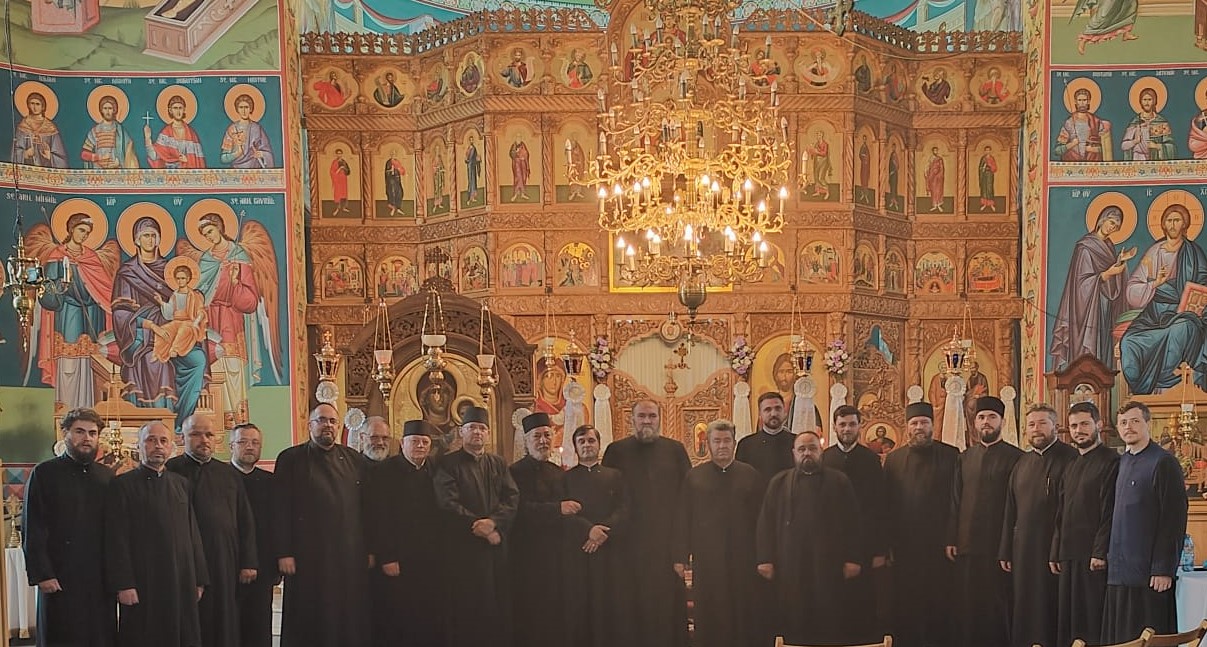
With the blessing of His Eminence Calinic, Archbishop of Suceava and Rădăuți, and under the guidance of the Department of Pastoral Mission and Christian Affairs of the Diocesan Center – Suceava, meetings of the pastoral circles were held in June in all the deaneries of the diocese.
Pastoral Circle No. 1
„Saint Leontius of Rădăuți”
On Tuesday, June 6, 2023, a meeting was held for the members of Pastoral Missionary Circle No. 1, under the patronage of Saint Leontius of Rădăuți. The meeting was preceded by the performance of the Vespers service, in the church parish The Nativity of the Virgin Mary from The City of Rădăuți.
Following the celebration of Vespers, a meditation entitled: „”The Current Attitudes of Older Adults Toward the Priest and the Church” and was presented by Parish Priest Ioan-Florin Mateiciuc from the aforementioned parish.
From the meditation, we highlight the following points:
Most dictionaries define the elderly person solely in terms of their personal relationship with time and their biological functions. The Holy Scriptures and patristic writings, however, define and highlight the elderly person in his personal relationship with God—his Creator. For us Christians, old age does not mean the first steps toward the grave but the first steps toward eternity. Through His coming into the world, Christ frees man from the burden of time; the years are no longer a burden but are God’s blessing for man.
The elderly are our first teachers. „Grandchildren are the crown of the elderly, and parents are the pride of their children,”, as Holy Scripture tells us (Proverbs 17:6). A child’s first teachers are their grandparents. With emotion and unblemished faith, grandparents teach their grandchildren their first prayer. With great tenderness, they take the little one’s hand and make the sign of the Holy Cross. Then they join their hands in the morning, in the evening, and before meals; they teach them to say prayers. In this way, the little Christians draw on the warmth and faith in God of their grandparents. Next comes First Communion, and at age 7, First Confession. This religious education that the elderly pass on to their grandchildren shows us the close bond they have with the priest and the Church, in accordance with the scriptural exhortation: „Teach a young person the way they should go; even when they grow old, they will not depart from it.” (Proverbs 22:6).
The elderly are a model of prayer. The elders’ prayer is simple, spoken with faith at all the important moments of their lives. They pray and teach those around them to pray as well—in the morning and evening, at mealtimes, at the beginning and end of work, but especially prays earnestly and fervently in the holy church. They know that in prayer they first praise God, give thanks to Him for everything, and only then ask for what they need: „Until I am old and gray, O God, do not forsake me” (Psalm 70:19).
It is in prayer that the elderly truly reveal their attitude toward the priest and the Church, which serve as their most precious source of support during the difficult years of old age. The elderly are more fervent and wise in prayer, not only because of their age and life experience, but also because of their stronger and more active faith: „Do not disregard the words of the elderly, for they, too, learned from their parents. For from them you will learn the wisdom and skill to respond appropriately when needed.” (The Book of the Wisdom of Jesus, son of Sirach 8:9).
The lives of the elderly shed light on the hierarchy of human values, help us see the continuity of generations, and beautifully demonstrate the interdependence of the people and God. The Church is the place where different generations are called to share in God’s plan of love. Our elders are the ones who, through their faith, respect, and devotion to the Church and the priest, truly preserve the spirituality and tradition of the places where they were born.
The discussions were led by coordinating priest Angel Prelipcean and archpriest-missionary George Mironescu. Among the topics discussed were the following: methods for attracting young people to the Church; showing due respect to the elderly; and applying the advice of the elders in pastoral ministry.
Based on the discussions on this topic, we note several proposals and best practices for the smooth functioning of the Church:
- We would do well to learn to wholeheartedly accept the changes that nature imposes upon us. Youth has its own beauty, just as old age does. If we lived in a meditative, peaceful, and tranquil way, old age would acquire a grandeur all its own. Just as the snow-capped peaks of tall, majestic mountains are so beautiful, so too does the white hair of an elderly person have its own beauty. The elderly person is wise, dignified, burdened by the weight of the years but also by the sweet burden of joy, wisdom, faith, and truth.
- The elderly, through their wisdom and faith, serve as role models for the faithful. They attend all religious services. If we enter a church during a religious service, we see that most of the people there are elderly. Their faith and love for the ancestral church are evident in their regular participation in services and parish activities.
- Parish Council and parish council They are mostly made up of older people who are spiritually and emotionally attached to the parish, serving as a direct link between the priest and the faithful. They are familiar with parish life and its needs; they know the faithful personally and have many relatives in the community, thus assisting the priest in his pastoral work. Their attachment to the priest and the church is also expressed through administrative activities: collecting donations and contributions, distributing calendars, organizing fundraisers for disaster victims or the needy, etc.
At the end of the meeting, thanks and congratulations were extended to Father Florin Mateiciuc for preparing the report and organizing the meeting, as well as to the other priests for their participation.
He noted,
Protopop Missionary,
Father George Mironescu
Pastoral Circle No. 2
„Saint John Jacob of Hozeva”
The priests of Pastoral Missionary Circle No. 2, under the patronage of Saint John Jacob of Hozeva and coordinated by Father Bogdan Lupaștean-Barfă, gathered for a working meeting on Thursday, June 15, 2023, at The Parish Saint Elijah the Prophet, in the commune of Dărmănești, Rădăuți Deanery.
Before the presentation of the report, the parents performed The Akathist of Saint Elijah the Tishbite – the patron saint of the church and parish of Dărmănești II. The meditation entitled „The Wisdom of the Elders and Its Application in Pastoral Care”, was presented by Father Mihai Cobziuc, Parish Priest, diocesan advisor in the Office for Relations with Minorities of the Archdiocese of Suceava and Rădăuți.
From the text of the meditation, we quote the following points:
Saint Paul the Apostle offers us an ideal portrait of the elderly when he instructs his disciple, Timothy, on the essentials of pastoral care: „Older men should be sober-minded, dignified, of sound judgment, and strong in faith, love, and endurance; and the older women likewise are to be reverent in their behavior, not slanderers, not addicted to much wine, but teachers of what is good, so that they may teach the young women to love their husbands, to love their children, and to be self-controlled, pure, working at home, kind, and submissive to their husbands, so that the word of God may not be discredited.” (Titus 2:2–5).
It is well known that not all elderly people attain that particular wisdom: „Wisdom should not be judged by age, nor should an old man be recognized by his white hair,” he says Saint John Chrysostom[1]. The education one receives—or the self-education one undertakes on one’s own—instills in each person’s soul and life a set of values and virtues, starting from childhood: „Those who have been raised in a bad way of life, such as the elderly, are hard to change, though it is not impossible, for if they wish, they too can change. Young people, however, who do not yet have life experience, will readily accept all the laws.”[2]A life lived in accordance with God’s will allows these things to bear fruit, and then we can speak of „a fruitful old age” or of beautiful elders.
Orthodox spirituality holds guidance in high esteem on the path to salvation: „Whoever wishes to be saved must set out on a journey”. The first advisor is, of course, the spiritual father. He is „the man who, through the mortification of the passions and the dispassion he attains, becomes knowledgeable about divine matters and possesses a sound judgment regarding human affairs, by virtue of which, without any danger to himself, knows how to guide others on the path of God.”[3] The Sacrament of Confession It is the place where we make a good start, through the forgiveness of sins, through the power of grace, but also through the value of the advice received from our spiritual father. There is also a non-sacramental spiritual fatherhood, which does not involve the Sacrament of Holy Orders. We can also seek advice from other „authorized” individuals—spiritual people who are advanced on the path to perfection. Especially in times of unrest and confusion, people seek counsel and prayer far and wide. The Paterikon presents a series of great counselors who had not received the Sacrament of Holy Orders but who possessed „words of great power.”.
To meet the spiritual needs of the elderly, it is necessary to understand them through effective communication and a high degree of availability on the part of the minister of the Lord. Involvement in liturgical life, through the sacred services and especially through the Divine Liturgy, Confession, and the Anointing of the Sick, is essential. „I don’t think there is any particular way for the Church to tell the elderly that it loves them other than by giving them Christ,” says Father Constantin Necula. By striving to apply the advice of these individuals to our own lives, we are already rich: „It is not the one who possesses much who is rich, but the one who needs nothing. For what good is it to one who possesses the whole world but lives in greater sorrow than one who has nothing? Inner peace is what makes people rich or poor, not the possession of money or the lack thereof.”[4]
The ensuing discussions on the topic were led by Father Bogdan Lupaștean—the group’s coordinator—and by Archdeacon George Mironescu. During these discussions, several aspects were highlighted regarding specific projects in which elderly parishioners could be involved: the church choir; publications, literary works, personal testimonies, reviews, etc.
During the discussions, suggestions for best practices to ensure the smooth functioning of the Church were made, including the following:
- When we read a book and come across a beautiful idea, we remember it, or write it down and share it in various situations, spreading our joy to others. We do the same when „the book”A person’s life is like a book: the good things we have learned from others, we pass on through one-on-one conversations or through words of wisdom. That is why, at the parish level, we can organize formal gatherings (spiritual evenings) or informal gatherings, with different target groups and objectives, in various locations—such as the church, the parish meeting room or library, or outdoors—including outdoor activities, etc. featuring guests over the age of 70 or 80—people with a certain spiritual experience who can enrich their peers with their advice.
- The involvement of older adults in parish activities (such as participating in the church choir, cleaning and beautifying the church premises, organizing pilgrimages, etc.), we convey to them the message that they are not useless, that they still have something to offer, and that we need them. This creates an opportunity to interact with others and learn from one another. Depending on the parish’s socio-economic conditions, it might be helpful to organize remedial programs or for performance for students, by subject, utilizing retired teachers, especially for children at risk (poverty, neglect, single-parent families, etc.).
- Editing some publications At the parish level, this could be an opportunity to engage the most creative members of the „senior” congregation: articles, studies, literary or artistic works, reviews, personal reflections, and interviews, all organized around a specific theme and reviewed by an „authorized filter”—the editorial board.
The meeting concluded with the customary expressions of appreciation and thanks directed at Father Mihai Cobziuc, the parish priest of the Church in Dărmănești II, for hosting the event, as well as to the other priests for their participation.
He noted,
Protopop Missionary
Father George Mironescu
Pastoral Circle No. 3
„Saint Peter Movilă”
On June 9, 2023, at The Parish The Holy Archangels Michael and Gabriel from the village Ciomârtan, in the village of Zamostea, Rădăuți Deanery, a meeting was held for the priests of Pastoral Missionary Circle No. 3, under the patronage of Saint Peter Movilă – Metropolitan of Kiev and coordinated by Father Cosmin Cucu.
After committing The Akathist of the Annunciation, followed by a meditation titled: „”The Advice of the Elders and Its Application in Pastoral Care” and was presented by Father Mazilu Constantin, the pastor of the church in Ciomârtan.
From the text of the meditation, we quote the following points:
In the works The Three Great Teachers and Hierarchs, Basil the Great and Gregory the Theologian and John ChrysostomWe associate old age with wisdom, but not with the wisdom gained through the passage of time; rather, it is the result of the elderly person’s growing closeness to God, of an awareness of the meaning of life, and of the way we respond to God’s call, and the practice of prayer as the most worthwhile effort one can make. Thus, our Romanian people have valued old age as a repository of wisdom, of experience accumulated through successes and failures, through battles won or lost; old age not as a burden for the young, but as a blessing and an opportunity for which we must thank God and ask Him to keep them near us because we have not yet reached the fullness of their understanding.
In ancient times, the vast majority of peoples were ruled by elders: among the Romans, for example, alongside the king there was The Senate („senex„ meaning „old man” in Latin); among the Jews, the elders of the people were part of Sanhedrin, and in ancient Greece, Sparta was ruled by The elders' advice (Gerusia). Among the Jews, the Sanhedrin was the institution recognized by the Romans, through which the people were governed, both religiously and politically. Unfortunately, the ”tradition of the elders” for the people of Israel has been and remains a stumbling block to Christ, showing us thereby that the counsel of the elders is not always correct; perfection belongs only to God or to whom He chooses to bestow it.
In the pastoral ministry of every priest, there is a dynamic, a changing relationship with God, whom he proclaims and to whom he offers the bloodless sacrifice of the Holy Liturgy, as well as a different approach toward the faithful he shepherds. Of course, this evolution is based on several factors that underpin the missionary-pastoral endeavor. One of the factors that can influence the trajectory of our ministry is our relationship with the elderly people around us.
This was followed by discussions on the topic, and recommendations for best practices to ensure the smooth functioning of the Church were made, including the following:
- The elderly deserve respect. The wise Solomon urges us: „Listen, my sons, to your father’s instruction, and pay attention so that you may gain understanding, for I give you sound teaching; do not forsake my counsel. For I too was a son to my father, the only one, and tenderly loved by my mother (Proverbs 4:1–3).
- Even when the elderly may not be keeping up with the times, Saint Paul tells us that we shouldn't confront them: „Do not rebuke an older man, but exhort him as you would a father (1 Timothy 5:1). And regarding the fact that the zeal of the young needs the experience of the older ones, Father Arsenie Papacioc left us with a maxim: If youth knew, and if old age could. When we are young and full of energy, we don’t really know what to do and need the advice of our elders, but in old age our strength wanes, yet we can still offer advice to others.
- Grandparents and parents play a vital role in our spiritual life. We have an example of this in the mother of the Maccabees, who, while once instructing one of her sons, said: „Son, have mercy on me, who carried you in my womb for nine months and nursed you for three years, and fed you and brought you to this age and raised you, carrying you in my arms. I beg you, son, as you look to heaven and earth and see all that is in them, know that God created what was not, and likewise created the human race” (2 Maccabees 7:27–28).
The meeting concluded with words of thanks and congratulations extended to Father Constantin Mazilu for hosting the event and leading the meditation, as well as to the other priests who participated in the gathering.
He noted,
Protopop Missionary
Father George Mironescu
Pastoral Circle No. 4
„Saint Daniel the Hermit”
On June 8, 2023, at The Parish The Healing Spring in the village of Upper Horodnic, the Deanery of Rădăuți, led by Father Grigore-Florin Vatamaniuc, a meeting was held for the priests of Pastoral Missionary Circle No. 4, under the patronage of Saint Daniel the Hermit and coordinated by Father Traian Molea.
The meeting began with the officiating of Akathist to the Mother of God – „Joy of All Who Sorrow,”, in the parish church. This was followed by a meditation titled: „The Advice of the Elders and Its Application in Pastoral Care” and was presented by the parish priest, Florin Vatamaniuc. The paper proved to be rich in content and meticulously crafted. Here are some of the topics covered: The Lay Apostolate; Pastoral Care of the Elderly; Veneration of the Elderly; The Mindset of Young People and the Mission of Adults; The Holy Fathers and Their Legacy; Worship and Culture; Memory and Human Restoration etc.
From the content of the report, we highlight the following points:
Sometimes old age is a relative concept. Sometimes, even at 40, a person feels like a useless old man. And the opposite happens too, when some people, even at the age of 70, feel strong and healthy, just like young people. We all want to live a long life. We wish each other: „Happy Birthday! May you have a long and happy life!” and so on. In fact, there are people who really do live a long time. Moses He lived to be 120 years old. Even at the age of 120, he had the physical strength of a young man, his eyesight was still sharp, and his teeth were perfectly healthy. He had a clear mind and a strong body. The Jews have a saying that goes: „One hundred and twenty years!” It seems they both want this, without adding anything else; they simply reply: „One hundred and twenty!”
The changes brought about by aging vary from person to person. The aging process is highly individualized, involving psychological and social factors in addition to biological ones. How we experience old age depends on our personality, our physical and mental health, our life experiences, the events that have shaped our lives, and the resources available to support us[5].
The World Health Organization estimates that by 2050, the percentage of older adults worldwide will double. In Romania, the population is steadily declining and aging. Estimates show that by 2050, one in four Romanians will be over 65, which could make us one of the oldest societies in the EU[6].
In the address titled „Priorities in the Pastoral Care of the Elderly,” delivered by His Beatitude Patriarch Daniel at the opening of the spring semiannual pastoral-missionary conference of the clergy of the Archdiocese of Bucharest (May 29–30, 2023), His Beatitude explained that the Holy Synod chose the first commemorative theme in light of the fact that „at no other time in history has there been a more aging population in Europe, not only in rural communities but also in urban ones.”[7]. In the remainder of his address, the Patriarch identifies and elaborates on three priorities that the Church must now adopt with regard to the pastoral care of the elderly:
- The involvement of the elderly in raising and educating children. „Through their spiritual maturity, the elderly can contribute greatly to fostering liturgical life and preserving Christian values in our culture, for the good of society and the family.”.
- Another priority we must keep in mind is to view old age as a privilege, a time of spiritual growth and enrichment through prayer. Old age is not a burden, but a gift from God. „The prayer of the elderly is both the source of their wisdom and a blessing for the entire community.”
- The active involvement of the elderly in the pastoral care and mission of the Church. „Unfortunately, today there are many elderly people who live in great loneliness and isolation from the community, feeling somewhat useless. But there are many elderly people who live out their old age with serenity and dignity, actively participating in the life of the Church and in helping other elderly people. The Church is called to strengthen its pastoral program regarding the elderly, to devise new and contemporary pastoral forms and methods, drawing closer to the needs and expectations of the elderly.”
The discussions were led by coordinating priest Traian Molea, assisted by missionary archpriest George Mironescu. In connection with the topic under discussion, proposals for best practices were made to ensure the smooth functioning of the Church, including the following:
- a) The parish community possesses a diversity of ministries, charisms, gifts, and vocations that must be actively engaged to foster the spiritual growth of the faithful and to transmit the faith and authentic Christian life. The priest must be the spiritual father of all parish members equally. Young people, women, children, the elderly—all these parish groups must not only be recognized but also organized around common projects. Ways must be found to involve all these groups in the spiritual life of the parish.
- b) We must give seniors in our parishes and the Church’s community structures the chance and opportunity to tell us what they are going through. Rebuilding our relationship with the elderly should begin with understanding the depths of their lives, communicating with them about their struggles, and identifying their spiritual and even physical wounds. On many of his visits to the parish, the priest hears about sufferings that, in people’s view, „not even Christ endured.”.
- c) Traditional society, which we no longer have, presupposes the existence of a living, unbroken bond between generations, in which everyone needs everyone else. Life should be a harmonious unity of several generations living side by side or even together. The connections between generations are very important.
The parents were delighted to have the lawyer there Emil Ianoș, the guest of honor at the pastoral gathering. A native of the village of Iurești, in the commune of Todireni, Botoșani County, he is a retiree who has dedicated his later years to composing folk-inspired poems through which we rediscover the fascinating world of the Romanian village. Reading several poems from the volume titled „Iurești – Longing and Poetry”, author Emil Ianoș has painted a picture of village life for a long timein all its forms, from events of historical significance (the heart of the peasant family, war, deportations, etc.) to everyday scenes and experiences (children at play, grandparents, weddings, funerals, rural life). Simplicity and beauty are ever-present in his poems: people lived in the village just as they had learned from their ancestors—beautifully and peacefully, their greatest treasure remaining the earth and faith in God.
The meeting concluded with words of thanks and appreciation directed at Father Florin-Grigore Vatamaniuc, the host of the meeting at the Horodnic de Sus II Parish, and to all those who attended the pastoral circle meeting Daniil the Hermit.
Recorded,
Protopop Missionary
Father George Mironescu
Pastoral Circle No. 5
„Saint Stephen the Great, Prince of Moldavia”
On June 7, 2023, at The Parish The Holy Archangels Michael and Gabriel in the village of Gălănești, the Deanery of Rădăuți, led by Father Ioan Moroșan, ... a meeting was held for the priests of Pastoral Missionary Circle No. 5, under the patronage of Saint Stephen the Great, Prince of Moldavia and coordinated by Father Florin Mihalescu.
After committing The Sacrament of Holy Unction In general, the parish priest led a meditation titled: „The Current Attitude of Older Adults Toward the Priest and the Church”. Before the lecture itself, the priest showed several videos featuring various elderly parishioners from the Gălănești parish, in which they shared their testimonies about what it means Church and the priest for them.
From the text of the meditation, we quote the following points:
Saint John Chrysostom He asserts that the soul grows stronger in old age; it is then that it reaches the height of its power, and it is then that it matures spiritually. In Christianity, the elderly are not worthless; on the contrary, after a life of moderation, now, in old age, their virtues shine even brighter. The elderly are our parents. They offer us spiritual nourishment that strengthens and prepares us for eternity. When we were children, we fed on bread, and now, spiritually, we too wish to reach the Land of the Heavenly Father—the Land of Our Fathers.
A book doesn’t love you, but an elderly person does; they carry you in their arms to church, they lead you to Christ. The elderly offer you a priceless treasure and leave it to you as an inheritance.
Living with Christ holds a special place in the lives of those who senior citizens. The way they relate to prayer, to the thirst for The Holy Liturgy and The Mystery The Anointing of the Sick, the tears from The Sacrament of Confession and The Light of the Eucharist, points the way to the Kingdom of Heaven.
Our elders are those who live with Christ; they teach us respect and the unbreakable bond with the Church and the local priest, preserving our ancestral spirituality and tradition intact.
The discussion on this topic was led by Father Florin Mihalescu, the group’s coordinator, assisted by Archdeacon George Mironescu. During the discussions, several points were raised regarding the respect we must show to the elderly (our elders should be visited more often; some of the more virtuous elders can be held up as examples of people of prayer, ascetics).
Here are a few suggestions and best practices for the smooth functioning of the Church, as discussed during the meeting:
- „Honor your father and your mother, so that it may go well with you and that you may live long on the earth…” (Exodus 20:12). In Hebrew, „honor” means „importance” or „value.” By honoring God, the elders honor those who came before them: „Honor your father and your mother, as the Lord your God has commanded you, so that you may live long and that it may go well with you in the land the Lord your God is giving you.” (Deuteronomy 5:16). Old age is the time that reveals the meaning of life and the wisdom of the heart.
- Hustle and bustle dominate our lives, causing us to forget the fundamental questions about dignity and vocation. Senior citizens is one of simplicity and contemplation. The moral and religious values offered by those for years are a vital resource for society. In the Church, the elders teach us respect for creation, love for our people and traditions, the value of the national costume, and the bond with the community priest, as the one who brings Christ the Savior into everyone’s home and heart.
- The attitude of the elderly toward death and the truth about the value of life, which God has instilled from the very beginning, are wisely taught by those covered with white hair. They teach us their sacred nature; they advise us that the „taboo” attitude toward death, meant to go unnoticed, is not good. The ritual of days of mourning intertwined with moments of piety will always remain a living testament to eternal remembrance.
The gathering concluded with words of thanks and congratulations for Father Ionuț Moroșan on his unique presentation of the meditation, as well as for the other priests for their participation.
Recorded,
Protopop Missionary
Father George Mironescu
[1] Saint John Chrysostom, About the Priesthood, Basilica Publishing House, Bucharest, 2015, p. 101.
[2] Saint John Chrysostom, Raising children – a sacred duty of parents, Published by the Archdiocese of Suceava and Rădăuți, Suceava, 2011, p. 6.
[3] His Eminence Andrei, Metropolitan of Cluj, Maramureș, and Sălaj, „He who wishes to be saved must set out on a journey with a question” in The Lumina Newspaper, April 29, 2016, https://ziarullumina.ro/regionale/transilvania/cel-ce-vrea-sa-se-mantuiasca-cu-intrebarea-sa-calatoreasca-111793.html (Accessed June 10, 2023).
[4] Words of Wisdom, Translated from Greek by Hieromonk Ștefan Nuțescu, Evanghelismos Publishing House, Bucharest, 2007.
[5] Fr. Claudiu-Ștefan Raicu, „Honorable Old Age, Prayer in Old Age, and Nursing Homes” in Church Guide – 2023, Andreiana Publishing House, Sibiu, 2023, p. 375.
[6] Ibid, p. 381.
[7] Deacon Vasile-Robert Nechifor, „Pastoral-Missionary Conference in the Archdiocese of Bucharest,” in The Lumina Newspaper, May 30, 2023, p. 9.
