
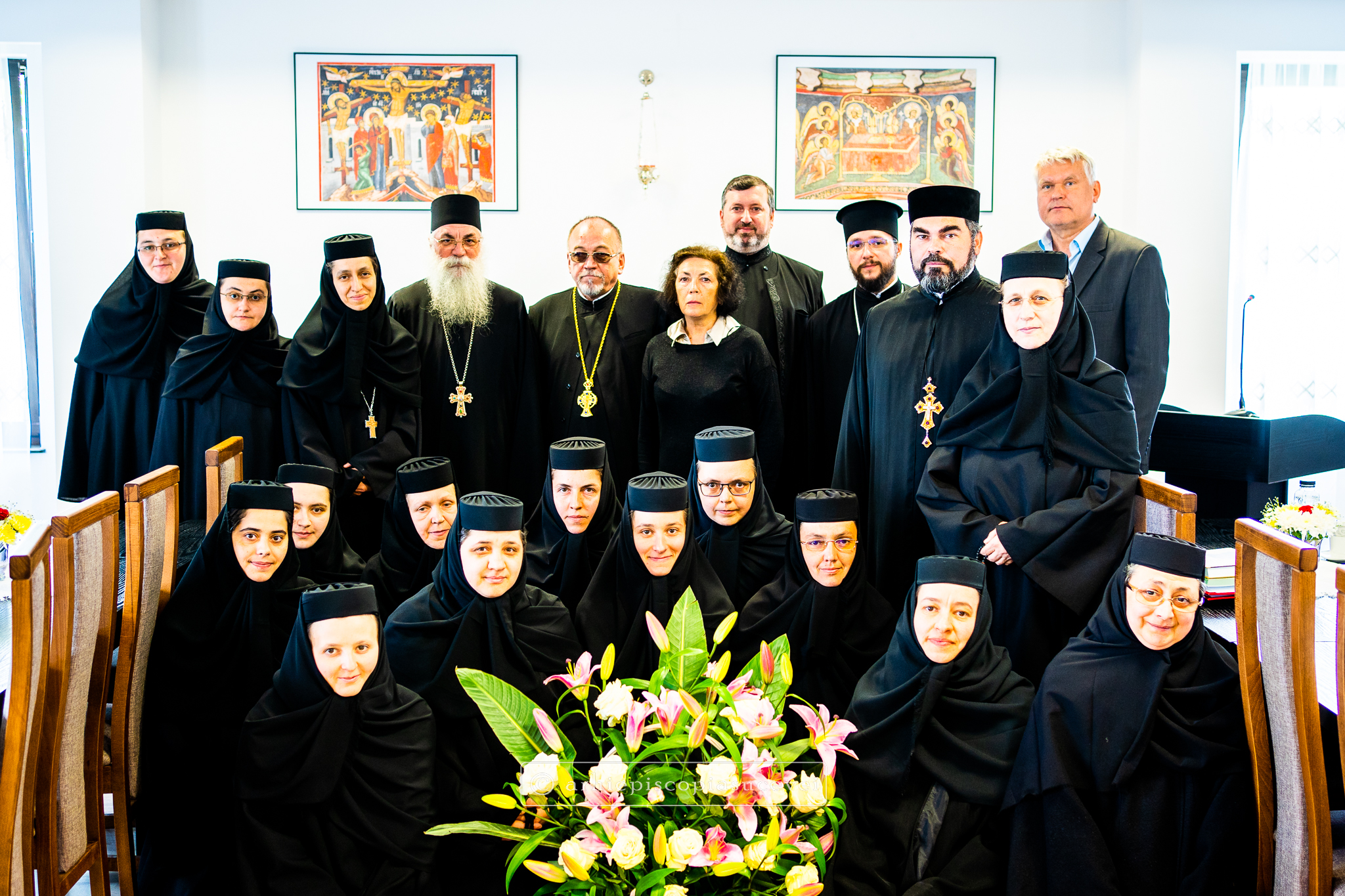
The beloved home of Anastasie Crimca, the Dragomirna Monastery was on May 7-9, 2022 the host of the International Symposium „Paisian Heritage in contemporary spirituality, art and culture. Anastasie Crimca, founder of the first hospital in Suceava”. During the event, held with the blessing of His Eminence Calinic, Archbishop of Suceava and Rădăuților, the following was consecrated Church in the cemetery, the foundation of the Metropolitan Anastasie Crimca, the place of the beginning of monastic life in Dragomirna.
In the context of the declaration of 2022 by the Romanian Patriarchate as Homennial Year of Prayer in the life of the Church and the Christian and Commemorative year of the Isishatic saints Simeon the New Theologian, Gregory Palamas and Paisias of Neamt, The symposium, dedicated to the personalities who have marked the history of Dragomirna Monastery, Paisie Velicicovschi (St. Paisie of Neamț), abbot of the monastery in the period 1763-1775, and Anastasie Crimca, aimed to bring to attention the life and work of those who have made Dragomirna remain over the centuries the place blessed with peace, light, prayer and joy.
On Monday, May 9, the session of scientific communications had prominent guests, experts in the fields of theology, history, philology and more. The symposium, organized by the Archdiocese of Suceava and Rădăuților in partnership with Suceava County Council, Suceava City Hall, the City Hall of Mitocu Dragomirnei, the County Emergency Hospital „St. John the New” Suceava and the Dragomirna Monastery, was transmitted live and on the official Facebook pages of the Archdiocese of Suceva and Rădăuților and its media partners, Bucovina TV, Doxologia, Trinitas TV, Basilica and Ziarul Lumina. The event began with a welcome message from the Mother Abbess of Dragomirna Monastery, Abbess Maria Magdalena Gherghina, not before a short moment of prayer in which the Psaltic Group „Crinii Țarinii” of the monastic settlement took part.
The first paper of the meeting was presented by Arch. Vasile Demciuc, counselor at the Sector Monuments, Heritage and Church Architecture of the Eparchial Administration and lecturer at the Faculty of History and Geography of the „Stefan cel Mare” University of Suceava, moderator of the event. Communication entitled The Dragomirna Monastery from Anastasie Crimca to St. Paisie from Neamt, founders of Orthodox culture and philanthropy in Moldavia brought to the attention of those present the historical course of the Dragomirna Citadel, highlighting the personality and especially the achievements of its main founder. „Historical research in recent decades has shown that, in addition to the literary and artistic activity of this great Moldavian hierarch, there are also aspects related to his social-philanthropic activity, expressed by the foundation of two convents: one at the Dragomirna Monastery in 1619, near the church dedicated to the Righteous Enoch, St. Elijah and St. John the Theologian, and one in Suceava, where the metropolitan residence was.”
Present online, Prof. Dr. Constantin Kornarakis, professor at the Faculty of Theology in Athens, spoke to the participants about The treasury of the philocalic tradition as the foundation of the rebirth of contemporary man. „The Nic Nicene life of the Philocalic fathers concerns a transformation and a renewal of human life, a new creation of fallen man. Philokalia, after all, means love of beauty, of the beauty of the Person of Jesus Christ, which is the divine brightness with which man is resembled by Baptism.”
Dr. Marina Vraciu from the Faculty of Letters, Department of Foreign Languages and Literatures, Department of Slavistics, „Alexandru Ioan Cuza” University of Iași, presented the study A Russian pilgrim: Sergey Cetverikov, author of the first modern monograph dedicated to the Venerable Paisie Velicicovschi.
The nun Alexandra Crețu, parishioner of the Dragomirna's oblate, gave the lecture Saint Paisios - The Great Abbot of the Eastern Orthodox, during which he emphasized the role of St. Paisie Velicikovski „as a great abbot not only for the monasticism of the Romanian Lands, where he grew and perfected his monastic community, but also for other nations (Ukrainians, Serbs, Bulgarians, Russians, Greeks), who under the guidance of the saint were able to live palpably unirea in spirit.”
The session continued with a speech by Prof. Dr. Serghei Shumilov, Director of the International Institute of Athos Heritage and Honorary Collaborator of Ukrainian Culture, entitled New information from the archives about the feast of St. Paisie Velicicovschi in the Chilia of St. Constantine on Mount Athos. „These places are an important part of the history, spiritual culture, tradition and heritage of Ukrainian and Moldavian monasticism on Athos, and have a special historical and sacred value, because it was here, around a young monk, still unknown to anyone, that a school was being founded, which later revealed to the world many personalities of the ecclesiastical and cultural sphere, monks and abbots. These holy places are currently in a state of oblivion and require further research, primarily archaeological, reconstruction and reconditioning.”
Prof. Dr. Leonte Ivanov, from the Department of Slavistics „Petru Caraman” of the „Alexandru Ioan Cuza” University of Iasi, spoke about Abbot Paisie Velicicovschi in the travel notes of a monk from Iasi. „A precious testimony, fixed in writing in an extensive work by a monk from Iași, printed in Moscow and little known in the Romanian cultural environment: Story about the pilgrimage and journey through Russia, Moldova, Turkey and the Holy Land.”
Pr. Mihai Cobziuc, director of the Minorities Department of the Pastoral Mission and Christian Actuality Sector of the Archdiocese of Suceava and Rădăutilor, dealt with the theme Reverberations of light in the life and work of St. Paisie Velicicovschi. „The luminous message of the Venerable Paisios still today opens the way for us to that science of the Spirit coupled with the message Philocalia, which, according to the Holy Fathers, is indispensable in the spiritual ascent of the believer. Philocelical spirituality has become a bond of the free soul in prayer and Christian living.”
Viorel Laiu, the director of the Theological Seminary „Veniamin Costachi” in Targu Neamt, explained to those present at the online meeting aspects of the work St. Paisie and the work of translating patristic works at Neamt Monastery. „St. Paisios paid special attention to the translation from Greek of the Greek of the Philocalic patristic writings, thus continuing the series of translations from Dragomirna and Secu. Some monks from Moldavia, Monteneva and Transylvania, being good Hellenists, translated the writings of the Holy Fathers from ancient Greek into Romanian, and the Slav monks translated into Slavonic, making the Neamț Monastery a true patristic and spiritual academy, unparalleled in other Orthodox countries of that time.”
The end of the meeting was marked by the launch of the booklet „The Dragomirna Monastery Cemetery - four centuries of existence”, edited by the Dragomirna Monastery's obseta, one of the most recent publications of the Crimca Publishing House of the Archdiocese of Suceava and Rădăuților. The symposium ended with a guided tour of the Dragomirna Fortress, entitled „In the footsteps of St. Paisie”.
The event dedicated to Dragomirna's founders is part of the series of anniversary events dedicated to the founders of Dragomirna. Jubilee Year – Muscat heritage - faith, culture, history, dedicated to honoring „the memory of those who, in times sometimes less auspicious, have erected monuments of inestimable cultural value, recognized nationally and internationally”. The papers presented at the meeting will be published in a collective volume by the Crimca Publishing House of the Archdiocese of Suceava and Rădăuților.
