
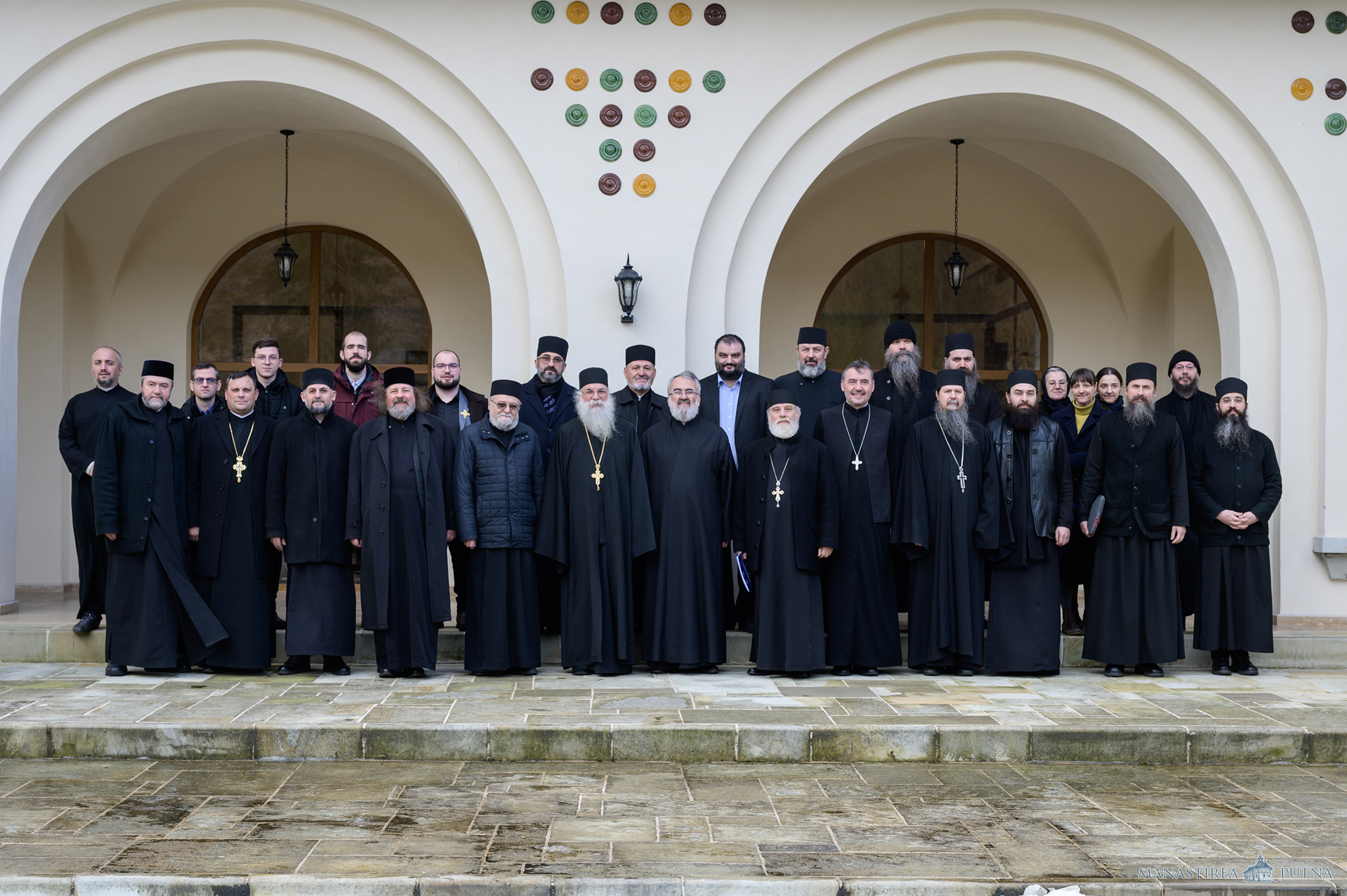
With the blessing of His Eminence Calinic, Archbishop of Suceava and Rădăuți, on December 12, 2023, Putna Monastery hosted the symposium „Theology, Culture, Mission, and Spiritual Life in the Work of Bishop Irineu Crăciunaș,” as part of the events organized by the Archdiocese of Suceava and Rădăuți to commemorate him on the 50th anniversary of his passing.
Given that Bishop Irineu Crăciunaș, in his capacity as administrative vicar and later as vicar bishop, was repeatedly delegated by Metropolitan Iustin Moisescu to serve at Putna Monastery and to address various issues concerning the monastery, as well as the benefit that his theological writings have brought to the monastic community, the monastery organized this symposium, with financial support from the State Secretariat for Religious Affairs; the speakers who presented papers were university professors.
The proceedings began at 9:00 a.m. with a welcoming address by Archimandrite Melchisedec Velnic, abbot of Putna Monastery and exarch, in which he described how Bishop Irineu Crăciunaș „a spiritual father to the community of Putna Monastery in the 1990s’ through his writings. Father Constantin Oprea, Cultural Advisor to the Archdiocese of Suceava and Rădăuți, presented the commemorative activities dedicated to Bishop Irineu Crăciunaș that took place within the Archdiocese. Next, a message was read from His Eminence Timotei, Archbishop of Arad, who had been a classmate of His Grace Irineu in Bucharest.
Archimandrite Dosoftei Dijmărescu, a monk at Putna Monastery and cultural exarch, presented the four volumes In Memory of Bishop Irineu Crăciunaș – 50 Years Since His Passing, published by the Crimca Publishing House of the Archdiocese of Suceava and Rădăuți and produced, at the request of His Eminence Archbishop Calinic, by the Exarchate Department, led by Archimandrite Melchisedec Velnic.
Next, Rev. Prof. Ion Vicovan, Ph.D., dean of the „Dumitru Stăniloae” Faculty of Theology in Iași, presented a paper in which he described the historical, social, cultural, and theological context in which Bishop Irineu Crăciunaș carried out his ministry. The paper, titled Bishop Irineu Crăciunaș. Reflections on the Context in Which He Worked and on His Historical Contributions It also included an analysis of his historical works, described as „well-written, elegantly styled, with substantial bibliographies and introductions.” Through his work and activities within the Metropolis of Iași, he was highly regarded both at home and abroad.
The first session of presentations, moderated by Prof. Ion Vicovan, Ph.D., began with a presentation by Rev. Prof. Daniel Niță-Danielescu, Ph.D., „Faces and Icons” of Bishops of the Past in the Writings of Bishop Irineu Crăciunaș. After an introduction regarding the work of the „good and gentle Irineu”—as the bishop was called by the then-Metropolitan, Iustin Moisescu—the professor spoke about two figures of bishops from Bishop Irineu’s writings: St. Pahomie of Gledin, Bishop of Roman, and Veniamin Costachi, Metropolitan of Moldavia, „spiritual fathers with many worthy sons.”.
Presentation by Rev. Dr. Bogdan Racu, Bishop Irineu Crăciunaș’s Interests in Church History, He referred to his „encounter” with the high-ranking clergyman through his writings and by participating in the commemorative events dedicated to him that took place this year. He analyzed Bishop Irineu’s historical work, which he divides into several categories: art history studies, studies dedicated to hierarchs and church figures, as well as to monastic communities, and studies concerning the Romanian Orthodox Church’s relations with other sister churches. At the same time, he mentioned several researchers with whom Bishop Irineu had fruitful scholarly discussions on iconography: Maria Ana Musicescu, Paul Mihail, Sorin Ulea, and Antonie Plămădeală. Father Bogdan Racu concluded his presentation with words of appreciation for the bishop, drawn from the remarks delivered at his funeral.
Next, Prof. Constantin Coman, Ph.D., presented his paper Outlines (Proposals) for a Theological Profile of Bishop Irineu Crăciunaș, based on an analysis of the moral theology studies in the second volume of the works of „this forgotten bishop.” Father Constantin Coman outlined Bishop Irineu’s theological profile using several indicators to assess his personality: his academic studies and the progression of his theological career; the documentary sources of his theological discourse, conducting a statistical analysis of citations from the Holy Scriptures and noting that the bishop cited nearly all the books of the New Testament and very few from the Old Testament, but that he also drew upon other theological writings, such as the Philokalia; the theological method employed, noting that he drew upon elements of both Western, scholastic theology and Eastern theology, which focuses on the nature of the person and holiness; and, finally, the dominant theological themes, which encompass two main topics: repentance and love.
This was followed by a presentation by Rev. Dr. Daniel Isai, The Concept of Interpersonal Relationships in the Thought of Bishop Irineu—A Possible Interpretation from the Perspective of Father Dumitru Stăniloae and the Philosopher Jean-Luc Marion, which, taking as its starting point the study „The Relationship Between People and Their Forms of Manifestation in Moral Life,” analyzed the connection between the writings of Bishop Irenaeus and those of the philosopher Jean-Luc Marion and Father Dumitru Stăniloae. The central concept of this analysis is intentionality, which he identifies in three categories of relationships: person-to-person, person-beside-person, and person-against-person, the latter two being marked by egocentrism.
Lecturer Dr. Alexandru Prelipcean, in his presentation Repentance in the Theological Works of Bishop Irineu Crăciunaș, referred to five of the Bishop’s studies on the mystery of repentance and emphasized the role of repentance in the lives of the faithful and the Church.
The final presentation of this session was given by Rev. Prof. Vasile Nechita, Ph.D., International Recognition of Bishop Irineu Crăciunaș’s Iconographic Studies, which refers to the Bishop’s efforts to revive monastic life through the restoration of the monasteries (Humor, Moldovița, and Arbore) and his contacts with those involved in these restorations: Sorin Ulea, Paul Philippot, and Paolo and Laura Mora. His iconographic studies have been validated by renowned researchers in the field, both nationally—such as I.D. Ștefănescu and Vasile Drăguț—and internationally: Paolo and Laura Mora and Paul Philippot.
The session concluded with several moving tributes: a personal tribute by Father Teodor Giosanu of Câmpulung, who was present at the bishop’s funeral, and reflections by Fathers Ionuț Ionescu and Ilie Macar of Sadova, who were related by marriage to His Grace Irineu.
The second session of presentations, moderated by Prof. Dr. Constantin Coman, began with a presentation by Deacon and University Lecturer Dr. Alexandru Mihăilă, Bishop Irineu Crăciunaș. Contributions to Biblical Exegesis, focusing on how the Bishop referred to Holy Scripture in his writings, noting that he exhibits the profile of a scholar faithful to the religious method. In this regard, he comments on several sermons included in the volumes published by Crimca Publishing House. Father Alexandru Mihăilă concludes that, in his writings, Bishop Irineu harmoniously combined the liturgical tradition with biblical patristics.
Associate Professor Ciprian Iulian Toroczkai, Ph.D., in The Commandment of Peace and Its Fruits, According to Bishop Irineu Crăciunaș, refers to the theme of peace found in the bishop’s writings, in which peace is not a commandment but an imperative, and has a Christological origin.
This was followed by a presentation by the priest, University Professor Dr. Ștefan Iloaie, The Fulfillment of the Human Being Through the Assumption of Moral Responsibility, According to Bishop Irineu Crăciunaș, which analyzes moral responsibility in the works of Bishop Irenaeus, discussing its values, its forms and foundations, the implications and specific nature of moral responsibility, its characteristics, ethical challenges, and necessary perspectives.
The last presentation was given by Rev. Prof. Gheorghe Popa, Ph.D., The Theological Consciousness of His Grace Irineu Crăciunaș: An Inspiring Model for the Formation of Today’s Young Theologians, on the theme of theological consciousness—the laboratory of the inner life—approached from the perspective of integrating scholastic theology into the theology of contemporary life. His Grace also painted a beautiful inner portrait of Bishop Irineu, emphasizing that the kindness and gentleness for which he was known sprang from the depth of his spiritual life.
At the end of the symposium, Abbot Melchisedec Velnic read a letter from His Eminence Calinic Argatu, Archbishop of Argeș and Muscel, in which he recounts his meeting with Bishop Irineu Crăciunaș, regarded both in his time and today as „a true monk.” In closing, the abbot thanked His Eminence Calinic, Archbishop of Suceava and Rădăuți, and the State Secretariat for Religious Denominations, whose support and involvement made possible not only the publication of the commemorative volumes featuring the works of His Grace Irineu Crăciunaș, but also the organization of this symposium. The papers presented will be published in a new volume dedicated to Bishop Irineu.
Recorded by: Archimandrite Dosoftei Dijmărescu
Photo: Protos. Timotei Tiron
