
The fast dedicated to those who are has begun first among the Apostles, seated on the throne and teachers of the world, Saints Peter and Paul the Apostles. A time to focus our minds, again and again, on the Way, looking at and living „through the lens of the Cross.”.
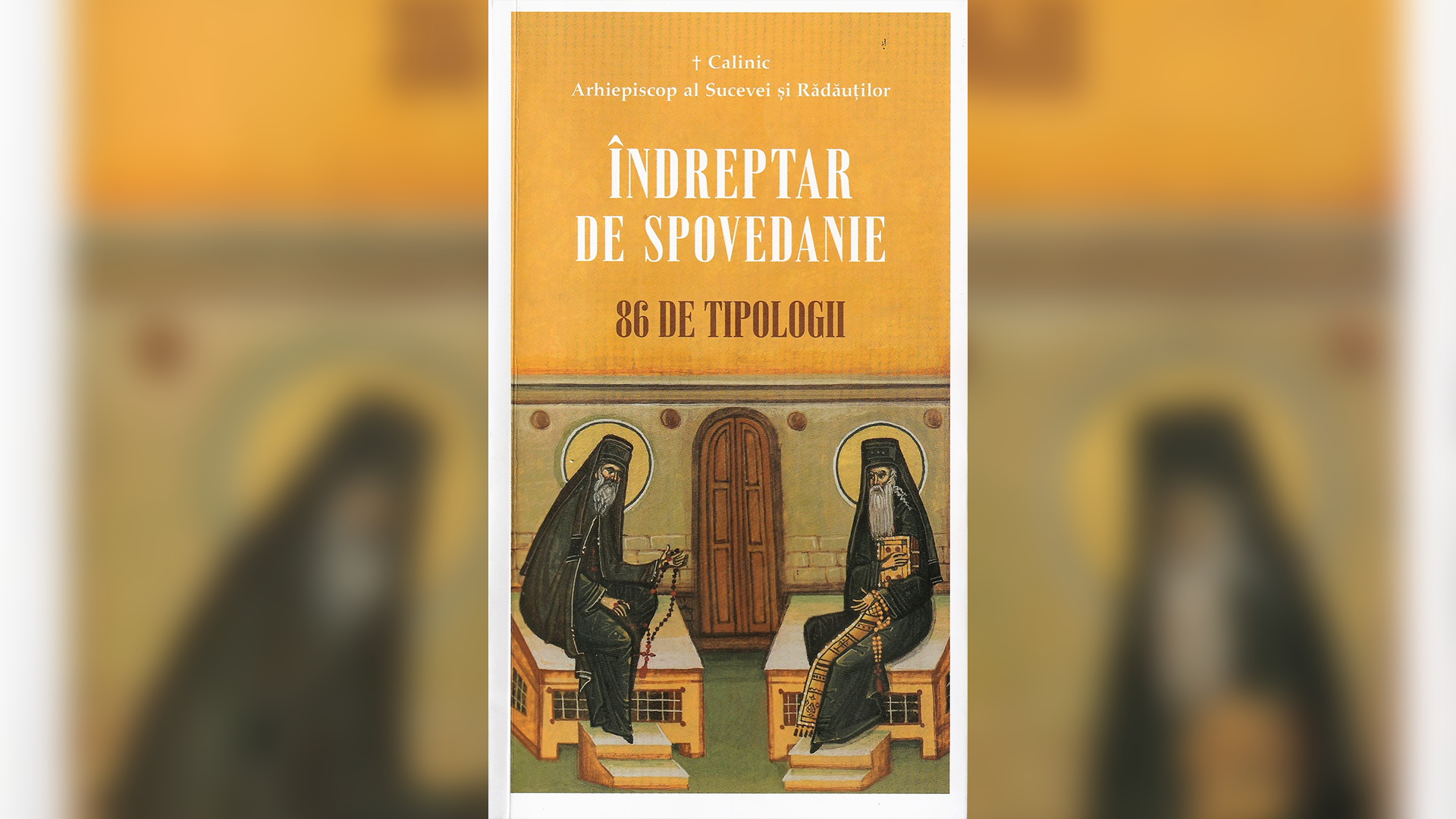
Hot off the press Guide to Confession, compiled by His Eminence Calinic, Archbishop of Suceava and Rădăuți, published by Crimca Publishing House, contains several sets of questions that can guide children’s confession, and each of them corresponds to a different principle of the pedagogy of fostering a friendship between young confessors and Christ.
A Guide to Confession, conceived within the paradigm of „all-fullness” 10, as defined by Saint Maximus the Confessor in „Replies to Thalassius” (Philokalia, vol. III), comprises 86 sets of 10 questions each, potential anchors for spiritual dialogue, which can guide the mystery of confession. And, among the 86 types proposed by the Archbishop, four address childhood: child (ages 4–7); child (ages 7–10); child (ages 10–14); child from an orphanage. To these are added seven more sets of questions, which open this brief treatise on spiritual guidance and which, from the very beginning, establish the coordinates of the place, purpose, and meaning of the effort toward spiritual ascent, toward perfection:Communion with God the Father; Communion with God the Son; Communion with the Holy Spirit; Communion with the Mother of God; Communion with the Saints; Relationship with the Church; Attitude toward holidays.
Therefore, the bishop’s recommendation is that self-confession should begin with the confession and reaffirmation of faith in the perfecting Love and in the Unity of the Holy Trinity, with the reaffirmation of trust in the intercessory power of the Holy Virgin, with the renewal of the aspiration to acquire exemplary virtues like the saints, and with the reaffirmation of the will to do Good, through communion and an authentic, witness-bearing life within the Church. Set forth in words that express the truth of the faith in a way children can understand, these questions, repeated from time to time in the Holy Sacrament of Confession, are themselves the foundation for strengthening the holy emotion of encountering Christ. A Christ of Love whom the child gradually and progressively learns to discover, to know, to love, to follow, to live, and to bear witness to.
Moving from the familiar, safe world toward the aspirational, desirable one, the guide It offers both a progression of introspection and a relevant forward-looking dimension of the child’s socio-emotional and spiritual horizon—as a young witness to and follower of Christ. The family, circle of friends, playmates and schoolmates, the school community and the extended school community are all environments in which the child aspiring to resemble his Creator can learn and practice the ability to distinguish between good and evil, between light and shadow, between what is right and useful, and desirable, and permissible, and what is neither useful nor appropriate, just as in days of old, the sons and daughters of kings, at the urging of Holy Sunday, or Holy Wednesday, or Holy Friday.
A pedagogy grounded in divine teaching and rooted in the practice of love for one’s neighbor, goodness, virtue, solidarity, and communion. Faith as the „cornerstone” of becoming, following Christ’s exhortation and example. An exercise in becoming, practiced continuously, together with others, in the Family, at School, and in the Church. And the structure of each set of guiding questions for children’s confession is precisely this: love learned and lived in the Family; virtue as an effort toward unceasing growth, at School; communion in the performance of good deeds and in prayer—the full crowning of the spiritual life in the Church. A natural path for the child’s friendship with Christ! A guide that can also be handy for a parent, for those moments of sitting down to counsel with one’s own child, a small universe learning self-revelation, at the time when the stirrings of the soul, eager to grow, find solace on the knees of good thought and wise, enlightening counsel. And I would recall here and now just a few questions: When you failed at something, did you—perhaps—feel as though God, the Virgin Mary, and the saints had abandoned you?; Have you ever been so disappointed by something or someone that you said God doesn’t exist? Are there people around you—parents, siblings, grandparents, friends, classmates, teachers, etc.—whom you haven’t been able to forgive for something specific? When you failed to fulfill your desires, did you blame God, your parents, your teachers, etc., for the failure?.
It's a Guide to confession to which our thoughts should often return, with the conviction that we are all—Family, School, Church—equally called to nurture a beautiful upbringing, „in spirit and in truth” (John 4:23), of the children of this world, in response to a repeated and lofty call: „Behold, I and the children whom God has given me” (Isaiah 8:18). An expected response, of which the synaxaria often bear witness, and which is also mentioned in The 3rd Icos from the Akathist of Saint Irodion of Lainici Monastery, spiritual father to Saint Calinic of Cernica, depicted—indeed—in an icon on the front cover of the guidebook: „As the brothers rushed to a spring of water (…), a great community was formed, O Pious One, and you, O Holy One, looking upon them, gave thanks to God, saying: ”Behold, I and the children given to me by God!’”.
