
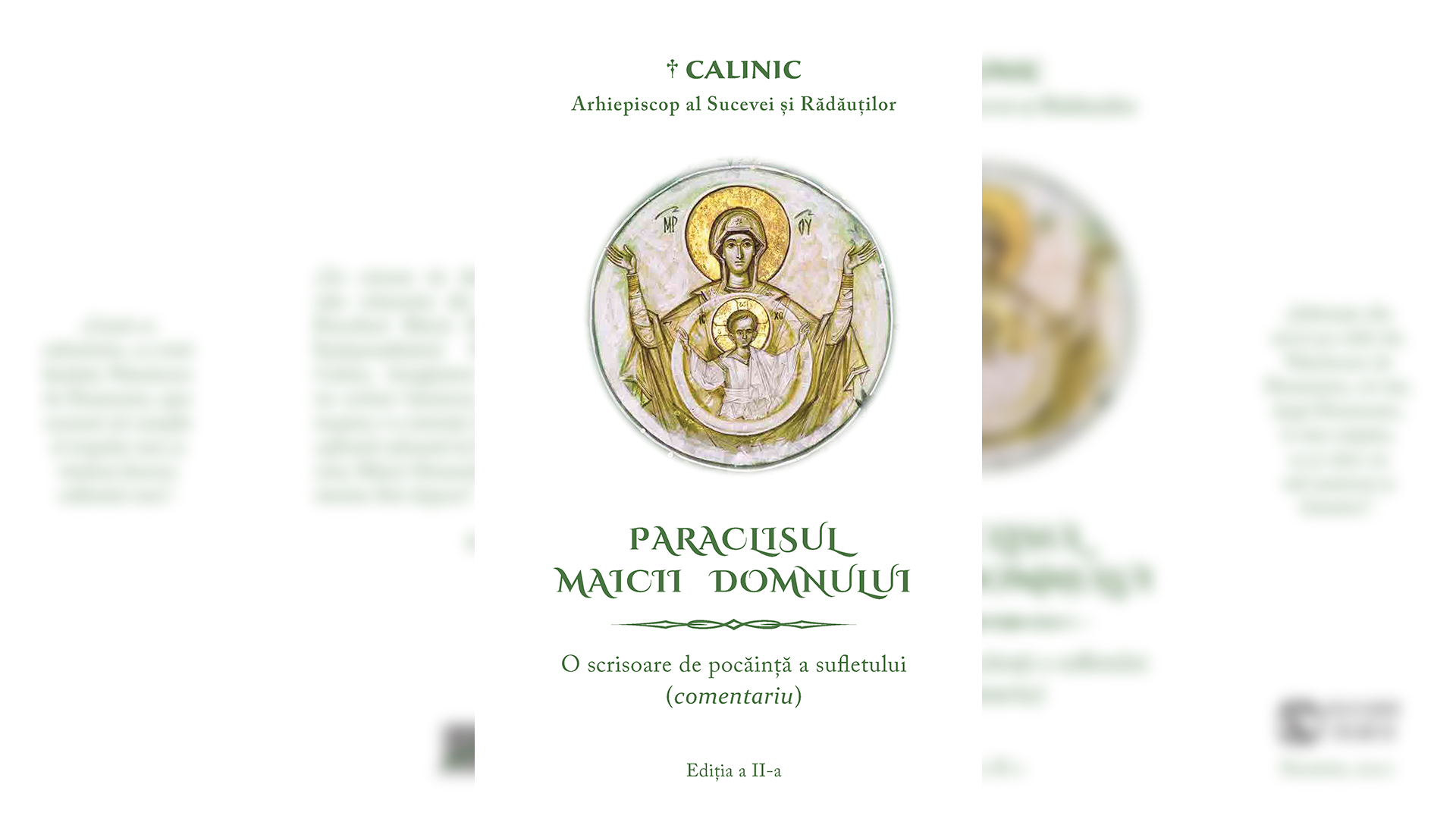
You can't read The Paraclete of Our Lady - A letter of repentance of the soul (comment), a volume bearing the signature of His Most Reverend Father Calinic, Archbishop of Suceava and Rădăuților, and not to have the feeling of prayer that reinterprets prayer.
This second edition of the commentary, published a few days ago by Crimca Publishing House, reveals itself to be an iconic reconfirmation of the imperative symmetry of ideational content - spiritual-emotional mandate - graphic representation.
The colors and design of the covers, white with inserts of pale green, olive, and the soft brown of the earth - the colors of the earth that was glorified also through the Blessed Virgin - and a discreet golden glow of nimbus, are in themselves an apperceptive prologue to the interiorization of a text that is at once theological and literary, exegetical and apologetic, liturgical and catechetical, in which the ideas are, in fact, metaphorical iridescence of a profound teaching of faith, gently and carefully unfolded in strips of light.
Cover I illustration, iconographic fragment taken from the composition „The Burning Bush”, a work bearing the artistic mark of Elena Murariu, included in the exhibition Church in heaven, is - in the key to understanding the diptych prayer-icon - an anticipation of the depth and expressiveness of the text, a setting in the sensitivity of art of the power of transfiguration of words. Moreover, the artist once confessed: „I love beautifully spoken text. It inspires me.”
On the flaps of the covers, within easy reach of the gaze and of the thought that seeks its time of prayer, are the verses of the Paracles of the Blessed Virgin, to which a chapter is dedicated in the commentary of the Archbishop: Deliver your servants from their needs, O Mother of God, so that all of us may flee to you, as to an unbroken and useful wall. and Seek with mercy, most gracious Mother of God, to the terrible affliction of my body and heal the pain of my soul. The conceptual matrix, circular and relevant, of the design of the work ends with a fragment of essentialization from the preface signed by Fr. Dr. Matei Corugă: „A horizon of dew-bringing spirit of dew comes to the reader from this commentary on the Paraclete of the Blessed Virgin composed by His Most Reverend Father Archbishop Calinic, a perfect liturgist and talented ecclesiastical writer, a commentary that he has entitled, inspired by the inspiration of the Holy Father, the A letter of repentance of the soul addressed to God through the intercession of the Mother of God, a letter that never goes unanswered.”
The entire commentary, structured - in an unbeatable logical sequence of analytical approach - in 17 chapters, from Short history and Structure of the chapel, by those that capture and unravel the order and purpose fisheries, al the stipendiaries and sedelnelor, as well as by the conviction that the Apostle and the Gospel contained in the ordinance of the confessional are equivalent A consoling chat or by the promise Heaven of goodies from catavasie and stihoavnă, reveals itself to us, from the very first receptive reading, as being written by a condeier who tries to calligraphize the world according to his soul.
A text that correlates both with an intensive, analytical, assimilative reading, as in the case of specialized dissertations, but also with an associative reading of reflective and metaphorical insertions, involving revisiting the text, associative, reflective and creative retrospections.
What did I retain from the ideas shared with such generous spiritual and pedagogical acuity? „St. Hierarch Dosoftei - the founder of the Romanian liturgical language”; „The Paraclete is the diamond chisel that digs out the petrified depths of the soul in order to mold and liberate”; „the discourse of the Paraclete is imperative”; „with the name of the Mother of God we penetrate from the outside to the inside of ourselves”; „pure and uninterrupted prayer is the only one capable of discovering us as we are”; „Psalm 50 anticipates the beginning of the war of penance”; „the prolonged and discreet pathos of the stichres”; „the mercy of the Mother of God recalibrates the weaknesses of the soul”; „we all need the light of God's commandments so that we may face the darkness of ignorance on our way to eternity”. And the need for the bath of divine grace, „acquired through the prayers of the Mother of God, carried in the mind and in the soul like a heruvimic and seraphimic hymn”. Or that of the recomposition of the soul wounded by sin, which needs „successive „successive prefaces, prayer and repentance bringing moral and spiritual renewal, a ”cross of repentance”"."
At the same time, the idea of the circuit of prayer in the Church, the evocation of the woman clothed with the sun, the interference of the soul's states on multiple levels, the diaphanous metaphors, the thrill of despair that is converted in the presence of the Blessed Virgin, giving way to light.
The apotheosis of the unceasing call of the Blessed Virgin remains apotheosized. „The calling of the name of the Blessed Virgin is just as when, saying the name of someone, we bring into our soul his whole being, with all that characterizes him, but especially as we see him at that moment, the name being not only a copy of the whole, but the real whole which, without ceasing to be outside, is also within the one who utters it.”
Also remarkable is the abundance of liturgical and typiconal terms and the sustained alternation between analytic perspectives and the unsuspected depths hidden in the flow of the words. Words after which you feel the need to shut up and let them build.
In the penultimate chapter, Heaven of goodness (Catavasia and stihoavna), literary expressions established by Mariological theology are invoked: „Most Blessed Virgin”, „the honored scepter of the Emperor Christ”, that which raised the Grapes of the mystery”, „the door of heaven and the unapproachable bush”; „the light of the whole world”, (...), „shady mountain”, „golden candlestick”, „Most Precious”, „glory of Christians”, „heaven”, „divine table”, „golden cloud”, „joy of all”, called by the Archbishop „spontaneous outpourings of a soul grateful for the blessings received from the Mother of God”. And perhaps the thought that this letter of repentance of the soul is also a voice of gratitude and a metaphor of two dignities - Mother and Virgin.
