
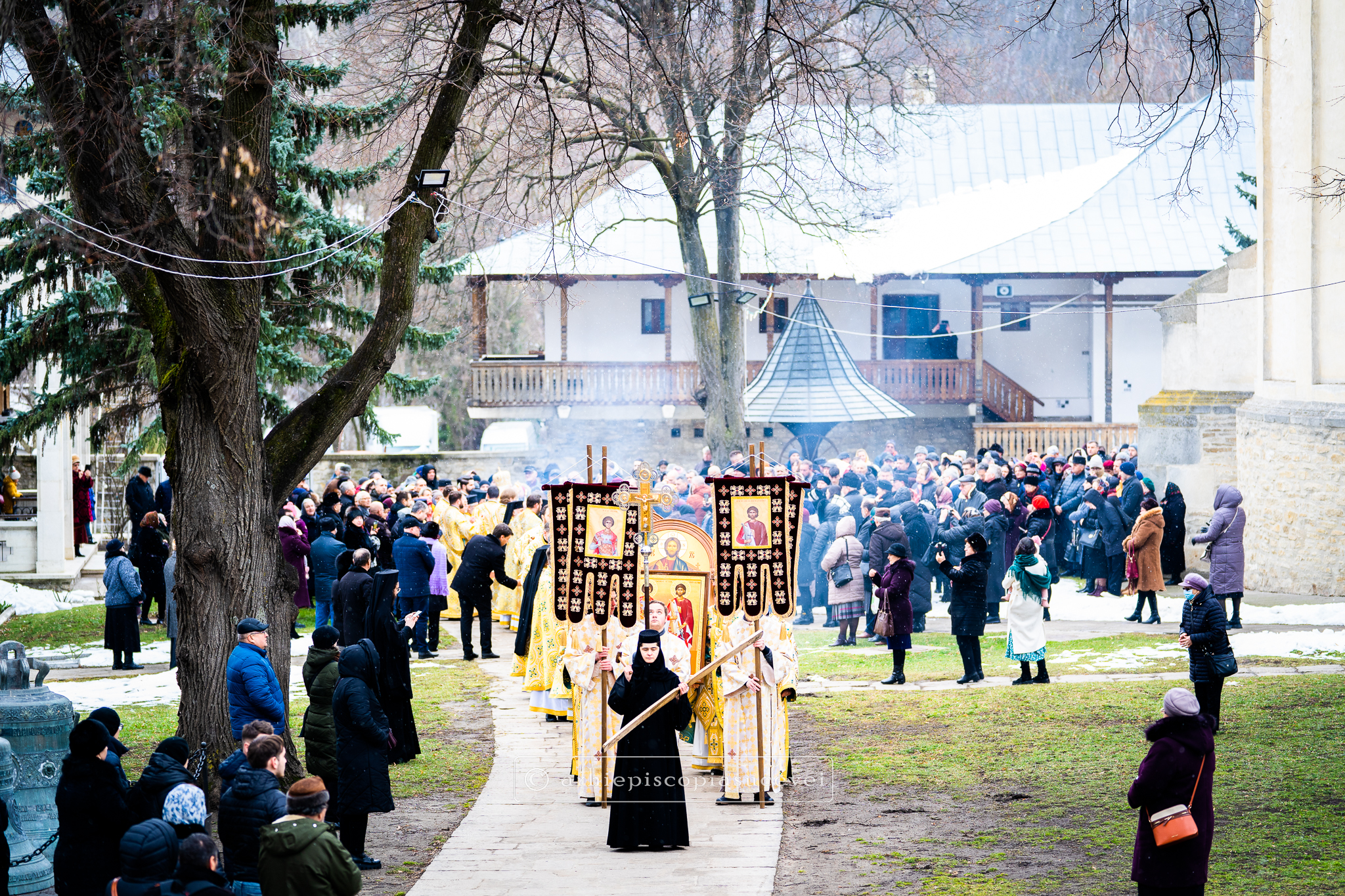
The First Sunday of Lent, also called Sunday of Orthodoxy, was an occasion of communion in prayer and Christian confession at the Archiepiscopal Cathedral in Suceava, the monastery in which the relics of St. John the New, great miracle-worker and prompt helper, are placed for honor
On this occasion Sunday of the Right Faith and Unity of the Church, The Most Reverend Father Calinic, Archbishop of Suceava and Rădăuților, celebrated the Holy and Divine Liturgy of St. Basil the Great with a choir of priests and deacons, including servants of the monastic settlement and clergy from the Eparchial Center Suceava, on the stage set up in the courtyard of the Monastery „St. John the New from Suceava”.
The liturgical responses were given by the mixed choir of the Archiepiscopal Cathedral of Suceava, conducted by Fr. Ionuț Lucian Tablan Popescu. In the context of the national declaration of the year 2023 as the „Ciprian Porumbescu Cultural Year”, during the Mass of Prayer Our Father was performed in the version composed by the genius Romanian ballads, as part of an effort to integrate several pieces by the great Romanian composer into the liturgical service.
At the end of the Holy Mass, Archimandrite Paraschiv Dabija, administrative vicar of the Archdiocese of Suceva and Rădăuților, read the pastoral message sent in the year of our Lord 2023 by the members of the Holy Synod of the Romanian Orthodox Church, on the occasion of the first Sunday of Lent.
„The Sunday of Orthodoxy the victory of the Church over all heresies is celebrated each year, commemorating those who have remained faithful to the Church in times of trial. In Holy Scripture there is abundant evidence of the duty of each one of us to honor holy icons. Already in the first chapter of the The facts God is said to have created man in His image (cf. The facts 1, 26-27). Therefore, man was created after the face(icon) of God. God so loved the world that he gave his only-begotten Son so that the world might have life, and have it more abundantly (cf. John 3, 16; 10, 10). Therefore, the Son of God became incarnate and became Man, because He is the image of the Father (cf. Jewish 1, 2-3). Therefore, Jesus Christ himself said: He who has seen me has seen the Father (John12, 45; 14, 9). St. John Damascene refers to the representation of God in the icon, saying: I portray the invisible God, not as invisible, but as the One who made Himself visible to us by participation in flesh and blood. I do not paint the invisible Godhead, but I paint the seen Body of God.”
In remembrance of the victory of Orthodoxy over iconoclasm at the VII Ecumenical Synod, after the Divine Liturgy a procession of the Holy Icons took place around the Church of St. George the Great, the Great Martyr of St. George of St. John the New Monastery, led by His All-Holy Father Archbishop Calinic. The hierarch, the priests and the faithful brought glory to God and to all those who fought for the honor of the holy icons. The icons, including Jubilee Icon, The icon of St. George and St. John the New, depicting the Holy Martyrs, painted to mark the half millennium since the consecration of the church of the monastery, as well as a copy of the icon of the Virgin Mary, the miracle-worker from the catapetheva of the place of worship, were carried in the hands of those present as a sign of witness to the importance of the cult of the icon in the life of the Church.
All the faithful present at the event received, on behalf of His Most Reverend Father Archbishop Calinic, icons that epitomize the work of the Seventh Ecumenical Council and the mystery of the representation of the visible representation of the supernatural, revealed to the fathers participating in this synod. The icons were realized at the „Vartolomeu Mazereanu” Printing House of the Publishing House Crimca of the Archdiocese of Suceava and Rădăuților.
At the end, His All-Holiness sent a thought of blessing and an exhortation to preserve the spiritual heritage entrusted to us by our forefathers. „May you be in good health and guard Holy Orthodoxy as we have taken it from those who are no more, but who watch over how we manage all our holy faith.”
Sunday of Orthodoxy, established as early as 843, in the time of the Byzantine Empress Theodora, represents the victory of Orthodoxy over those who opposed the cult of holy icons, putting an end to its martyrdom, but also over all the heresies and false teachings of faith of the first eight centuries. By raising prayers with piety and faith either to the Savior, or to the Mother of God, or to the saints represented in the holy icons, they strengthen us and help us to overcome temptations and sins, the icon being the graceful space of human union with God.
Daniela Livadaru
Irina Ursachi
