
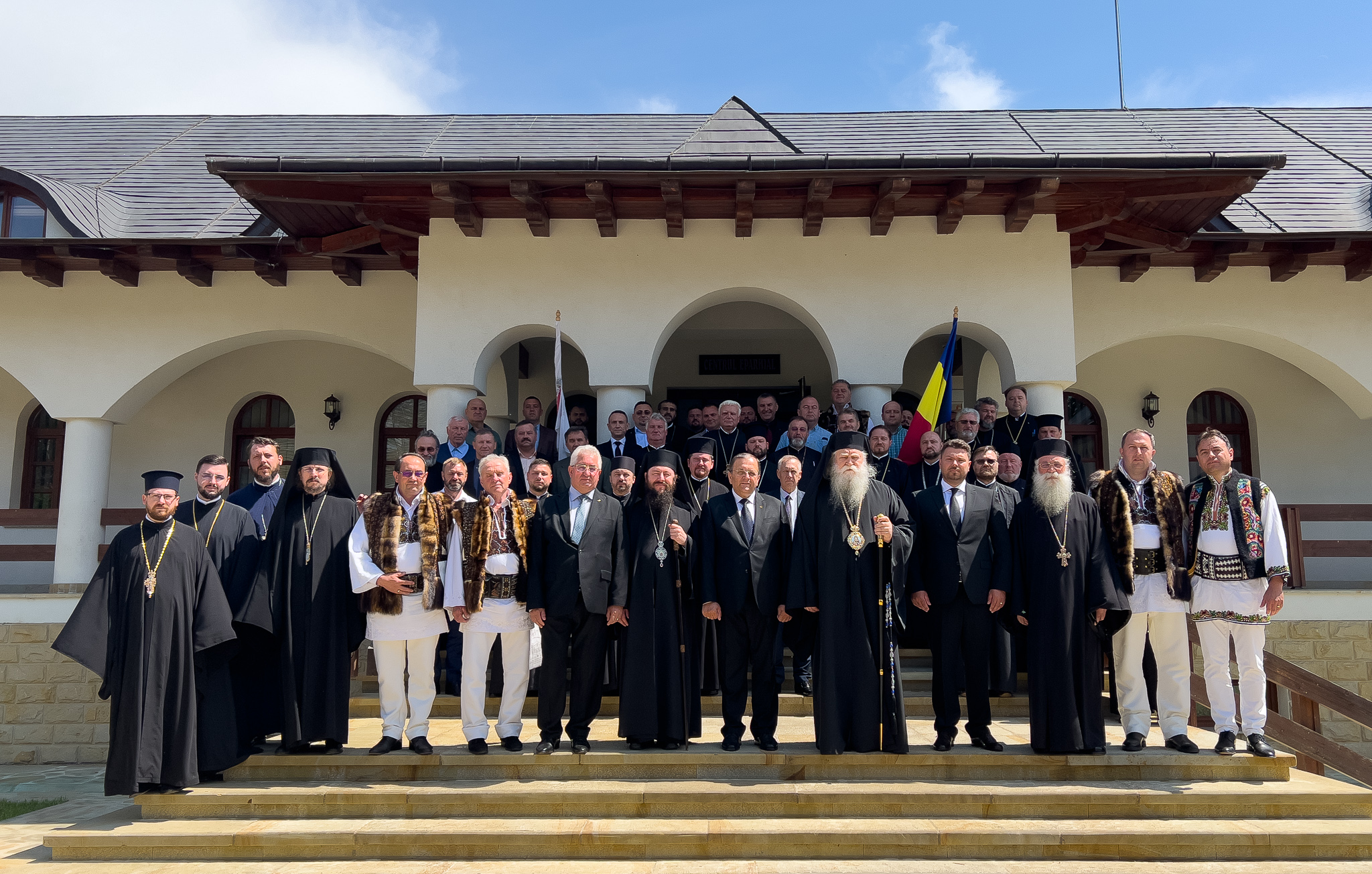
On Saturday, June 4, 2022, when the Orthodox Church celebrates the feast of the Holy Martyrs of Niculițel, Zotic, Atal, Camasie and Filip, the meeting of the new Eparchial Assembly of the Archdiocese of Suceava and Rădăuților took place in the „Pimen Archbishop” Hall of the Eparchial Center.
At the opening, His Eminence Archbishop Calinic, diocesan counselors and inspectors, as well as elected members of the ecclesiastical forum, clergy and lay people, participated in the Mass Te-Deum, celebrated in the Church „St. George” of the Monastery „St. John the New”, Archiepiscopal Cathedral of Suceava, by His Eminence the Most Reverend Father Damaschin Dorneanul, Bishop-Vicar, surrounded by a choir of priests and deacons.
The proceedings of the extraordinary session began with a welcome message by His Eminence Calinic, followed by the PC Pr. Dimitrie Horga, Eparchial Counselor in the Administrative-Bclesiastical Sector, who briefly presented the methodology for electing the new composition of the Eparchial Assembly for a new 4-year term of office, from 2022-2026.
Then followed the nomination and constitution of a provisional secretariat, headed by PC Pr. Constantin Georgian Rotar who, after the roll-call of the elected members according to the electoral constituencies to which they belong, centralized the mandates of the elected members, assisted by the provisional secretaries. As the Assembly was legally constituted, the President of the Assembly invited the members of the ten electoral constituencies to organize themselves into two sections to verify the mandates, and then the rapporteurs of the ten constituencies, as there were no contested mandates, proposed that the elections be validated. After the vote, the new Eparchial Assembly was declared by His Eminence Archbishop Calinic to be legally constituted and able to take decisions.
After the composition of the Bureau of the Eparchial Assembly, the Secretary General, designated in the person of PC Pr. Constantin Georgian Rotar, read the agenda, during which the list of titular and honorary members for the 2022-2026 mandate was read and the 5 commissions of the assembly were constituted: administrative-church, cultural and educational, economic, budgetary and patrimonial, social philanthropic and the organizational, juridical and validation commissions. Each of these commissions is made up of two clerics and four lay members.
The meeting continued with the election and delegation of members to the National Church Assembly, to the Eparchial Council (3 clergy and 6 lay people) and to the Eparchial and Monastic Consistory. At the same time, 2 clerics and 2 monastic clerics for the Monastic Consistory were nominated for approval by the Metropolitan Synod as members of the Metropolitan Consistories.
Present at the extraordinary meeting to constitute the new Eparchial Assembly, Mr. Ioan Stan, Member of Parliament, Mr. Eng. Gheorghe Flutur, President of the County Council, and Mr. ec. Mr. Ion Lungu, Mayor of Suceava, were proposed as permanent guests of the Assembly for the period 2022-2026.
The last item on the agenda was the speeches from those present. His Eminence invited all those who wished to make points to the microphone, and the secretariat will note the relevant points in the minutes.
Mr. Gheorghe Flutur thanked His Eminence the Archbishop for the invitation to take part in the Eparchial Assembly and congratulated him for the entire organization of such an event. He also congratulated all the members of the ecclesial forum and wished them every success in their mission:
„I wish you success and we wish you success for the mission we have. It is very important to understand our mission in the new conjuncture and to define the challenges to which we will have to respond intelligently in the period ahead. Because the world is changing, mankind is changing, and the war on our borders makes us think a little differently, organize our priorities differently.”
Among the societal challenges he pointed out, we mention the decreasing birth rate, caused by the massive exodus of the population abroad, as well as the conflict between modernity and traditionalism, as a result of which, more often than not, Romanian national values suffer. „These are challenges to which I believe that each of us, and together, must find an answer, because they are challenges in which the Orthodox Church is expected to intervene. She is also intervening, I can see it, I feel it, but she is still expected to intervene because in history the Church of the nation has been a pillar of stability [...] We have an important mission, namely to enhance the family and all traditional Romanian values: religion, the Church, faith; all of which I believe we must defend better, to be personal examples. [...] Let's bring young people and families to church. I am not saying this to you. I say this to myself as head of the county administration, I say this to my fellow mayors, because we have this mission.”
Then followed Senator Ioan Stan, who thanked those present for the vote to be a permanent guest of the Eparchial Assembly, while promising all the support in the steps that the Archdiocese of Suceava and Rădăuților is taking to build a new Eparchial Center. The Mayor of Suceava, Mr. Ion Lungu, also showed his openness to join this initiative initiated by His Eminence Archbishop Calinic, emphasizing that it is a challenge for the members of the Eparchial Assembly to fulfill this desire. In his address to those present, he emphasized the financial support offered by the institution he heads, as well as the fruitful social-philanthropic collaboration between the institutions.
The other speakers were Mr. Ioan Burlui, Brigadier General (in reserve) and President of the Suceava County Branch „Plăieșii” of the National Association of the Cult of Heroes „Regina Maria”, and Dr. Valeriu Gavrilovici, who is in his second consecutive term in the Eparchial Assembly of the Archdiocese of Suceava and Rădăuților. His reign brought up the measures taken by the authorities during the pandemic period, especially in the run-up to the 2020 Easter holidays, when all churches were forced to close their doors. „It simply took away the right to go to church. Because just as caring for the body is taken for granted and every man takes care to look after his health and go to the doctor or hospital when he needs to, it cannot be that caring for the mind, soul, spirit is considered second-rank. The Latin saying, which we all know, Mens sana in corpore sano tells us that first the mind must be sound. Or the minds of so many people (...) have been altered, have been damaged.” The family and the demographic problem, the ideological onslaught of social networks and their harmful impact on young people, as well as the need to promote patriotism and knowledge of the history of the Romanian people are other issues raised by the doctor from Suceva, who in conclusion, paraphrasing Father Nicolae Steinhardt, told his colleagues in the Eparchial Assembly that a true Christian must do what is not possible, because „with God all things are possible”.
Aurel Goraș, the Protoprioress of the Deanery of Câmpulung Moldovenesc, in his speech, noted that this „wise” formula was chosen, "to gather in one bouquet all the energies of the county" in order to realize beautiful works in the mandate of the new Eparchial Assembly.
Archimandrite Melchisedec Velnic, Exarch of the Monasteries, followed, after the congratulatory message to the newly elected, and brought up the problem of the Bukovinians from across the border in Ukraine. They were and still are forbidden to speak Romanian, and books are scarce or scarce and expensive. In the context of the military conflict in the neighboring country, His Holiness drew the attention of the Eparchial Assembly to the fact that „we are witnessing depopulation and, I would say, a kind of purge in the Romanian lands and villages on the other side.” Another aspect raised was the decision of His Eminence the Archbishop to reopen all the monasteries closed in the Archdiocese of Suceava and Rădăuților during the Austrian period, starting with Solca Monastery, a place of worship which this year celebrates 400 years since its consecration.
In his closing speech, His Eminence Archbishop Calinic thanked all those who took the floor and who „spoke like biblical patriarchs” and who „approached the topics holistically, as such topics should be approached in such meetings”. He also presented all the participants with two of his latest works, published by Crimca Publishing House, „Tanatology and immortality” and „Parables - gems of Jesus” teaching". At the same time, in order to support each member of the Eparchial Assembly when, at the end of the year, he will have to draw up a report on the work carried out, His Eminence has prepared a Decalog, which we publish in full:
DECALOGUE OF THE DIOCESAN DEPUTIES
- Show your faith in God by serving the Church in the dignity to which you are called.
- Defend the values of Orthodoxy, living testimonies of the identity of the Romanian people.
- Promote and support ongoing Church initiatives and activities.
- Propose new projects, in the committees you are part of, that bring added value to the work of the Church.
- Support the restoration, consolidation and renovation of churches and monasteries, as well as the construction of social settlements.
- Be in the community witnessing apologists of the treasure of Orthodoxy.
- Highlight in society the spiritual, social-philanthropic, cultural, educational, missionary and building work of the diocese you represent.
- Do not hesitate to take a stand, in writing or verbally, when the Church is wronged.
- Defend and promote the truth when the image of the Church and its ministers is damaged.
- Work for the Church as you would work for your own family, for I assure you that God is not indebted to anyone.
According to Articles 90 and 91 of the Statutes for the Organization and Functioning of the Romanian Orthodox Church, the Eparchial Assembly is the deliberative body for all administrative, cultural, social-philanthropic, economic and patrimonial matters of the diocese.
The Eparchial Assembly is composed of elected representatives of the clergy and the faithful, in the proportion of one third clergy and two thirds laymen, with a moral and religious life worthy of a Christian, who have applied for election with the blessing (written approval) of the local hierarch. In the event of actions contrary to the Church, their mandates are revoked by the Eparchial Assembly on the proposal of the hierarch.
The lay members of the Eparchial Assembly are elected by the delegates of the parish councils, constituted in lay electoral colleges, by circumscriptions.
The clerical members of the Eparchial Assembly are elected by all priests and deacons in office, constituted in priestly electoral colleges by circumscriptions. Members of the Eparchial Assembly, clergy and lay, are elected for four-year terms. They can be elected for a maximum of two terms. Their number is 30.
