
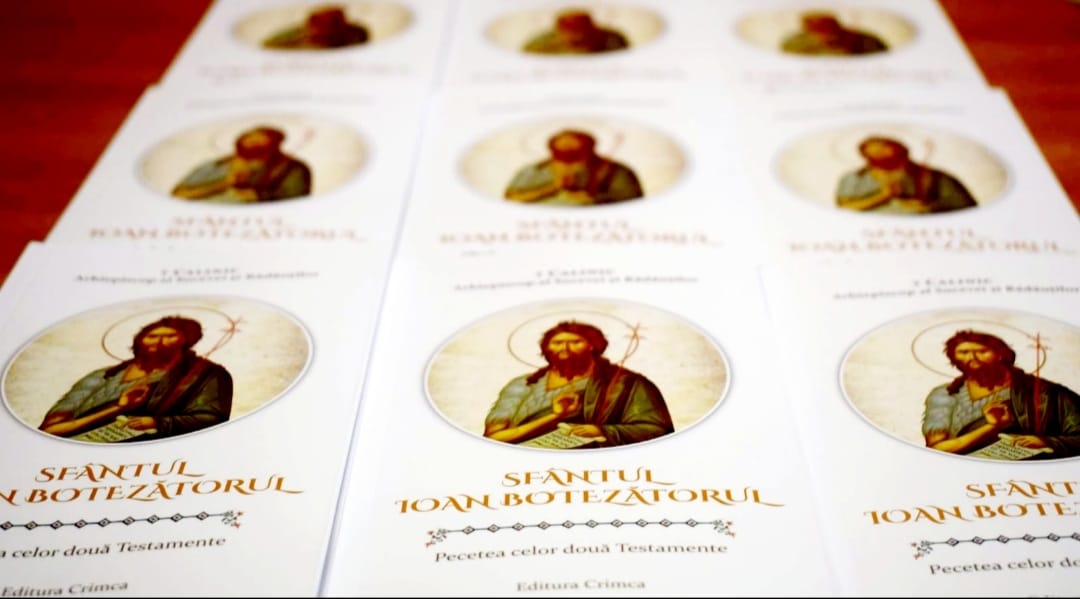
On the day on which our Church remembers the martyrdom of St. John the Baptist, the Wayfarer before Christ, the kneeling of the soul is deeper and the prayer more persevering. It is a day on which, after the apololy of Holy Mass, it is the turn of the mind to blossom. And I would think, perhaps I'm not mistaken, that it may also be time for a book, published a short while ago by Crimca Publishing House, in the Archdiocese of Suceava and Rădăuților, another volume bearing the signature of His Most Eminence Archbishop Calinic, dedicated to the saint whose perfect sacrifice we are celebrating today, St. John the Baptist, The seal of the two Testaments.
A book - prayer and gift, in which we rediscover, in a concentrated scriptural, historical, liturgical and exegetical evocation, the prophetic personality of the saint of whom the Savior Himself said that „There has not risen among those born of women a greater than John the Baptist” (Matthew 11:11). And, in a natural extension of the thought thus subjected to the entrustment, The acatist hymn of the miracle-working icon of the Forerunner of the Lord, from Gorovei Monastery.To read the book in its entirety would only take a few hours. But hours of prayer and sharing of grace.
Observing the color and design of the covers, white with inserts of pale green, olive, brown of the earth - the colors of the earth and those of asceticism in ermines - you get the feeling of a beautiful asceticism of the eye; in fact, an iconic reiteration of the symmetry of the ideational content - spiritual-emotional mandate - graphic representation, an anticipation of the semantics of prayer, as it was lived, and invoked, and cried out by St. John the Baptist.
On the cover, in a medallion, the icon of the Forerunner, the saint in whom courage and humility were so perfectly combined, the „angel” whom the Prophet Malachi saw walking „before the face of the Lord”.
On the cover flaps, within easy reach of the eye and of the thought that seeks its respite of prayer, the 9th and 10th Canticles of The hymn of the miracle-working icon from Gorovei Monastery, hymn testimony of the hymnographic grace of the Archbishop: Multitudes of the faithful from everywhere run to your miracle-working icon in times of trouble, hoping in your intercession, and in times of joy they come to give you thanks for your intercession at the throne of the Most Holy Trinity and to sing to you: «Rejoice!»and to God: Hallelujah!” and Monks and nuns, hermits and hermits, male and female believers alike, run to your miracle-working icon, Holy John the Baptizer, and with tears of humility pray to you to strengthen them in the temptations of many kinds and guide them in their spiritual life; for this they sing to you: «Rejoice!», and to God: Hallelujah!”.
The editorial note achieves its apperceptive valences and summarizes the structure of the volume, the aesthetic considerations of the spiritual and cultural act placed between the pages and some landmarks of the reading experience imposed by such a writing.
The architecture of the work itself evokes the prophetic personality of the „angel of the wilderness”, suggestively contoured in two parts. First, in the brilliance of scriptural evocations - his teaching, his prophetic activity, his earthly life. Five chapters: The Prophets of the Old Testament, The Birth of St. John the Baptist, The Day of John's Revelation to Israel, The Baptism of John, The Martyrdom of St. John the Baptist. Then his angelic dignity, heavenly consecration, prayer - The hymn of the miracle-working icon from Gorovei Monastery, „a creation of the author, offered as a sacrifice to this icon, rightly considered a true icon «treasure trove of spirituality».
The first chapters, conceived in the paradigm already established by the Archbishop of the verses, of the concentration of long and successively refined messages with the depth of a thorough, comparative and argumentative study, illuminated by the staunchness of prayer and fullness of grace, totals 135 paragraphs, each of which is in itself a miniature of a treatise of the scriptural erminia type. And in the even more emphatic articulation of their syntality - historical information and data, cultural details, patristic additions and explanations, moral and liturgical extensions. And I would stop, for example, totally by chance, at verse 24 of the chapter entitled Old Testament prophets: Although the prophetic activity - in the sense of „teacher towards Christ” - ended with St. John the Baptist, for „all the prophets and the Law prophesied until John” (Matthew 11:13), yet the law of grace and truth cannot lack the prophetic spirit, just as the Revelation of St. John the Theologian - considered to be the greatest prophetic book - is not missing from the canon of the books of the New Testament.
And the most cursory glance identifies at least ten exegetical ideas and dogmatic teachings synthesized in this paragraph, right? And such a handy synthesis!
Or, verse 10 of chapter Birth of St. John The Baptist: It is noteworthy that Elizabeth called the Virgin Mary, her cousin, „Mother of God”. Thus, in the house of the priest Zechariah, the confidence that the joy of the salvation of men is near was shared for the first time.
And: St. John, responding to the call of the wilderness, was purified by the inner flame of ascetic purification „until the day of his appearing to Israel” (Luke 1:80), so that „he could turn many of the sons of Israel to the Lord God” (Luke 1:16); (verse 1, chap. The day of John's revelation to Israel).
Like: Although the cutting off of the head of St. John the Baptist took place before the Jewish Passover - 14 Nisan of A.D. 30 -, the Church chose August 29 as the feast day, the day on which a church was consecrated, built over the tomb of St. John in Sevasta, the capital of Samaria; (verse 1, Martyrdom of St. John the Baptist).
As for beauty The hymn of the miracle-working icon from Gorovei Monastery, is to be lived and fully understood through kneeling and prayer. A prayer - a string of ectenæ like the grains of wheat in a metanier, like the one that concludes this hymn: Fulfill, Holy John the Prophet, Forerunner and Baptizer of our Lord Jesus Christ, the prayers and petitions of the infants, children, youth, the young, the aged, the elderly, the married and the unmarried, as well as of the hierarchs, of the fathers of monasteries and parishes, of monks and nuns, of hermits and hermits, and of the faithful who pray with faith before your icon of the wonder-working miracles for this land and for the whole world.
A book for everyone. To be read especially on this day, as an extension of the prayer in the Holy Altar. A book to give as a gift, because it is itself a book - prayer and gift.
