
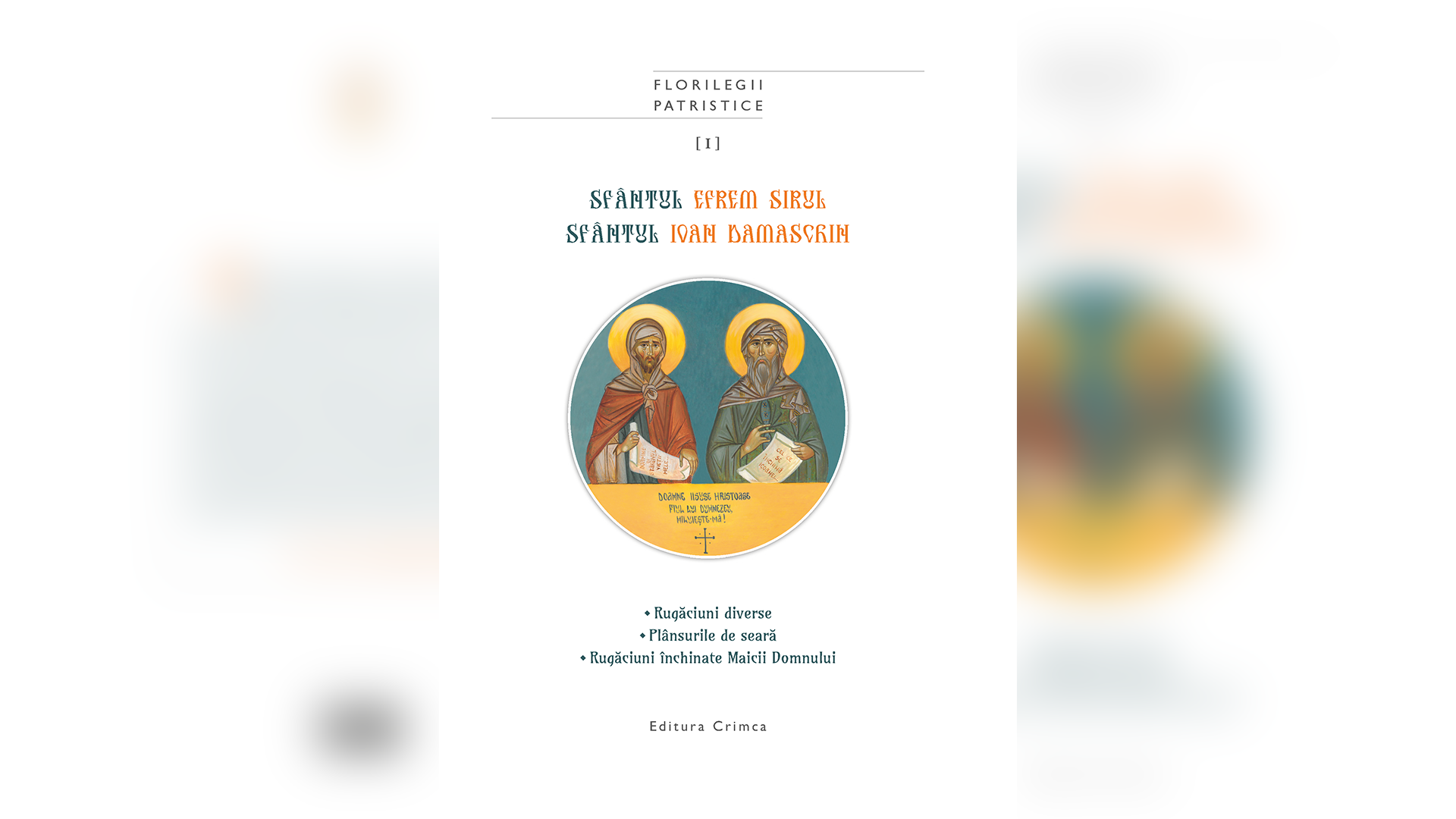
St. Ephrem Sir, St. John Damascene, Various prayers. Evening cries. Prayers dedicated to Our Lady, introductory study, translation and notes by Alexandru Prelipcean, Forward by pr. lect. dr. Roger Coresciuc, Crimca Publishing House, Suceava, 2022, pp. 213.
The revealed text of the Bible occupied, immediately after the formation of the New Testament canon, a central place in theology. Thus, from very early times, as can be seen in the earliest texts evhologions, the prayers and the liturgical experience of the Church itself have revolved around the fundamental ideas of scriptural revelation.
For, as is well known, what does not correspond to revealed truth has hardly found a privileged place in dogmatic and creedal texts. For example, we know how much the question of the introduction of the term homoousios in the Creed; because it had not the value of a hapax legomenon, The Holy Fathers, therefore, accepted with great difficulty a word or expression that appears only once in Holy Scripture, after lengthy expositions on the terminological usefulness necessary for the ultimate goal of the spiritual experience, namely: the salvation of man.
When the Christian ethos departs voluntarily or involuntarily from the biblical texts, then it becomes anything but authentic spirituality, because only full attachment to the word of God addressed to man can and must reveal to us the sure itinerary to salvation. In other words, soteriology is closely linked to both the purpose The Gospel, as well as the one transmitted in The New Testament Epistles. Thus, naturally, the patristic theology of the Church, in order to be of real use to the faithful, has promoted, as an aspect of spiritual normality, the thought and the texts of the Holy Fathers, as they have been handed down. There is another interesting aspect: if, at least in the medieval period, scribes intervened in the non-testamentary texts, and their interventions came to light through the special efforts of biblical criticism, which produced editions of the New Testament compiled according to the most rigorous academic methods, patristic texts have been less intervened on; today we have modern editions that analyze the historical particularities that led some patristic authors to write in a certain way, in order to solve a problem that arose in time, which was aimed at the very identity of Christianity, endangering salvation.
That is why, in the West, through the efforts of intellectuals and clerics, among whom I should mention only Henri de Lubac and Jean Danielou, a vast project has been initiated, dedicated to the healthy reception of patristic texts. Of course, the collection I am referring to is the famous Source Chrétiennes. Benefiting from extensive introductions, the fruit of long study, elaborated as a necessary collection in the French-speaking world, by established scholars who had already long proven their skills in the rigorous understanding of the words of the Holy Fathers and ecclesiastical writers, the collection has established itself as essential in the contemporary academic theological landscape.
The model of patristic research in France has been copied with some success in the local Orthodox space, after, as we know, during the communist regime, the famous collection was initiated Church fathers and writers (PSB) which, although it had many disadvantages in terms of establishing the text in bilingual version, nevertheless, benefited from extensive introductory studies by specialists such as Fr. Dumitru Fecioru, Fr. Dumitru Stăniloae, Fr. Teodor Bodogae, Fr. Ene Braniște, etc. The moment represented a reinvigoration of local patristics which, although it came much later than the editions present in the most important university libraries in the world, was nevertheless a sign that patristics and historical research in our country have not yet said their last word.
In the post-Decembrist period, in Sibiu, the deacon Prof. Ioan Ică jr started an interesting and admirable project for that time, initiating the publishing house Deisis where the most important academic research on Eastern theology and spirituality will gradually appear in translation. The phenomenon Deisis has brought together under the same aegis names such as Andrew Louth, Karl Christian Felmy, Gabriel Bunge, Kallistos Ware, Henry Crouzel, but above all essential translations of the texts of the Hesychastic saints such as Basil of the Apple Orchard, Paisias of Neamt, Ephrem and Isaac of Syriac, etc. The project happily filled in a happy way the growing gaps. When theology does not benefit from laborious editions, from competent research, an inexplicable gap emerges which may have undesirable long-term effects. So, in a sense, the work initiated by Father Ică jr. in Sibiu was the foundation of other exceptional publishing projects, including the collections initiated by several researchers from Sibiu at the publishing house of the Metropolitan of Moldavia and Bucovina, Doxology, began to increasingly bring the Western method as normative for indigenous theologians.
However, in Suceava, through the special care of His Most Reverend Father Archbishop Calinic, a new publishing house has been established, bearing the name of Anastasie Crimca, a scholar hierarch, unjustly forgotten. Works that are already proving their usefulness are beginning to appear here. Among them, the collection Patristic Florilegies which is coordinated by Dr. Alexandru Prelipcean, researcher and lecturer at the Faculty of Orthodox Theology „Dumitru Stăniloae” in Iasi, are returned to people of good faith some prayers composed by saints Ephrem Sir(ian)ul, and John Damaschin(ul).
As I mentioned at the beginning, the first volume of the collection is deeply anchored in the scriptural texts, which the editors have placed in plain view, in the vicinity of the central text. The method is that found in American circles, among scholars such as Jaroslav Pelikan, a theologian who, in order to facilitate the reading of laborious theological research, opted for their „mirror-image” juxtaposition, instead of keeping them at the bottom of the page. The idea comes to the aid of those who (still) pray with Holy Scripture beside them, reading the texts of the prayers and meditating on the spiritual nourishment offered by the Word of God.
Valuable by volume are both Word before of Fr. Roger Coresciuc, specialist in the works of St. Gregory Palamas, as well as Introducing and annotations by Mr. Alexandru Prelipcean. The current edition also corrects some older shortcomings, which had become ingrained in the minds of the faithful. Problems of style, cursivity, archaisms that are no longer understood today, all these are solved in an exemplary manner, the volume being put together with the rigor that has become a letter of law in Suceava.
The text is divided, as the title suggests, into three segments. In the first part, the reader is offered a variety of prayers, the first three of which are worth mentioning.
The first prayer, although not explicitly mentioned, is inspired by the text Psalm 24 (25 in the Masoretic Text): „The sins of my youth and of my ignorance do not remember; remember me according to your mercy, for your goodness”. If I have quoted from the Septuagint, In the volume, the marginal note by Mr. Alexandru Prelipcean shows that, literally, the text „Hear me, O God, hear me, showing Your power, without remembering, at the [time] of this prayer, the unceasing iniquities that I, the insignificant one, do!”[1] denotes supplication to God, with the meaning „without remembering”. In the Hebrew edition, Psalm 25 in v. 7 harmonizes and certifies the literal version: „Do not remember the sins of my youth or my transgressions”[2].
Equally interesting is the third prayer, which corresponds to the text of the evening prayers, for example, the third prayer, again addressed to the Holy Spirit. The difference is that here the text is much more ample and, naturally, it is translated according to the current language, preserving the normative stylistic qualities of the Romanian Orthodox Church.
Another prayer in the first collection is addressed to the „Lamb of God”, an image of real spiritual power, because if „the lion is the image of the victorious Christ who reigns [we, however - Claudiu Coman] can see the Lion only as He comes to us, in the form of the Lamb slain [...] The tension between the Lamb and the Lamb shows us that the Gospel is the only key to understanding the Book of Revelation”[3].
Of real benefit to the soul will prove to be the prayers called generic evening cries. Ascetic by its very identity, Eastern spirituality has always relied on the beneficial effects of metanoia and the notions that can be associated with this concept. I believe that, from the point of view of research into this unique phenomenon in Christianity, the monograph dedicated by Irénée Hausherr to the subject is essential and up-to-date. Entitled Weeping and piercing the heart in the Eastern Fathers[4] The paper presented the qualitative differences between ordinary weeping and tears of joy, characteristic of Eastern spirituality.
St. Ephrem, a very good connoisseur of Scripture, was able to synthesize key passages on tears, with a structure similar to the model initiated by St. Andrew the Cretan in The Great Canon, read during Lent. Originally published in Greek, these texts symbolize a true „penitential ladder”. Its steps, on each day of the week, are reasons for spiritual meditation, regret and repentance, following people from biblical history.
The last part contains several prayers addressed to Our Lady. With a rich theological symbolism, full of hope to the „Mother of Mercy”, the texts represent the stages of the spiritual ascent, which always culminates in the Eastern Orthodox tradition with the human being's becoming deified. For this reason, the believer must be aware that the memory of a mistake, of missing the target (amarheia) represents a point at which the role of the Virgin Mary as mediatrix causes her Son, the Lord Christ, to be merciful to sinners who sincerely express their desire to make a good beginning and, by implication, to redirect themselves towards the Kingdom of Heaven.
Translated with philological discernment, respecting the highest academic and editorial standards, the florilegium compiled by Mr. Alexandru Prelipcean will certainly have a central place among the mystical, ascetical and liturgical works of the Romanian Orthodox Church, imposing itself as an edition that should be found in the library of any believer who wishes to pray and understand its purpose and its mission.
Pr. Claudiu Coman
[1] St. Ephrem Sir, St. John Damascene, Various prayers. Evening cries. Prayers dedicated to Our Lady, introductory study, translation and notes by Alexandru Prelipcean, Forward de pr. Lect. Dr. Roger Coresciuc, Crimca Publishing House, Suceava, 2022, p. 31.
[2] ***, Hebrew Bible. Book of Psalms, bilingual edition, Coord. Madeea Axinciuc, reading in Hebrew by Prim-Rabin Rafael Shaffer, Editura Polirom, Iași, 2020, p. 57.
[3] Graeme Goldsworthy, Worthy is the holy Lamb! The Gospel in Revelation, translation by Elena Meștereagă, Edituraa Roua, Oradea, 2020, pp. 30-31.
[4] Irénée Hausherr, Weeping and piercing the heart in the Eastern Fathers, 2nd edition, translated by Mihai Vladimirescu, Deisis Publishing House, Sibiu, 2009, pp. 256.
