
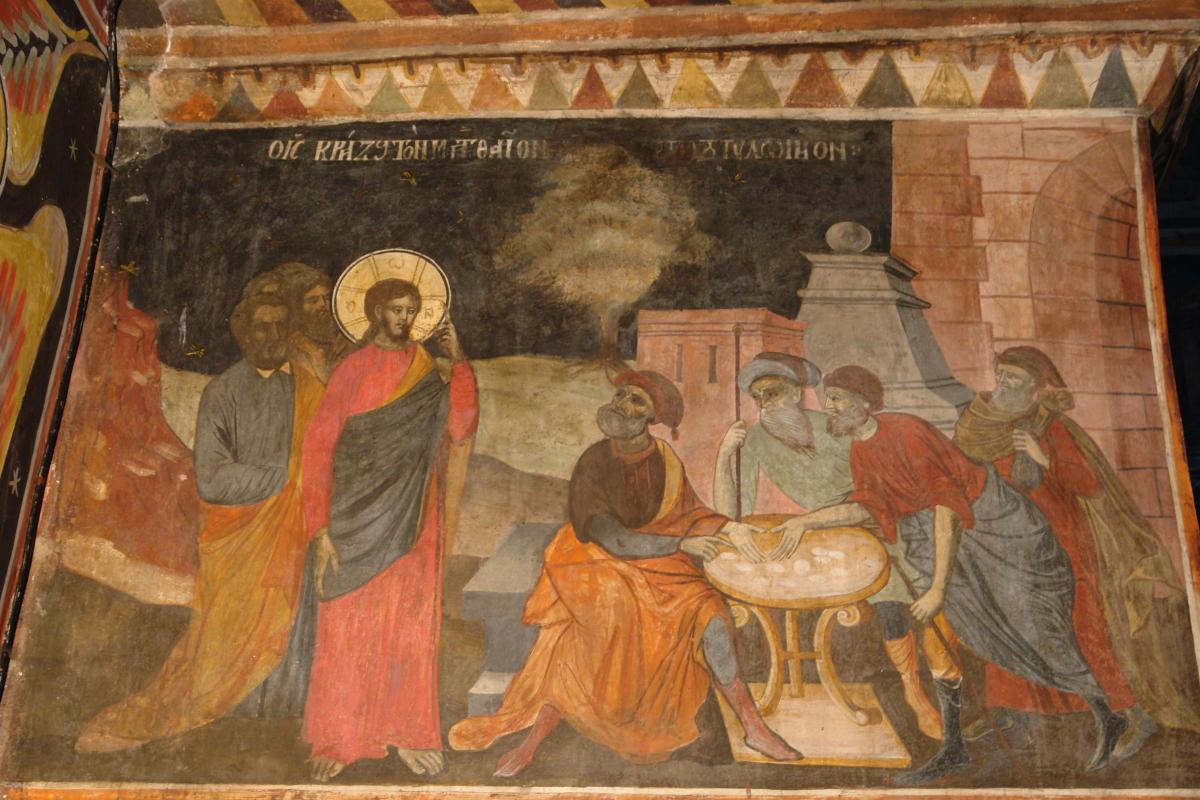
In the context of the economic crisis, which is becoming increasingly widespread across the continent and beyond, people are looking to gain from absolutely everything. Thus, talking about usury is a topic on the agenda. We all know that giving money as a form of loan-sharking is a very old practice, found all over the world, bringing in considerable income without physical or intellectual effort. The only thing the moneylender has to have is money. Because of this, it is tempting for many to increase their income in a dishonest way.
According to Explanatory Dictionary of the Romanian Language, the term ”camătă" means "excessive interest charged by a moneylender on money borrowed"[1], and a moneylender is ”a person who lends money in exchange for a camel"[2].
It should be noted at the outset that, although they are one and the same thing, the words camătă and interest, have today come to be defined separately. Unlike camătă, interest has gained legality over time.
To lend to someone in need is a divine commandment; the loan, however, must be without camel, without hardship, in order to help someone in financial distress: If you lend money to the poor brother of my people, you shall not extort it from him, nor extort it from him. (Ex 22:25). Tora It therefore had clear prescriptions to protect the poor, especially debtors, from the greed of moneylenders, thus making it compulsory to lend without receiving a loan in return. If your brother becomes poor and comes to distress before you, help him, whether he be a stranger or a sojourner, that he may live with you. Do not take from him interest and increase, but fear your God, that your brother may live with you. I am the Lord. Thy silver thou shalt not give him thy silver for hire, neither shalt thou give him thy bread for gain. (Leviticus 25, 35- 37).
Lending to the poor was considered Tora an act of mercy. Such a man the Psalmist praises when he says: Good is the man who bears and lends...(Psalm 111,5)[3]. God himself praises the one who lends to the poor and does not take a loan, assuring him that he will live (Ezekiel 18, 5-9)[4] and bless him in all that he does with his hands (Deuteronomy 23:19-20)[5], But he who seeks to gain unjust gain from his neighbor will work against him, and will incur the wrath of the Lord. In you they take bribes, that blood may be shed; you take interest and usury, and take gain of your brother with diligence, and have forgotten me, says the Lord GOD. And, behold, I have smitten My palms together, seeing your covetousness, which is seen in you, and the shedding of blood which is done in your midst. Will your heart suffer, and will your hands be strong in those days when I work against you? I the Lord have said, and will do it. (Ezekiel 22, 12-14)
The free loan was made only with those of the same kindred, for from a foreigner, Tora does not forbid the taking of usury, but actually recommends it, as was the custom among all the neighboring peoples (Deuteronomy 23:20)6.
If the Old Testament literature condoned the extortion of those of another nation, New Testament forbids it altogether, and no Christian, no matter how needy he may ever become, is permitted to become a moneylender.
New Testament greets man with something special, the divine commandment of love. If the Mosaic law condemned extortion, the law of love exhorts us: To him that asketh of thee, give; and from him that would borrow of thee, turn not away thy face (Matthew 5, 42). Furthermore, we are exhorted to give to those from whom we do not expect to receive back: To everyone who asks of you, give; and from him who takes your things, do not ask for them back. […] And if you lend to those from whom you hope to get back, what thanks can you have? For sinners also lend to sinners, that they may receive back just as much. (Luke 6:30; 34.)
The Savior urges us to be merciful: Be merciful, as your Father is merciful (Luke 6:36), and it does not tell us not to take from our brother, or to take from a stranger, but simply exhorts us to be merciful and to give whatever, whoever asks of us, but to give as if we were giving to God, because this is the way to holiness, and not expecting to be ”repaid in full", for where our treasure is, there is our heart (Matthew 6, 21).
Chastity is the manifestation of the love of silver, a mortal sin, and the root of all evil, from which springs the offspring of many other vices: That the love of silver is the root of all evil, and those who coveted after it have gone astray from the faith and pierced themselves through with many sorrows (I Timothy 6, 10).
Orthodox teaching places cameta among the deadly sins, because giving a material loan with the desire to get back more, without working, is greed, lack of love for the poor, who in turn is the image of God, love of (in)wealth. St. Basil the Great offers perhaps the most realistic, complete and comprehensive definition of what is what is what is called ”idleness": "I believe that it is called idleness because of the many evils to which it gives rise. How else could it have acquired such a name? Or perhaps it is so called because of the pains and sorrows it usually causes in the souls of those who lend themselves.... Camels should be called 'young vipers', because they are the offspring of moneylenders. It is said that vipers, when they are born, eat the wombs of their mothers; and cameletes are born eating the houses of debtors"[6]. In unanimity with St. Basil the Great, St. John Cassian, says that passion argyirophilia, from which the cammodity arises, is a form of idolatry and that from it many other vices are born. The one who is possessed by this passion for the sake of gain is capable of making any compromise, committing any sin, and leaving room for other sins to enter the soul[7]. Tell me! Do you demand money and gain at this money from the poor? If he could tell you he was richer, what would he be doing at your door? He came to help him and found an enemy! He sought cures and found poison! You should have eased the man's poverty, but you increased his want. You seek to make the wilderness bloom. Like a doctor who goes to the sick, but instead of curing them, he takes away what little health they have left, so you make the suffering of the wretched an opportunity to get rich. And as the ploughmen pray for rain so that their seeds may multiply, so you pray that people may be poor and destitute, so that money may make you money. Don't you realize that by creating the increase of your wealth out of your camel's wages, you make your sins greater?”[8].
Chivalry has its origin in the passion of the love of silver, and Christian morality teaches us that the love of silver is a very heavy passion, because there is nothing to mitigate it, for it does not have its beginning in man's nature, but in his free will, in his freedom of choice[9]. Man alone, through freedom of will, chooses to serve either God or Mammon, for Mammon in Greek means material wealth. Thus God warns man that: No one can serve two masters, for either he will hate the one and love the other, or he will cling to the one and despise the other; you cannot serve God and Mammon. (Matthew 6, 24). St. John the Martyr comes to our aid and tells us very clearly that the love of silver is idol worship, the daughter of unbelief, the cause of impotence and that the lover of silver is a mocker of the Gospels, of the revealed word of God and a transgressor of the law. Then we read Second scholia to the sixteenth word for the love of silver that he that loveth silver, turning away his mind from the love of God, loveth idols of men digged and hollowed out with gold[10].
As long as man is dominated by this passion, money is his god, but a tyrant god, because St. John Chrysostom warns us that ”The tyranny of money is great... If we practice all the virtues, the love of money is a tyrant over all of them"[11]. Because of this, pagan writers called love silver, acropolis of evil[12],St. Paul the Apostle, the root of all evil (I Timothy 6:10), and St. John calls it Judas disease[13].
In order to discourage the practice of adultery among its faithful, the Church has had to take certain canonical measures aimed at the spiritual correction of those who commit sin. ”The certain spiritual character of the Church's punishments is indissolubly linked in the canonical tradition to the Eucharist-centered character of the whole of the spiritual experience. Thus we find at the center of what we call the ''penal law'' of the Orthodox Church, with a strong spiritual character, the centering on the Holy Eucharist"[14]. This is also highlighted by canon 32 of St. Nichifor the Conf confessor[15], which prohibits the moneylender from taking communion or eating with the community. If in civil law, the punishment for this offense is deprivation of liberty[16], The deprivation of ”eternal food" (Holy Communion) is the harshest in church law, for both clergy and lay people.
Canon 14 of St. Theophilus of Alexandria, stipulates that the person who gives with usury should be excluded from the ecclesiastical community but with the possibility of being reprimitted in exchange for the promise that he will give up this occupation. St. Theophilus Theophilus recommends that this be left to the discretion of the bishop or priest who investigates the penitent and who considers whether or not he is worthy to be reprimitted.
In the course of time, misconduct among the clergy has also been observed and that is why Apostolic Canon 44[17] says that the cleric who demands any kind of interest, either cease or be catechized. Canon 17 of the First Ecumenical Council[18], We observe from this canon that ”both simple interest and extortion, that is to say, burdensome and despoiling interest, is absolutely forbidden to clerics, under the penalty of cathexis, whatever form it may be practiced"19. This is also what Canon 10 Trullan: The bishop, or presbyter, or deacon, taking usury, or the so-called sutimi (percentages), either to cease, or to be canceled. The Cam Camitan was also condemned at the Synod of Carthage in 419 by Canon 5 who further condemns greedy clergymen by saying that ”no one can work against the preachers or against the gospels without danger of being punished".
Although this practice has been condemned since the Old Testament, and the Holy Canons provide very harsh measures for the laity and unequivocally, the cathegization of clerics who commit such sins, Canon 14 of St. Basil the Great[19], says that the one who has been engaged in money-lending can be received into the clergy only after he has shared the earnings from this occupation with the poor. Thus, St. Basil, with his philanthropic spirit, shows us all that the Church does not want the death of the sinner but his return and salvation.
The canons of the Church were never meant to be punitive, but their purpose was to make the penitent realize that he is threatened with spiritual death and to help him begin to climb again on the road to resurrection.
In conclusion, although it has never been accepted in the history of humanity, being considered a ”disguised theft”, ”offspring of vipers", "acropolis of wickedness", the extortion could not be stopped, because there have always been people in need and people who take advantage of the needs of others to round their income by making no effort, thereby earning themselves a lot of sins. One thing, however, is certain, and that is that the Church welcomes both rich and poor, rich and poor, righteous and sinners, for we are all her children, good and bad, extending a helping hand to all, to some through philanthropy and to others through the call to repentance.
Priest Ovidiu Macovei,
Parish of ,,Sf. M. M. Mc. Dimitrie”, Deia, com. Frumosu
Diocese of Câmpulung Moldovenesc.
Bibliography
- Bible or Holy Scripture, Publishing House of the Biblical and Orthodox Mission Institute, Bucharest, 2013.
- Church Fathers and Writers, Vol. 23, St. John Chrysostom, Homilies on Matthew, trans. by Pr. D. Fecioru, Editura Institutului Biblic și de Misiune al Bisericii Ortodoxe Romane, Bucharest, 1994.
- Church Fathers and Writers, Vol. 17, Homilies on the Hexaemeron, Homilies on the Psalms, Homilies and sayings, trans. by Pr. D. Fecioru, Editura Institutului Biblic și de Misiune al Bisericii Ortodoxe Romane, Bucharest, 1986.
- St. John the Scary, Scara, Predania Publishing House, Bucharest, 2008.
- St. John Cassian, The plague of the love of silver and its cure through mercy, Trinitas Publishing House, Iasi, 2003.
- Ioan Prof. Dr. Ioan Prof. Dr. N. Floca, Canons of the Orthodox Church notes and commentaries, 3rd edition, Sibiu, 2005.
- Hieromonk Nicodim Sachelarie, Church Pravila, 3rd edition, Valea Plopului, 1999.
- Explanatory Dictionary of the Romanian Language, 2nd edition, Publishing House, Encyclopedic Universe, Bucharest, 1998.
- Emilian Iustinian Roman, Miscellanea juris, bibliographical and canon-legislative guide, Performantica Publishing House, Iași, 2008.
- Vlassios I. Phidas, Canon Law: an Orthodox perspective, trad. Claudia Elena Dinu and Adrian Lucian Dinu, Pontos Publishing House, Chisinau, 2013.
- Dr. Georgios I. Mantzaridis, Christian morality, Vol. I, trans. Deacon. Drd. Cornel Constantin Coman, Editura Arhiepiscopiei Sucevei și Rădăuților, Suceava, 2014.
- Prof. Dr. Petre Semen, Biblical archaeology today, Trinitas Publishing House, Iași, 2008.
- Official Gazette of Romania, Part I, No 827/22.XI.2011, year 179 (XXIII).
[1] Explanatory Dictionary of the Romanian Language, 2nd edition, Editura, Univers enciclopedic, Bucharest, 1998, p.129.
[2] Ibid, p. 150.
[3] Pr. Prof. Dr. Petre Semen, Biblical archaeology today, Trinitas Publishing House, Iași, 2008, p. 139.
[4] If a man be righteous, and do judgment and justice; If he eat not the sacrifice in the mountain, and turn not his eyes toward the idols of the house of Israel; And his neighbor's wife he shall not dishonor, and shall not come near to the woman in her time of her uncleanness; He does not covetously deprive a debtor of his money, he does not turn over his rent to a debtor, he does not steal, he gives his bread to the hungry, he clothes the naked with a garment; he does not give his money in exchange for a loan, he does not take in exchange for a loan; he keeps his hands from unrighteousness And judgment between one man and another he doeth righteously; He keepeth my commandments and my statutes faithfully, he is righteous, and shall surely live, saith the Lord GOD..
[5] Thou shalt not give to thy brother in exchange for money, nor for bread, nor for anything that can be given in exchange. And to another nation you shall not give in exchange; and to your brother you shall not give in exchange, that the LORD your God may bless you in all that is done by your hands in the land where you go to possess it.
[6] Pr. Prof. Dr. Petre Semen, Idem.p.139.
[7] St. Basil the Great, Homily II to part of Psalm XIV, in "Fathers and Church Writers", Vol. 17, E.I.B.B.M.M.B.B.O.R, Bucharest, 1986, p. 218.
[8] Cf. St. John Cassian, The plague of the love of silver and its cure through mercy, Trinitas Publishing House, Iasi, 2003, p. 4.
[9] St. Basil the Great, Op. cit. p. 215.
[10] Prof. Dr. Georgios I. Mantzaridis, Christian morality, Vol. I, trans. Deacon. Drd. Cornel Constantin Coman, Editura Arhiepiscopiei Sucevei și Rădăuților, Suceava, 2014, p. 45.
[11] St. John the Scary, Scara, Predania Publishing House, Bucharest, 2008, pp. 227-228.
[12] St. John Chrysostom, Homily LXII on Matthew, in P.S.B. Vol. 23, E.I.B.M.B.O.R. Bucharest, 1994, p. 726.
[13] Ibid, p. 734.
[14] Ibid, p. 910.
[15] Vlassios I. Phidas, Canon Law: an Orthodox perspective, trad. Claudia Elena Dinu and Adrian Lucian Dinu, Pontos Publishing House, Chisinau, 2013, pp. 138-139.
[16] It is not fitting for those who are partakers of the usury to partake of communion or to eat together if they continue in iniquity.
[17] Law, number 216/2011, regulates the prohibition of the activity of money-lending. In the context of this law, the giving of money with interest by an unauthorized person, as a hobby, constitutes a criminal offence and is punishable by imprisonment from 6 months to 5 years and the money obtained in this way is confiscated. Law banning the activity of money-lending, in Monitorul Oficial al României, Part I, No 827/22.XI.2011, year 179 (XXIII), p. 2.
[18] The bishop or presbyter, or deacon, who shall demand interest from those whom he lends, shall either cease, or be excommunicated.
[19] Since many of those in the canon (are counted among the clergy) pursuing greed and shameful gain (running greedily to shameful gain), have forgotten the divine Scripture which says: „his silver he gave not for usury (interest)” (Ps. 14,5); and borrowing for hundredths (percent), the holy and great synod rightly judged, that if after this ordinance, if any one should be found to be taking usury from his occupation (with this business, with the money-lending), or thus spinning the thing, or demanding back and half, or any other contriving for shameful gain, to be disfellowshipped from the clergy and to be a stranger to the canon (the state of the clergy).
[20] Arhid. Prof. Dr. Ioan N. Floca, Canons of the Orthodox Church notes and commentaries, 3rd edition, Sibiu, 2005, p. 67.
[21]He who takes usury, if he will receive to use the unjust gain for the poor, and after that he is freed from the sickness of the love of money, he is received into the priesthood.
photo credit: doxologia.ro - Roman Archbishop's Cathedral / Driving the vendors out of the temple
